The modernization of accounts payable (AP) no longer stops at digitizing paper checks. And finance teams shouldn’t stop there, either.
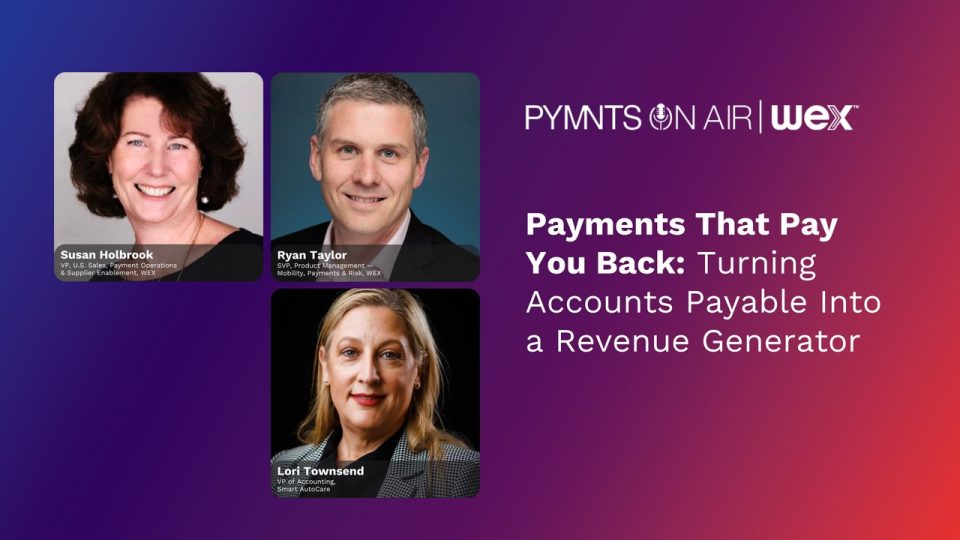
“What’s changed is where payments are showing up,” said Ryan Taylor, senior vice president of product management for mobility, payments and risk at WEX, speaking with WEX’s Susan Holbrook, vice president of U.S. sales payment operations and supplier enablement, and Lori Townsend, vice president of accounting at Smart AutoCare.
As finance teams face rising fraud, operational complexity and pressure to automate, payments are increasingly being treated as strategic infrastructure — one that can drive efficiency, strengthen controls and generate revenue for the enterprise.
“Payments just happen as part of the workflow within operations or within products,” Taylor said.
For many companies, the economics are changing alongside the technology.
“It used to just be a cost center,” said Smart AutoCare’s Townsend. “Now my AP department actually contributes back to the business.”
How Virtual Cards Turn Accounts Payable Into a Revenue Driver
Virtual cards are emerging as one of the clearest ways to unlock growth through payments. They combine automation, security controls and payment data into a single programmable workflow — and allow finance teams to set spending conditions before a payment is issued.
WEX’s Taylor described virtual cards as “a digital payment credential” generated for a specific transaction without requiring a physical card.
“You set the spend limits, the timing, the supplier and other controls right at the time of creation,” he said. “That dynamically reduces the fraud exposure compared to checks or more traditional payment methods.”
The technology also streamlines reconciliation and reduces manual intervention across AP operations. At Smart AutoCare, for example, WEX built a custom API integration connecting payment workflows directly between systems. Repair facilities now receive pre-authorized, single-use virtual cards tied to the exact value of the repair transaction.
“Not a penny more, not a penny less,” Townsend said. “That precision alone eliminated a significant source of manual oversight and error on our end.”
The impact extends beyond operational efficiency. Virtual cards are also changing the economics of AP. Under many virtual card programs, buyers earn a rebate, a percentage of supplier payment volume returned based on card spend. That changes how finance leaders evaluate the role of AP.
“These are payments you’re already going to be making,” Taylor said. “We’re simply optimizing that current operational flow and spend that’s already happening within organizations.”
“Accounts payable stops being a liability on the balance sheet and starts functioning as a strategic asset,” WEX’s Holbrook said. “Virtual cards flip that entirely.”
The Hidden Costs of Manual Accounts Payable Processes
Many organizations still underestimate the operational burden of legacy payment systems because the inefficiencies are spread across departments and processes. The true cost of paper checks extends beyond printing and postage. Manual approvals, invoice routing, reconciliation work, exception handling and supplier follow-ups create operational drag that compounds at scale.
“What surprises organizations the most is all of this hidden manual work that existed inside their process,” Holbrook said. “A lot of organizations don’t fully realize how much time their teams spend managing payment friction until those workflows become automated and centralized.”
The economics become difficult to ignore under high transaction volume.
“A single paper check can cost anywhere from $4 to $20 to process, depending on the workflow,” Holbrook said. “Operationally, they create a lot of friction.”
For Smart AutoCare, those inefficiencies became unsustainable as payment volume increased. Before modernizing its payment operations, the company was processing more than 8,000 claims and roughly $10.4 million in payments each month.
“Originally, we were calling each repair facility individually, supplying them with card information over the phone, or telling them that we’d send a paper check,” Townsend said. “With over 450 claim payments a day, that process just wasn’t sustainable.”
We’d love to be your preferred source for news.
Please add us to your preferred sources list so our news, data and interviews show up in your feed. Thanks!
The operational strain also created growing security concerns.
“Sharing card information over the phone, putting a check in the mail—both of those have real risk involved with them,” Townsend said. “We get very little visibility or control once we send that payment out.”
Checks remain one of the most vulnerable payment methods businesses still use today, Holbrook said.
“Checks can be intercepted, altered, duplicated [or] easily redirected compared to digital payment methods with built-in controls,” she said.
How Embedded Payments Are Reshaping Enterprise Finance Operations
The modernization of payments is also reshaping the relationship between finance and technology teams. As APIs become central to enterprise architecture, businesses increasingly want payments embedded directly into operational software rather than managed separately across disconnected systems.
“Tech teams care more about how payments fit into broader system architecture,” Taylor said. “They’re evaluating things like scalability, implementation effort and flexibility.”
Embedded payments allow transactions to occur natively inside existing workflows. Taylor offered an example: a property management platform automatically generates a secure virtual card the moment a landlord approves a maintenance repair.
“The payment becomes part of the workflow,” he said. “Saving time, improving security, automating reconciliation and creating a better experience for the customer.”
The rise of artificial intelligence-driven workflows is accelerating the trend further.
“When you ask someone to toggle between systems or manually reenter data that already exists somewhere else, you’re creating opportunities for delay, error and frustration,” Taylor said. “As AI enters into products, that’s also lost context.”
For finance leaders, the result is a broader strategic shift in how payments are viewed inside the enterprise.
“The whole conversation shifts from operational savings to strategic value,” Holbrook said. “That’s when organizations begin seeing payments very differently.”
See the full interview here: Payments That Pay You Back
For all PYMNTS B2B coverage, subscribe to the daily B2B Newsletter.


 Add as Preferred Source