Small businesses don’t appear to need more payment options as much as they need better control over when money leaves the business.
That’s the central takeaway from “Ready for Change: Why Nearly Half of SMBs Want to Ditch Cash and Checks,” a PYMNTS Intelligence report produced with Mastercard. Based on a survey of 412 U.S. small and medium-sized businesses, the report found that 45% are highly interested in reducing their reliance on cash. Interest rises to 68% among businesses owned or operated by members of Generation Z. The findings suggest that many SMBs aren’t resisting digital payments. They’re waiting for tools that fit the way they manage cash flow, suppliers and daily expenses.
We’d love to be your preferred source for news.
Please add us to your preferred sources list so our news, data and interviews show up in your feed. Thanks!
Key Points:
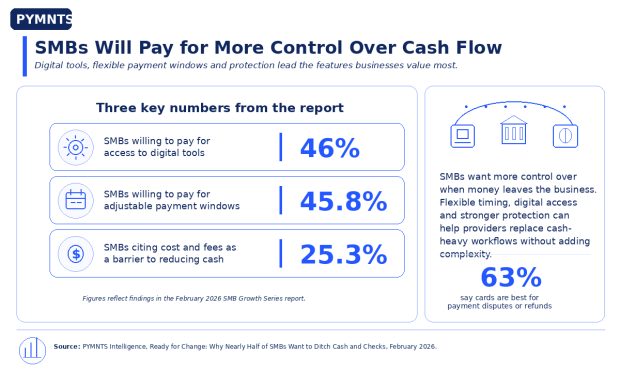
- Build around cash-flow control. SMBs showed the strongest willingness to pay for tools that improve flexibility. Forty-six percent would pay for access to digital tools, 45.8% for the ability to adjust payment windows based on available cash and 40.2% for installment options. Issuers can treat the card like a financial shock absorber, giving owners more room to match outgoing payments with incoming revenue. Rewards can support the offer, but flexible timing should lead it.
- Replace the workflow, not only the payment method. Cash remains useful because it feels immediate, familiar and easy to reuse. Providers that want to move SMBs toward cards need to preserve those advantages while adding security, records and spending visibility. Fast approval, simple onboarding and clear access to funds can make digital products easier to adopt. Cost remains the largest barrier, cited by 25.3% of SMBs, so pricing must also feel transparent and proportionate.
- Match products and service to the business. Construction firms tend to value flexible credit and speed. Retailers place more value on integrated tools and business experiences. Professional services firms focus more heavily on protection and efficiency. Service preferences also vary. Digital self-service leads overall, but smaller, rural and cash-reliant SMBs often want live help during onboarding or problem resolution. Banks and FinTechs can improve adoption by combining digital access with a clear route to a person.
The report also found that 63% of SMBs view business cards as the best way to dispute a payment and recover funds, while 59% favor cards when they need to pay without cash on hand. Those strengths give providers a positive starting point. The growth opportunity lies in turning familiar protections into broader operating tools that help businesses plan spending, preserve liquidity and move forward with greater confidence.


 Add as Preferred Source