Merchant acquiring has a multiplication challenge.
Payments companies want more merchants, but adding salespeople one at a time is a costly way to get them. That is pushing more attention toward one-to-many distribution models in which Independent Sales Organizations (ISOs), Independent Software Vendors (ISVs) and their downstream partners can extend merchant acquisition through networks rather than individual sales relationships.
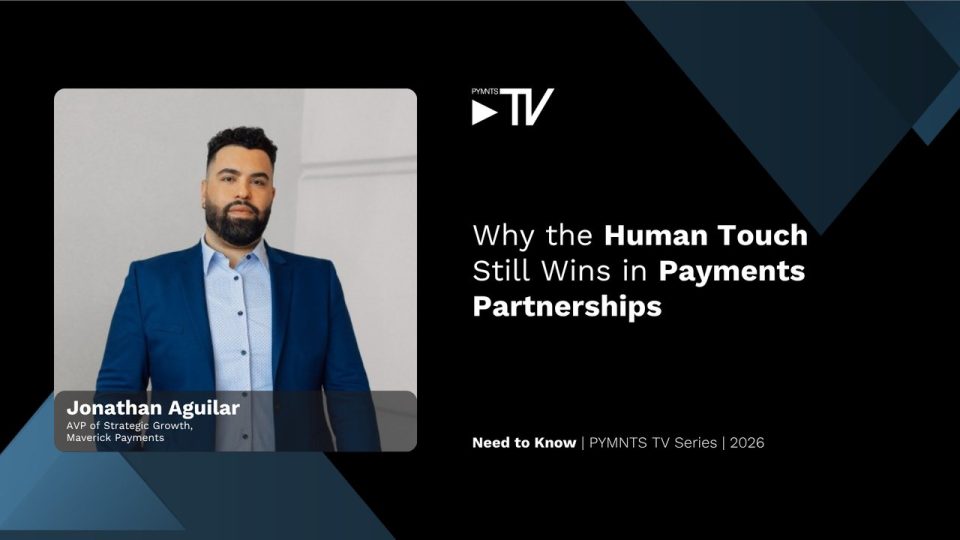
Jonathan Aguilar, AVP of Strategic Growth at Maverick Payments, told PYMNTS that the model increasingly depends on giving partners the infrastructure to operate through multiple channels.
“The goal is to create a scalable growth engine,” Aguilar said. “But in order to do that, you want to be able to do that in multiple channels.”
That makes the structure of the partner network increasingly important. An ISO can recruit agents and sub-agents that bring merchants into its acquiring relationships. An ISV can potentially deliver hundreds or thousands of merchants through software used by a particular industry or business segment.
Those are different distribution models, even when they ultimately connect merchants to the same payments infrastructure.
ISOs and ISVs Take Different Routes
The distinction matters as payments become more deeply integrated into software and commerce workflows.
For ISOs, merchant acquisition and servicing remain central functions. Technology can make submitting, approving and boarding merchants faster, but the ISO model still relies heavily on managing sales relationships and downstream distribution.
Aguilar pointed specifically to APIs that can streamline the path from merchant submission to processing.
ISVs start from a different place. Their core product is software, with payments integrated into that environment. A vertical software provider may potentially bring hundreds or thousands of merchants through one integration, making automated onboarding, compatibility with gateways or terminals, and rapid boarding particularly important.
“When you have someone that’s a true ISV, they’re going to have hundreds, if not thousands of possible merchants,” Aguilar told PYMNTS.
The result is a partner network that can contain several distinct layers rather than a single merchant-acquirer relationship.
An ISO may recruit and manage sub-agents. An ISV may aggregate merchants through its software. Payment providers sit behind those channels supplying acquiring capabilities, underwriting, onboarding, processing and technology.
Sub-agents extend that network further.
Aguilar said sub-agent channels themselves are not new. What is changing is the infrastructure available to manage them, including dashboards, residual reporting and tools that give downstream agents quicker access to merchant and performance information.
We’d love to be your preferred source for news.
Please add us to your preferred sources list so our news, data and interviews show up in your feed. Thanks!
That is where “enablement” becomes more than industry shorthand for providing technology.
Aguilar defines it as a combination of technology, operational support and expertise. A partner must be able to deploy the tools throughout its organization, train people to use them and follow merchants after approval to make sure processing actually begins.
In other words, approving a merchant is not necessarily the end of distribution. A merchant that has been boarded but never activates does little for the payment provider, ISO, ISV or agent.
APIs Connect the Layers
As these networks add participants, APIs become connective infrastructure.
Aguilar described a multi-location merchant example in which merchant information could be pushed through systems, approved and boarded through API connections rather than handled location by location.
That capability matters for both sides of the partner ecosystem. ISOs can reduce manual work as their agent networks expand. ISVs can integrate merchant onboarding and payments into software environments without creating separate processes for every merchant.
Maverick’s role in that structure is as an acquiring and technology provider behind those distribution channels. Aguilar described its dashboard, APIs, boarding capabilities and support infrastructure as tools offered to partners rather than as replacements for the partners themselves.
His outlook is that the networks will become more distributed. He expects sub-agent channels to remain while white-label capabilities allow more downstream participants to present their own brands to merchants, even when payment and operational infrastructure comes from providers further upstream.
That could make the payments ecosystem look increasingly like a network of networks: payment providers supporting ISOs, ISOs supporting agents and sub-agents, and ISVs distributing payments through software to large merchant populations.
The scale comes from connecting those layers without pretending they perform the same job.
Watch the Interview
Watch the full conversation with Jonathan Aguilar, AVP of Strategic Growth at Maverick, for:
- More on how one-to-many distribution models are changing merchant acquisition.
- Why ISOs and ISVs require different approaches.
- How sub-agent networks can be managed at scale, and where APIs, automation and AI fit into increasingly layered payment partnerships.


 Add as Preferred Source