Issuer processing is moving closer to the moment when payment data becomes a decision, giving financial institutions a clearer path to approve more legitimate purchases and manage risk more precisely.
That shift anchors “Where Payment Decisions Happen: How Issuer Data Is Powering the Next Era of Commerce,” a May 2026 report from PYMNTS Intelligence and FIS. The report finds issuer processing platforms are expanding beyond transaction execution. They are beginning to connect data, processing capacity and participants across the payments ecosystem so banks, FinTechs, networks and automated systems can work from a more complete view of each transaction. The result could be faster responses, stronger fraud controls and smoother customer experiences.
We’d love to be your preferred source for news.
Please add us to your preferred sources list so our news, data and interviews show up in your feed. Thanks!
Key Points:
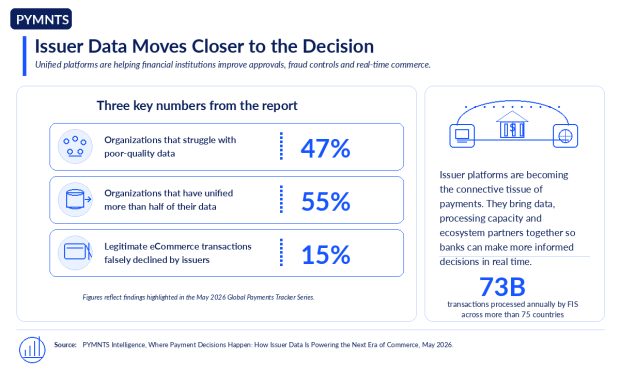
- 47% of organizations still struggle with poor-quality data that limits the effectiveness of AI-driven decisioning. That finding shows why collecting more information alone won’t solve the problem. Platforms also need to organize, verify and activate the data in real time.
- 55% of organizations have unified more than half of their data. That progress gives many companies a foundation for more coordinated decisions, but it also leaves significant room to connect information that remains scattered across products, systems and partners.
- 15% of legitimate eCommerce transactions are falsely declined by issuers, contributing to an estimated $430 billion in lost global sales each year. Better access to transaction history, device information, updated credentials and behavioral signals could help issuers distinguish fraud from a genuine purchase.
The emerging platform resembles an air traffic control system for payments. It doesn’t simply move each transaction from one point to another. It gathers signals, coordinates participants and helps determine the safest route in real time.
Scale can strengthen that model. Following its TSYS acquisition, FIS processes more than 73 billion transactions annually across more than 75 countries, according to the report. That volume can support broader model training, risk analysis and authorization improvements, provided the underlying data remains accurate and connected.
The report also points to a growing role for issuer processors in agentic commerce, where software may initiate purchases for consumers or businesses. In those transactions, issuer platforms can validate credentials, apply spending controls and authorize activity without direct user intervention. Financial institutions that build these connections now could turn issuer processing into a more useful operating layer.
That layer can support better approvals, reduce avoidable friction and prepare payments infrastructure for a more automated form of commerce.


 Add as Preferred Source