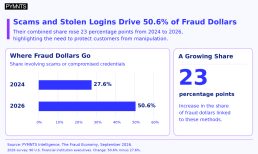
Artificial intelligence is breaking the economics of the traditional accounts payable fraud model. Attackers can scale cheaply, but finance teams cannot respond by scaling manual verification at the same rate.
“They are using the technology that’s out there, the AI, every tool available to them in order to make their attempts bigger, broader, faster,” Katie Elliott, senior risk and fraud officer at Bottomline, told PYMNTS during a discussion for the PYMNTS B2B Payments Event 2026, “Stopping B2B Fraud Before AI Moves the Money.”
That threat reality is turning supplier verification from a back-office control into infrastructure.
“Cybercriminals used to be more targeted. Now they can do mass spamming, mass phishing,” Elliott said.
For CFOs, the emerging problem is not just detecting more fraud but finding a verification model that can scale economically with the risks of corporate payments.
How CFOs Are Fighting Back Against B2B Fraud’s Operating-Leverage Advantage
The existing situation, on paper, looks like a steep hill for finance teams to climb. Fraudsters can afford thousands of failures because only a handful of attempts need to work. Finance departments face the opposite constraint, they must evaluate more signals without slowing legitimate payments or adding armies of fraud analysts.
Faster payments make that imbalance more consequential.
“Once you click that send button, once that payment is authorized, it can move in an instant,” Elliott said. A fraudster receiving the funds is “taking it out as soon as they can get their hands on it.”
That moves the economic value of fraud prevention upstream. Recovering money after an erroneous payment becomes less viable as a control. Establishing confidence in the counterparty and payment instruction before sending becomes more valuable. And doing that well requires more than validating a bank account.
Elliott pointed to digital identity, phone information, email domain history and other signals that can establish whether a payment request makes sense.
“Don’t rely on one piece of data in order to make a business decision on where your payment is going to go,” she said.
But assembling that intelligence independently gets expensive. Payment networks can potentially spread the cost of data sources, APIs, verification tools and fraud expertise across a broader transaction base.
“The cost to get some of these third-party relationships can be expensive, especially for smaller businesses,” Elliott said.
We’d love to be your preferred source for news.
Please add us to your preferred sources list so our news, data and interviews show up in your feed. Thanks!
That changes the network proposition for CFOs. Its more durable future value lies not simply in moving money, but in providing verification capabilities an individual AP department may struggle to replicate economically.
Humans Move to the Exceptions
Elliott does not argue that more sophisticated fraud requires more human involvement everywhere. Instead, human judgment becomes more targeted.
AI can handle normal activity without being manipulated by the urgency and emotion fraudsters routinely use against employees. Humans intervene when established patterns break — payment instructions change, transaction velocity spikes or a supplier suddenly requests an abnormal amount.
If a supplier typically receives the same payment and suddenly requests three times as much, Elliott said, the AI should conclude: “I’m going to need to spit that one out for human approval.”
That makes human attention a scarce control reserved for anomalies rather than applied indiscriminately across payments.
The stakes rise further as AI makes it easier to manufacture convincing identities. Elliott called “the ability for fraudsters to use AI to generate a whole identity” the area that concerns her most.
For CFOs, that could undermine a basic assumption of supplier management: that verifying a business during onboarding establishes enough trust to keep paying it.
As identities become easier to fake and money moves faster, trust may need to be continuously established rather than periodically checked.
That is the bigger shift. AI is not simply creating another fraud problem for finance to manage. It is turning supplier verification from an AP procedure into payment infrastructure — and forcing CFOs to reconsider how much of that infrastructure still makes economic sense to build alone.
Watch the full PYMNTS TV interview with Katie Elliott to hear more about:
- Why AI is breaking the economics of B2B fraud prevention. Elliott said fraudsters can now make supplier impersonation attempts “bigger, broader, faster,” while finance teams still face the expensive job of verifying who should actually get paid.
- Why supplier verification could become shared payments infrastructure. Elliott said effective fraud prevention increasingly requires multiple identity, account and behavioral signals — capabilities that payment networks can provide at a scale and cost individual AP teams may struggle to replicate.
- Why AI could make human judgment more valuable, not less. Elliott said AI can automate normal payment activity, but bank account changes, unusual payment velocity and other anomalies should trigger human review — concentrating finance teams on the moments when trust breaks down.
For all PYMNTS B2B coverage, subscribe to the daily B2B Newsletter.


 Add as Preferred Source