Tokenization promises to eliminate financial market friction, but it may take new friction to get there. The transition introduces a consequential trade-off. Removing intermediaries and settlement delays could also eliminate mechanisms that financial institutions rely on to manage liquidity, distribute risk and maintain market stability.
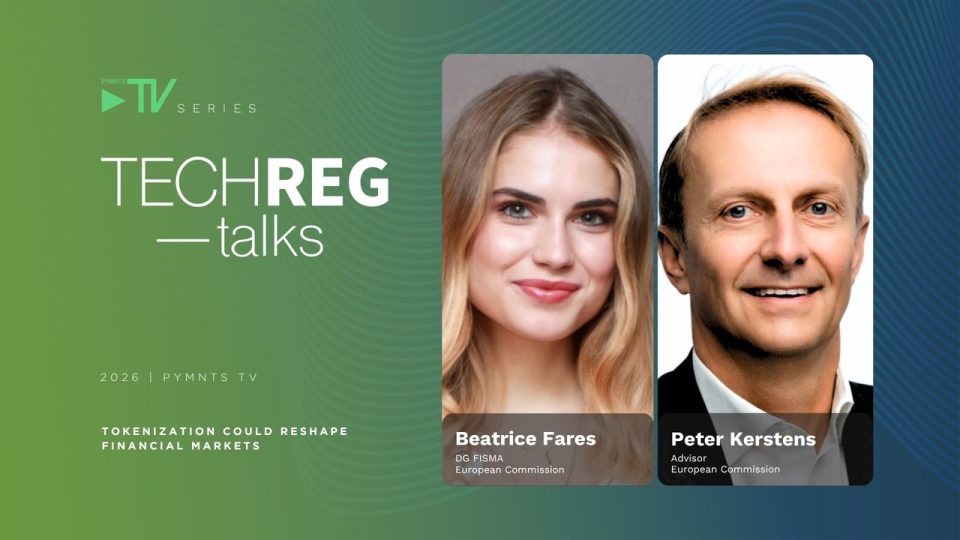
That tension was at the center of a discussion between Beatrice Fares, ex-directorate general for Financial Stability, Financial Services and Capital Markets Union (DG FISMA), European Commission, and Peter Kerstens, adviser at the European Commission, hosted by Competition Policy International (CPI), a PYMNTS company.
“With the tokenization, trading, clearing and settlement will be included in one single step,” Fares said, adding that this consolidation, enabled by programmable transactions and shared ledgers, could shift trust away from established intermediaries and toward the underlying infrastructure and smart contracts.
When Faster Settlement Changes the Economics of Liquidity
Traditional financial digitalization made trading and clearing faster without changing the institutional architecture supporting them. Tokenization introduces a different proposition by promising to bring trading, clearing and settlement onto shared digital infrastructure, potentially eliminating much of the operational complexity that has defined securities markets for decades.
But the implications extend beyond operational efficiency.
Today’s settlement delays provide institutions with time to source securities, arrange financing, net obligations and perform compliance checks. Atomic settlement, in which the exchange of assets and payment occurs simultaneously, could substantially reduce counterparty exposure while removing that flexibility.
“From, in a way, post-trade, post-financing your trades, you now will have to almost pre-finance your trades,” Kerstens said.
For banks, brokers and institutional investors, the distinction matters. Instantaneous settlement can reduce the need for intraday credit, but requiring liquidity to be available immediately may create new pressures during periods of market stress. Rather than eliminating financial risk, tokenization could change where and when institutions encounter it.
New Technology, Same Old Financial Giants?
Tokenization also promises to challenge the established infrastructure providers that dominate securities clearing and settlement. But Fares warned that the same network effects protecting today’s incumbents could reappear on blockchain-based infrastructure.
“The same network, network effects will come back on shared ledgers,” she said.
Platforms attracting major banks, issuers and custodians accumulate liquidity, improve pricing and attract additional participants. That creates a self-reinforcing advantage that smaller competitors may struggle to overcome.
Established providers are hardly standing still. Fares pointed to Euroclear and Clearstream’s work on common data standards as evidence of incumbents adapting to tokenized markets.
We’d love to be your preferred source for news.
Please add us to your preferred sources list so our news, data and interviews show up in your feed. Thanks!
The next competitive battleground may therefore be less about who builds the most advanced blockchain and more about who controls institutional participation, liquidity and access to shared infrastructure.
Europe’s Regulatory Problem Could Become America’s, Too
The transition is also exposing a growing disconnect between traditional securities regulation and digital asset rules. Europe’s Markets in Crypto-Assets Regulation (MiCA) framework was designed for cryptocurrency-asset markets, while conventional securities remain governed by separate regulatory regimes. As tokenized financial instruments increasingly combine characteristics of both systems, companies must navigate overlapping requirements that raise compliance costs and create opportunities for regulatory arbitrage.
“There are regulatory barriers to entry in this market,” Kerstens said, emphasizing that those barriers can favor established institutions with extensive legal resources while making market entry more expensive for smaller competitors.
A broader framework covering traditional and tokenized assets could reduce inconsistencies and modernize rules around the underlying technology, he said.
For Europe, the stakes extend beyond compliance. Tokenization could help connect its 27 fragmented national capital markets, potentially reducing longstanding barriers to cross-border investment. But achieving that outcome will require more than upgrading settlement technology.
The Real Battle Is Over Who Controls the Rails
The financial industry’s next infrastructure shake-up may ultimately be determined by market design rather than transaction speed. Who provides liquidity when trades settle instantly? Who controls access to tokenized networks? And can new entrants compete when established institutions already command the deepest pools of capital?
Tokenization can collapse multiple financial processes into one transaction. Whether that produces a more competitive, resilient and economically efficient market remains unresolved.
For banks, investors and regulators, the critical question is no longer simply how fast money and securities can move. It’s who pays for making them move faster.
Watch the full TechReg Talks interview with European financial policy experts Beatrice Fares and Peter Kerstens to hear more about:
- Why instant settlement could make liquidity more expensive. Kerstens said tokenization can reduce counterparty risk and settlement costs, but forcing institutions to pre-finance trades could create new liquidity pressures, particularly during market stress.
- Why blockchain won’t automatically break Wall Street’s biggest monopolies. Fares warned that the same network effects protecting today’s financial infrastructure giants could reemerge on shared ledgers, allowing incumbents to retain their advantages in liquidity, institutional participation and market access.
- Why tokenization could force regulators to rewrite the financial rulebook. Kerstens said overlapping crypto and traditional securities regulations create compliance costs and barriers to entry, making regulatory harmonization critical to building more integrated and competitive financial markets.


 Add as Preferred Source