A notable shift is showing up in the finances of subprime consumers: fewer of them are regularly carrying credit card balances month after month, suggesting a group often seen only through a risk lens is adapting its payment habits in practical ways.
That is one of the clearest takeaways from PYMNTS Intelligence’s “Who Is the Subprime Consumer? A Behavioral Profile,” which looks at how roughly 1 in 6 U.S. adults with subprime credit scores navigate spending, borrowing and bill paying.
We’d love to be your preferred source for news.
Please add us to your preferred sources list so our news, data and interviews show up in your feed. Thanks!
The broader report finds that subprime consumers remain a stable and sizable part of the market at 17% of U.S. adults, or about 44 million people. It also shows that this group faces consistent cash flow pressure, uses a mix of credit tools and often turns to whatever payment option works best at the moment.
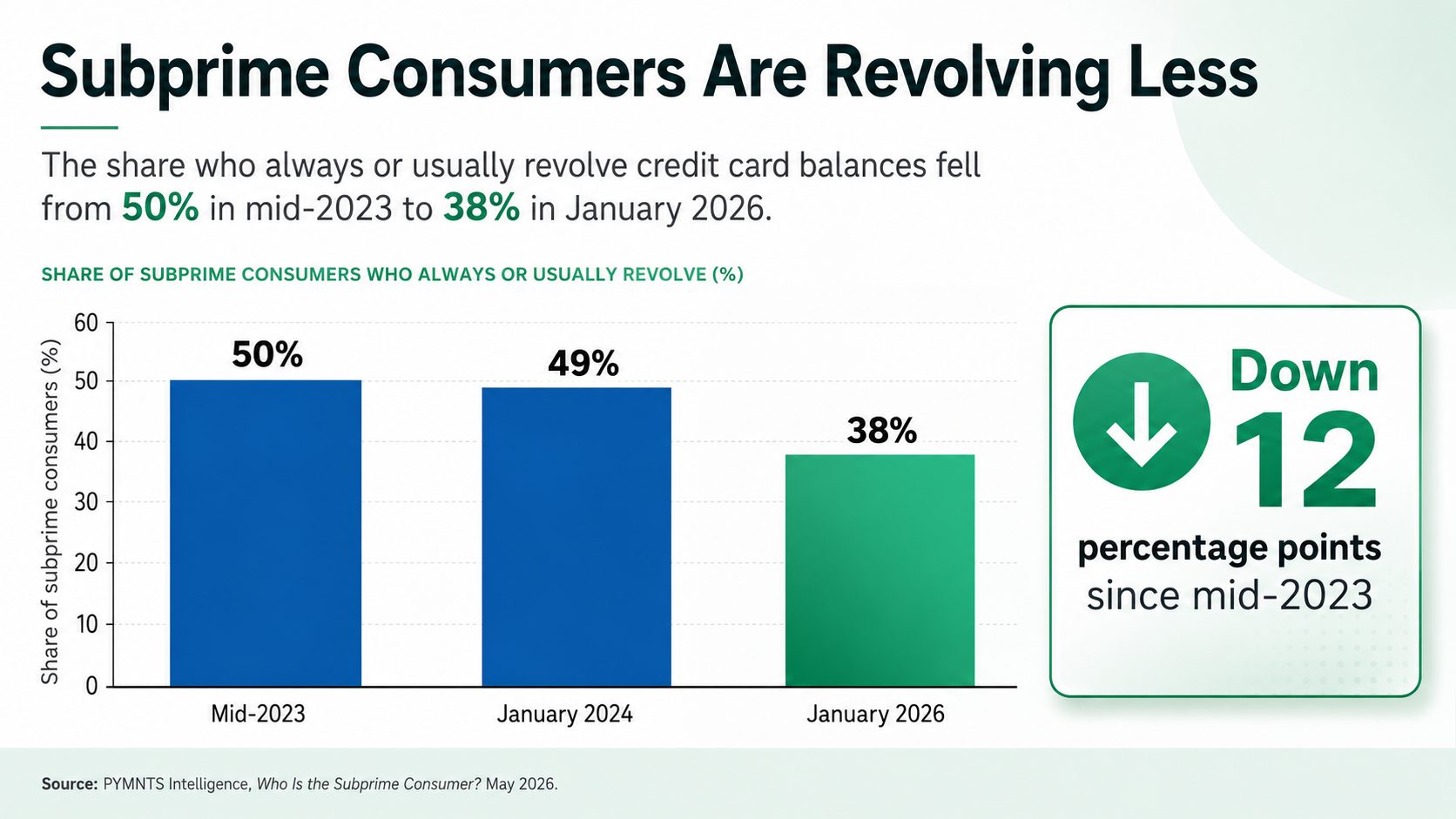
- In January 2026, 38% of subprime consumers said they always or usually revolve credit card balances, down from 50% in mid-2023 and 49% in January 2024. That 12-point drop is the report’s third key finding and may point to a consumer base that is becoming more selective about when and how it uses revolving debt.
- In the same report, only 15% of subprime consumers said they paid their full monthly card balance in the last month. At the same time, 45% said they paid more than the minimum but less than the full balance. That suggests many are still under pressure, but they are not simply standing still. Many appear to be inching forward, a little like drivers taking side streets instead of the highway when traffic gets too heavy.
- The shift also appears tied to a changing product mix. 35% of subprime consumers hold no credit or store card at all, and 4% report using only BNPL as their pay-later product with no credit card. In addition, 19% of subprime consumers used BNPL in February 2026, above the 13% whole-sample rate. In other words, some consumers are moving away from traditional revolving credit and toward more controlled installment-style options.
The rest of the report adds useful context. Among subprime consumers, 55% live paycheck to paycheck with difficulty paying bills. Younger subprime consumers are also more likely to delay medical care, with 23% putting off a doctor’s visit because of cost.
Tax refunds play an outsized role too, with 67% of subprime refund recipients calling that money critical or very important to their finances. Still, the report’s larger message is not one of retreat. It is a picture of consumers actively reorganizing how they pay, borrow and stay afloat.



 Add as Preferred Source