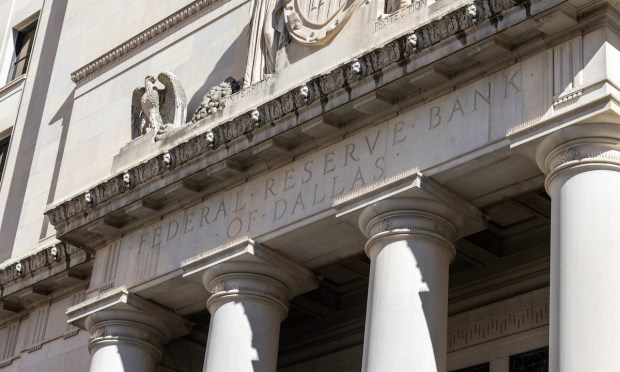
Widespread adoption of tokenized deposits could make it easier for depositors to move their funds to pursue higher interest rates and therefore require banks to raise their rates to remain competitive, two Federal Reserve Bank of Dallas economists wrote in a Tuesday (Aug. 25) blog post.
If the weighted average life (WAL), or the amount of time deposit balances are expected to remain on a bank’s balance sheet, declines by 10%, the maturity transformation capacity of banks would shrink by $580 billion, according to the post.
If the price sensitivity of deposits increases 10%, the duration risk appetite of banks could drop by $700 billion, per the post.
We’d love to be your preferred source for news.
Please add us to your preferred sources list so our news, data and interviews show up in your feed. Thanks!
“Given the real-time, instant nature of tokenized deposit transfers, meaningful adoption would likely increase both the volatility of deposit balances and uncertainty around potential outflows during the normal course of business,” Dallas Fed economists Rosie Levy and Srini Ramaswamy wrote in the post.
The economists pointed to the effects of Brazil’s Pix, an instant payment system that, like tokenized deposits, enables instant outflows from one bank to another. Heavier usage of Pix has caused banks to seek more liquid assets, per the post.
“Widespread adoption of tokenized deposits could have meaningful consequences for banks, but there may be broader implications too,” Levy and Ramaswamy wrote. “Market participants and policymakers should consider the potential implications for current payment systems, monetary policy transmission and implementation, potential asymmetric effects across bank sizes and types, and the role of the central bank as the lender of last resort in a heavily tokenized world.”
It was reported in June that JPMorgan Chase, Bank of America, Citigroup, Wells Fargo and other major commercial banks plan to launch a tokenized deposit network in the first half of 2027. The network will connect traditional payment rails with digital asset infrastructure, allowing tokenized deposits to settle instantly across a blockchain around the clock.
On Aug. 4, it was reported that Wells Fargo hopes to launch tokenized deposits for corporate and commercial customers this fall.
The Bank for International Settlements announced in May that it and its partners marked a new milestone in their Project Agorá by demonstrating that tokenized commercial bank deposits could be combined with the “trust and safety” of tokenized bank reserves using a shared platform.


 Add as Preferred Source