For anyone who remembers carrying an RSA SecurID key fob to log in to work, the company’s role is familiar. For more than 40 years, RSA has helped organizations establish who belongs inside their systems. In fact, they more or less established that standard.
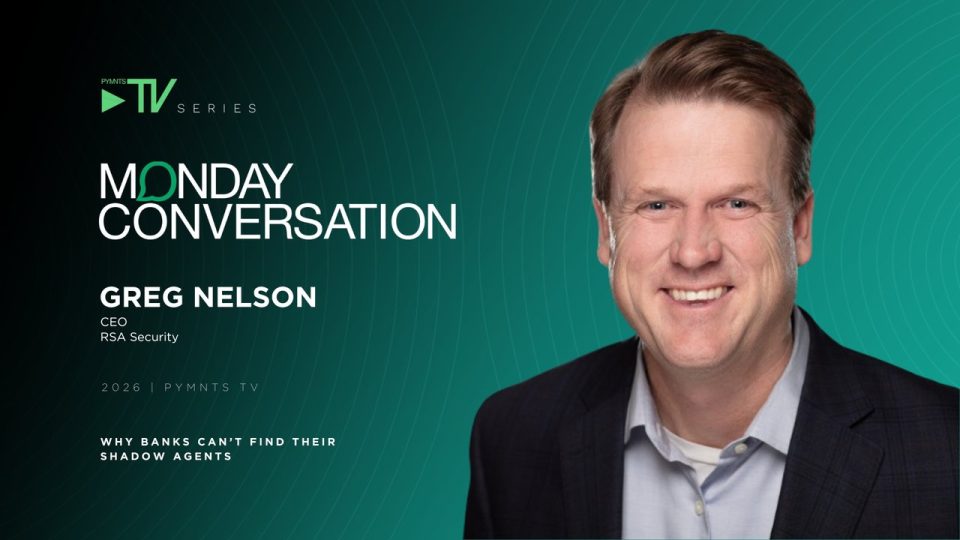
Now RSA Security CEO Greg Nelson is applying that experience to a different kind of user: the AI agent. The job is to establish which agents are operating, what they’re allowed to do and who is responsible for them, then match the oversight to the work.
That’s the transition Nelson described in a Monday Conversation with PYMNTS CEO Karen Webster. RSA is extending its work managing employee access to agents that he says can keep working even after the person who put it there has left.
Webster cited an unnamed midsize bank that told RSA that it had no agents. RSA found 4,000 operating inside it.
For Nelson, who became CEO in September 2025 after serving as president and chief business officer, that example fits a broader pattern. He said roughly 40 customer meetings over the preceding 30 days had surfaced widespread uncertainty about how many agents were already at work.
“I haven’t found one company yet that is comfortable that they know how many agents they have,” he said. An incomplete inventory gives a bank reason to look more closely, even though it may not mean that agents handling consequential work are operating without supervision.
Webster put the distinction to him: “is it the number [of agents] or is it what they’re doing?” A bank could have thousands of agents and only a small share doing work that warrants close scrutiny. Those are the agents a regulated bank should be supervising most closely, and it may already be doing so.
Nelson said that the more practical question is whether the bank can account for the agents with consequential permissions and confirm that the right controls cover them. It’s not always that easy given the pace at which companies are embracing AI and agentic workflows.
Oversight Starts With What the Agent Can Do
Nelson contends that some agents already have access that exceeds their users’ authority. His starting point for banks is straightforward. Every agent needs a person who is accountable for it. The agent shouldn’t have more authority than that person, and the level of oversight should reflect the work it’s doing.
“If an agent’s looking to wire $50 million, you do not just want that to naturally occur,” Nelson said. His hypothetical illustrates the kind of activity a bank would be expected to review closely. It also shows why the discussion has to move from counting agents to examining their permissions and approvals.
That question becomes more complicated when the software is already operating inside the institution. “So how do you permission an agent that’s already inside?” Webster asked.
Nelson described a process that starts with discovery, connects each agent to a responsible person and continues to govern its access and activity. Lower-risk work still needs ownership and appropriate permissions. Higher-risk work needs closer supervision.
He said that banning tools could become a knee-jerk reaction with even more serious repercussions, sending employees toward applications the bank doesn’t oversee. That’s why it’s much better for banks to more reliably find and govern the software that’s already in use.
Human Oversight Needs Human Attention
Even when a bank has an approval process, Nelson said the review has to be meaningful, more than just a checking a box. That depends on whether the person receiving a request actually takes the time to examine what they’re approving and why.
“People get overloaded,” Nelson said. He described employees receiving dozens of requests and approving them together. The bank may have required a human response, but that doesn’t mean someone has examined each and every one of the actions they are asked to review, especially given the pressure from business units to move things more quickly through the approval process.
That’s why Nelson’s approach reserves explicit intervention for the work that warrants it. Routine requests can consume the attention that higher-risk decisions need, weakening the oversight the approval process was meant to provide.
Nelson mentioned another agent interaction where oversight matters. When the employee responsible for an agent leaves, he says it’s possible that the agent can remain behind with its permissions intact, continuing tasks the bank hasn’t reassigned or stopped.
Nelson said institutions have devoted more attention to getting agents started than retiring them. Ending an agent’s access when its work or relationship ends has to be part of the process, just as assigning that access was in the first place.
RSA Brings Its Access Experience to Agents
RSA has announced Agent ID to help institutions find their agents, manage their access and establish who’s accountable for them. Its development reflects financial services and government requirements. For those institutions, “it’s regulatory compliance [and] it’s human assurance,” Nelson said. Where failure is not an option, he emphasized.
That, Nelson said, requires visibility across cloud applications, on-premises infrastructure, mainframes and isolated environments. RSA’s opportunity is to bring the discipline it has applied to employee access to software operating across those systems.
Nelson suggested that the bank with 4,000 agents might have 20,000 within a year. The task is to keep track of them, identify those handling higher-risk work and confirm that the right human oversight is in place. As he put it: “You [have to] know your agents, and you [have to] have the right discovery tool.”
In other words, the time to decide what an agent can do is before the bank has to explain what it already did.