A shopper can make it through product search, comparison and cart building, then disappear at the payment screen. For merchants, that turns a nearly completed sale into a preventable loss.
The PYMNTS Intelligence report “The Hidden Cost of Checkout Gaps: What 56 Million Abandoned Carts Mean for U.S. Merchants and How Agentic AI Is Changing What Comes Next” found in September that 21% of consumers in the United States abandoned an online cart in the 30 days before being surveyed because their preferred payment method wasn’t available. That represented nearly 56 million shoppers. Digital wallets accounted for the largest share of that missed business, as 47% of cart abandoners wanted to use one, equal to 26.3 million consumers.
We’d love to be your preferred source for news.
Please add us to your preferred sources list so our news, data and interviews show up in your feed. Thanks!
Key findings from the report:
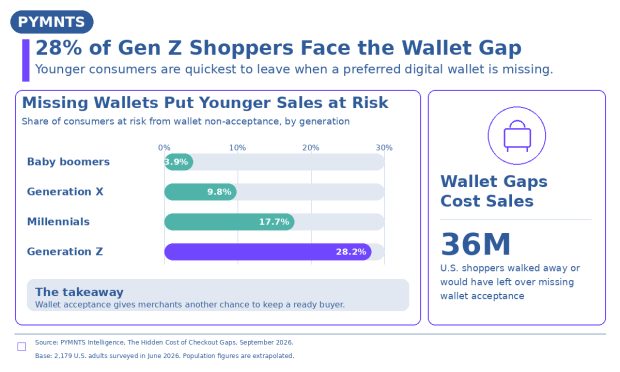
- Young shoppers leave fastest. The share of Generation Z consumers who abandoned a cart over a missing payment method was 36%, compared with 31% of millennials, 15% of Generation X and 8% of baby boomers and seniors. The wallet gap alone put 28% of Gen Z shoppers at risk of leaving, nearly twice the 14% rate for all shoppers.
- Financial pressure raises the cost. When their preferred method was missing, 29% of consumers living paycheck to paycheck who struggle to pay bills abandoned a cart. That was nearly three times the 11% rate among consumers who don’t live paycheck to paycheck. Supporting more payment choices can help merchants retain shoppers who need greater control over when and how they pay.
- A missing wallet can send the sale elsewhere, as 33% of digital wallet users said they would have delayed a purchase, switched merchants or skipped it if their wallet hadn’t been accepted. Nearly half of Gen Z retail wallet users would have changed merchants or abandoned the transaction. Checkout is the last handoff in a relay, and a missing payment option can drop the baton just before the finish.
The report also found that 87 million consumers, or one-third of U.S. shoppers, used a digital wallet online in the prior 30 days. Gen Z led at 47%, while millennials followed at 44%. That usage gives merchants a path to recover sales now and prepare for automated shopping later. The report revealed that 52% of wallet users said they would likely link a wallet to an artificial intelligence agent within two years, compared with 39% of nonusers.
Consumers showed the most interest when they could approve purchases, set spending limits and control which payment sources an agent uses. Merchants that broaden wallet acceptance and preserve those controls can reduce today’s checkout losses while building a stronger foundation for the next stage of digital commerce.
At PYMNTS Intelligence, we work with businesses to uncover insights that fuel intelligent, data-driven discussions on changing customer expectations, a more connected economy and the strategic shifts necessary to achieve outcomes. With rigorous research methodologies and unwavering commitment to objective quality, we offer trusted data to grow your business. As our partner, you’ll have access to our diverse team of PhDs, researchers, data analysts, number crunchers, subject matter veterans and editorial experts.


 Add as Preferred Source