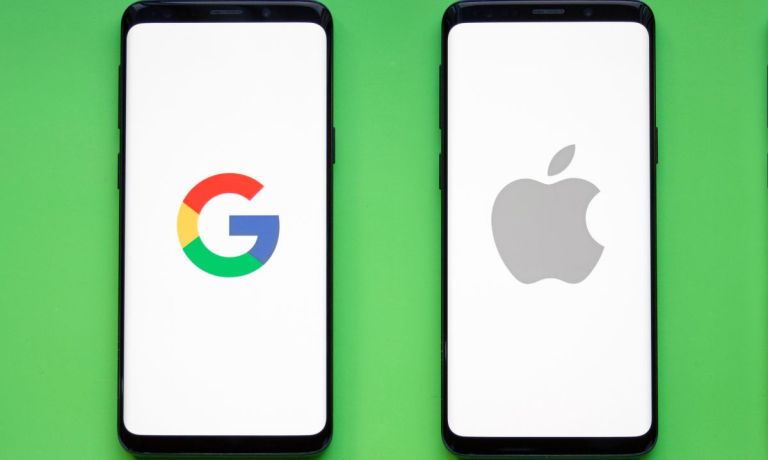
That’s according to a report Thursday (Jan. 8) by Bloomberg News, which characterizes the milestone as an indication of how the company has become one of the biggest winners in the artificial intelligence (AI) race.
Google, which trades under its corporate name Alphabet, had reached a valuation of $3.89 trillion the day before, ahead of Apple’s $3.85 trillion. By Thursday afternoon, that gap had opened up, with Google at $3.92 trillion and Apple at $3.80 trillion.
The report said this marks the first time since 2019 Google has overtaken Apple in terms of value. The top company is still Nvidia, valued at $4.49 trillion Thursday afternoon.
Writing about Google’s AI efforts earlier this month, PYMNTS argued that the company was signaling a shift in how it wants the technology to be deployed.
“Alongside its cloud-based Gemini models, the company has been expanding its edge AI stack, including Google Edge tooling and a new compact model called FunctionGemma,” the report said. “Together, these efforts point to a strategy that treats local execution as a core layer of AI infrastructure rather than a niche optimization.”
Advertisement: Scroll to Continue
FunctionGemma, the report continued, was created to run directly on mobile devices and translate natural language commands into actions without relying on cloud inference, letting phones respond instantly to user intent.
“FunctionGemma fits into Google’s broader edge AI push, which includes Google Edge tooling designed to help developers deploy and run models locally across phones, browsers and embedded devices,” PYMNTS added. “Together, these efforts reflect a shift toward hybrid AI architectures that divide responsibilities between local and cloud systems.”
And earlier this week, PYMNTS examined Google’s role in redesigning shopping around the rise of AI, pointing to a recent report from Google Cloud that argued that retail has entered a new stage of agentic adoption.
The report, based on an interview with Kapil Dabi, Google Cloud’s market lead for retail and consumer industries in the Americas, characterized agentic AI as technology that can reason, understand context and carry out action in ways resembling human decision-making.
“For retailers, this shift allows AI to interpret nuanced requests, such as visual style or situational needs, rather than relying on keywords or predefined rules,” PYMNTS wrote. “Google positions this evolution as foundational to improving discovery, personalization and engagement across increasingly complex shopping journeys.”