“We’re able to provide more data to the clients for them to understand and unlock that value of out-of-home [advertising],” said Levi.
Improving the mobile ad experience
Levi also sees an opportunity for the RADAR program to improve the mobile retargeting experience and improve engagement.
“What we do is operate under a premise here of retargeting with mobile after someone has been exposed to an out-of-home ad drives a greater likelihood of engagement with the consumer than just pushing the mobile ad,” said Levi.
Bundling out-of-home ads with mobile ads is paying off, he said. Retargeting people who are exposed to an out-of-home ad with a mobile ad is leading to much higher click-through rates on the mobile ad.
“We think that makes logical sense,” he added. “If you see some random ad show up on your phone, it’s invading your phone; it’s getting in the way, and it’s an annoyance.”
However, Levi believes that consumers are more likely to respond positively to an ad on their mobile device if they have just been exposed to an effective out-of-home advertisement because it amplifies something they recently noticed.
“Seeing that same message show up on your device, it has a greater likelihood of resonating because it’s not the first time you’ve been exposed to it,” said Levi.
Building a better shopping experience through data
While RADAR is still in its early stages, Levi sees programs like it as an opportunity to improve connectivity and communication between devices by offering businesses the chance to realize the opportunity that can be found in a “data ecosystem.”
“Where we are today is [using] some very interesting experiments and applications of data and connected devices and beacons and other parts of this IoT ecosystem that are starting to create use cases and proof that there is value here,” said Levi.
As the data ecosystem evolves, Levi anticipates datasets will expand and connectivity will improve, which will ultimately offer greater insights into consumer behavior and improve their mobile device experience. This model is based on data that relies on his behavior and preferences, instead of pushing a random ad.
“If I can eventually get to the point where Starbucks knows that I buy my drink every morning at 7:30 a.m. and it’s typically an iced coffee with almond milk and I’m walking by my typical Starbucks and they can push me a message that says, ‘Today, it’s free’ or ‘Today, it’s $1 off,’ that’s kind of cool for me,” said Levi. “That’s where I’d like to see things get to.”
. . . . . . . . . . . . . . . .
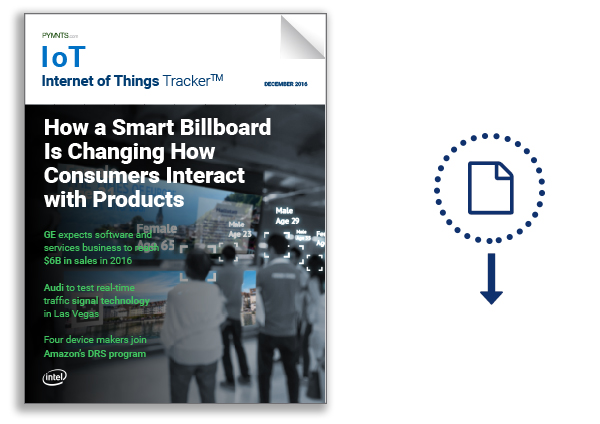
Click here to download the December 2016 PYMNTS.com Internet of Things Tracker™.
About The Tracker
The PYMNTS.com Internet of Things Tracker™ showcases companies that are leading the way in all aspects of the Internet of Things. Every month, the Tracker looks at what these companies are doing across the ecosystem and in several categories, including Personal, Home, Retail, Transportation, Wearable, Mobile, Infrastructure, Data and more.