For nearly 60 years, Mastercard has answered one question over and over. How do you get two parties who’ve never met to trust each other enough to do business? The answer was a card, a network, a rulebook everyone agreed to follow.
There’s a new party at the table now. It isn’t human. It’s an agent, acting on someone’s behalf, ready to shop, compare and pay with nobody watching. So the question isn’t whether machines will transact. They already do. The question is who builds the trust that makes it safe, who wins when the buyer is an algorithm, and what kind of commerce becomes possible that we can’t yet picture.
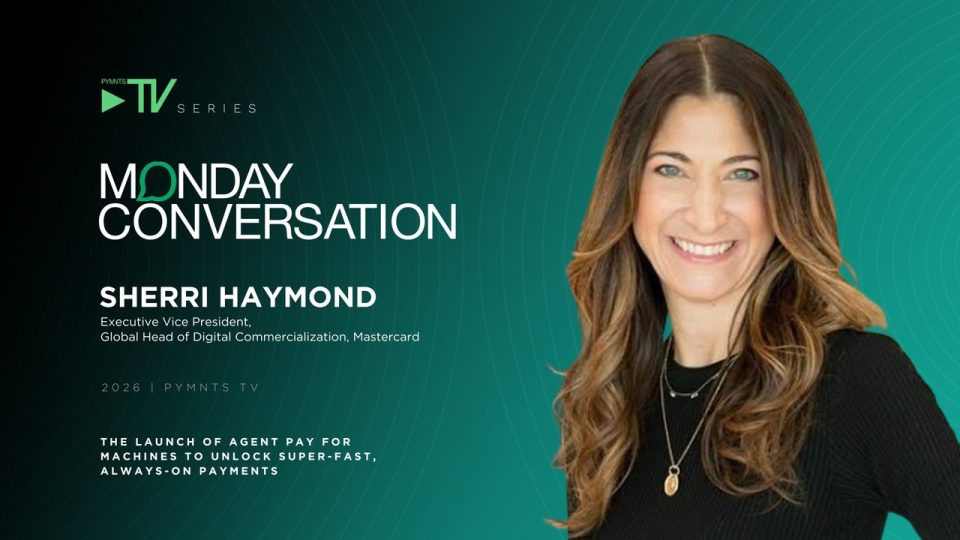
That was the table PYMNTS CEO Karen Webster set for Sherri Haymond, executive vice president and global head of digital commercialization at Mastercard, in this week’s Monday Conversation. Mastercard had just driven another stake into the agentic ground with Agent Pay, and its newest extension, Agent Pay for Machines, built for transactions one piece of software executes on behalf of another.
“We know consumers want to go to those models,” Webster said. “They want to type their intent into the prompt, and they want to execute a transaction.”
The plumbing to do that safely and at scale is the part nobody sees and everybody needs.
Commerce Leaves the Website
Each wave of commerce moved the storefront. eCommerce put it on a website. Mobile put it in an app. Wallets stripped friction out of checkout. Through all of it, one thing held: The customer made every buying decision.
Agentic commerce breaks that. Consumers and businesses are starting to hand pieces of the buying job to software that can find products, weigh options and pull the trigger. Haymond pointed to the places where this is already happening.
“We see real commerce happening on certain platforms,” she said. “Google is a great example.”
Social platforms, like Meta, are testing the buy button inside the ad. Independent shopping agents are showing up. And discovery, the part where you find the thing in the first place, is moving out of the browser and into the chat window.
The Blank-Check Problem
Here’s where it gets interesting, and where the risk lives. When a consumer delegates spend to an agent, they’re not the one reading the fine print anymore.
“When you’re delegating spend authority to an agent, you’re not the one going to the website or the app yourself,” Haymond said. “To read the terms of sale, the product descriptions, to see if something’s final sale, when it’s going to be delivered. All of that has to get filled in somehow.”
That gap is the whole game. It’s the industry’s biggest opening and its biggest exposure at the same time. Consumers already trust software to recommend a product. Trusting software to spend the money is a different thing altogether.
“The most important ingredient is trust,” Haymond told Webster. “If consumers, or people acting on behalf of businesses, don’t trust that the system will work as intended, they’re just not going to use it.”
Mastercard’s answer runs Agent Pay on top of the rails it already owns. Tokenization. Credential management. The digital payments infrastructure it spent two decades building. The bet is that trust isn’t something you bolt on. Haymond’s point is that trust is something you’ve already earned, or you haven’t.
When the Buyer Is Software
Agent Pay for Machines pushes the idea past the consumer and into machine-to-machine commerce. Haymond walked through a case that lands fast for anyone who’s ever tried to start something.
A small business owner is opening a new store and neglected to create a website or even buy a domain name, and forget even the notion of a marketing program on Instagram. She asks her favorite AI assistant to put the business online. The agent buys the domain, builds the site, stands up a marketing campaign. It compares providers and gets the owner’s sign-off. Once the owner says yes, the payments happen in the background, at machine speed, using funding sources such as cards, virtual cards, bank balances, lines of credit or stablecoins. The point isn’t to remove the business owner from the process, at least not at first. It’s to let the owner stay in control while the agent handles the steps that normally require time, staff and manual coordination.
In this case, the payment stops being a separate errand. It lives inside the work.
“This really solves a major problem,” Haymond said. “But it opens up a tremendous amount of opportunity. It’s a whole new category.”
Think about the unlock, Webster remarked. The small business, or any business, frankly, with no or limited staff and no time to do any of this. In minutes, it has a digital footprint that used to take months, and people and lots of money. The work that priced out the smallest players just got cheap and becomes the platform for innovation.
We’d love to be your preferred source for news.
Please add us to your preferred sources list so our news, data and interviews show up in your feed. Thanks!
Standards Before Scale
Payments has learned one lesson the hard way, over and over. Infrastructure scales when everyone agrees on the rules first. Haymond expects agentic commerce to follow the same script.
“Standardization is key,” she said. “There are some things that just aren’t competitive. They’re foundational, enabling pieces.”
That’s the thinking behind Verifiable Intent, Mastercard’s framework for tying identity, instructions and outcome together in a record you can check after the fact. Mastercard introduced it earlier this year. Then it did the thing that signals it actually means “foundational.” It handed the framework to the FIDO Alliance for the whole industry to use, rather than keeping it as a moat.
For Mastercard, Haymond said the larger opportunity isn’t simply about making today’s payments faster. It is opening a new market in which agents become buyers and customers in their own right. As businesses begin using agents to find services, compare options and complete tasks, many of those actions will end with a payment. That creates a new class of machine-to-machine transactions and a new set of services around them.
Companies could monetize the payment itself, the tools that make the transaction safe and the data services that help agents deliver better results. Haymond pointed to personalization as one example, where anonymized insights could help an agent show more relevant options to one buyer than another. In that model, agents do more than assist a business. They become a new channel for commerce, and a new source of revenue for the companies that can serve them.
The Next 18 Months
As the conversation was coming to an end, Webster asked Haymond to describe the frictions holding back agentic commerce that Mastercard looks to overcome. Her answer came in two parts.
First, she said, we will move past the death by a thousand protocols that define agentic commerce today.
“I think some of the standards work themselves through,” she said. “I don’t necessarily think that we’ll be talking about protocol wars, so to speak. Everyone’s ready to roll up their sleeves and standardize everything so that the business can actually take off.”
Then, the agentic process and workflows will be smoother, outcomes better, efficiency even more demonstrable than they are today. Haymond described it as the culmination of a thousand small handoffs people stop noticing.
That means, she said, the job between now and then is making sure each handoff is safe enough that the next one feels obvious and trusted.
That’s the rulebook. And writing rulebooks for parties who’ve never met is the very first job Mastercard ever had, Haymond said.
Watch the full Monday Conversation for more on:
- Why trust, not technology, is the gate between experimentation and adoption.
- How Agent Pay for Machines is built for delegated, machine-to-machine purchasing.
- Where the networks have to cooperate for agentic commerce to exist at all, and where Mastercard intends to win.


 Add as Preferred Source