Hippo CEO Says Growth Starts With the Risks It Won’t Take
Highlights
Progressive is making Hippo more selective, not simply sending it more homeowners. Hippo has made roughly 50 underwriting adjustments since the partnership began.
In Q2, the Homeowners segment represented only 22% of Hippo’s gross written premium in the second quarter, but 42% of the premium it retained after reinsurance.
AI handles routine service and prepares claims files, but licensed adjusters continue to make every final claims decision.
Watch more: Hippo CEO Says Growth Starts With the Risks It Won’t Take
Insurance companies rarely get into trouble because they can’t find enough customers. They get into trouble because they keep writing business after the price no longer covers the risk. That lesson sits at the center of Hippo Holdings’ growth strategy.
President and CEO Rick McCathron told PYMNTS CEO Karen Webster in an exclusive interview on Thursday (July 30) that new distribution relationships, more underwriting data and a broader mix of insurance programs are giving Hippo more business to choose from. They aren’t giving the company a reason to accept it all.
The distinction helps explain Hippo’s latest results, released Thursday. Gross written premium rose 61% to $482 million, while the company earned $10 million and recorded its fifth consecutive profitable quarter. Those numbers are the proof. The more important story is how the business now works.
What Is Hippo’s Business Model?
Hippo started as a technology-led homeowners insurer. It now has two related businesses.
The first is insurance that Hippo develops and underwrites itself, particularly homeowners coverage. Hippo controls the product, pricing, underwriting and customer experience and keeps most of the ordinary, non-catastrophe risk.
The second is its program-carrier business. Managing general agents, usually called MGAs, can design, market and administer specialized insurance products, but they need a licensed carrier with the capital and financial rating required to issue the policies. Hippo supplies that carrier capacity, along with underwriting oversight, data, claims expertise and technology.
Hippo earns fees on those partner programs and decides how much of the insurance risk it wants to retain. The rest can be transferred to reinsurers. That means premium written through a partner program isn’t the same as Hippo’s revenue, and Hippo doesn’t necessarily stand behind every dollar of potential claims.
That distinction matters when looking at Hippo’s business mix. Homeowners premium grew 7% to $107 million in the second quarter, but it accounted for only 22% of gross written premium. Homeowners nevertheless produced $76 million, or 42%, of Hippo’s net written premium, which is what the company kept after reinsurance. It remained Hippo’s largest line on that basis.
The partner businesses look much larger when measured by all the premium passing through Hippo than they do when measured by the risk and economics Hippo keeps. Hippo’s original homeowners business isn’t disappearing. Commercial and casualty programs are simply growing faster.
Hippo now supports more than 50 insurance programs, twice as many as it did in the first quarter of 2025. McCathron said much of the growth is coming from existing partners expanding with Hippo, rather than from the company accepting unfamiliar programs simply to add volume.
The Accelerant partnership shows how the model can scale. Hippo expects to serve as the fronting carrier for more than $500 million in annual gross written premium from Accelerant’s U.S. specialty insurance portfolio in 2027. But that $500 million isn’t equivalent to $500 million of Hippo revenue. Hippo will earn fees, evaluate the underlying programs and selectively retain risk.
The appeal is diversification. Hippo can grow homeowners when prices and claims trends are attractive, use commercial and casualty programs to balance its portfolio and pull back from any area where the economics deteriorate. McCathron called them “levers.”
Webster pressed McCathron on the tradeoff. Partner programs can produce thinner margins and put more distance between Hippo and the end customer. They also leave Hippo with underwriting, oversight and reputational risk even when much of the financial exposure is reinsured.
McCathron’s response was that Hippo isn’t simply renting out its insurance licenses and balance sheet. It chooses the programs it will support and competes on underwriting, claims expertise, data, technology and the ability to retain risk when the economics make sense. That gives Hippo more control than the term “fronting carrier” might suggest, but it also makes choosing the right programs and deciding how much risk to keep central to the model.
Progressive Makes the Funnel Bigger and Tighter
McCathron described Hippo’s relationship with Progressive as more than a distribution agreement. Hippo’s homeowners insurance is available through Progressive’s HomeQuote Explorer and in-house agents in eight states, giving Hippo access to consumers it might not reach as efficiently on its own.
But access isn’t the same as acceptance. Hippo decides which states, properties and risk profiles will receive a quote. Progressive can retain customers who fit its underwriting strategy, while Hippo can “pick and choose” the business that fits its own. That makes the relationship a customer-matching system as well as a sales channel.
The first few months have also created a faster learning loop. McCathron said Hippo has made roughly 50 adjustments to its underwriting models since the relationship began, using the performance of the funnel to refine which customers it wants to quote before expanding into more states.
“What we’ve really learned over the last few months is, ‘How do we tighten that funnel to meet the customers that we want to write?’” McCathron told Webster.
The point isn’t to maximize the number of Progressive shoppers who receive a Hippo offer. It’s to generate enough qualified opportunities that Hippo can be more precise about which homes it insures and at what price. Better selection can improve loss performance before a policy is issued, while Progressive provides the volume needed to keep testing and refining the model.
That is the “one plus one equals three” logic McCathron used when he and Webster discussed the relationship in April. Progressive brings reach and customer traffic. Hippo brings a homeowners product and underwriting appetite that can complement Progressive’s own. The combined funnel can serve more consumers without requiring either company to write business it doesn’t want.
Why Hippo’s Growth Looks Different
Webster pressed McCathron on why Hippo was growing quickly and making money while some larger insurers were reporting weaker profit growth and other InsurTechs were still generating losses.
Being smaller gives Hippo room to expand, but it doesn’t explain why that expansion is profitable. McCathron’s answer came back to the number of levers Hippo can pull.
Progressive and Hippo’s builder relationships widen homeowners distribution. The program-carrier business adds commercial and casualty opportunities. Underwriting models determine which policies and programs fit, while reinsurance determines how much exposure Hippo keeps. When prices soften or claims trends deteriorate in one segment, Hippo can slow its growth there without shutting down growth across the company.
The more opportunities Hippo sees, the less pressure it has to chase any one of them. That’s different, McCathron said, from cutting prices or relaxing underwriting standards simply to keep policy counts rising.
Is AI Helping Hippo Improving Claims or Mainly Cutting Costs?

We’d love to be your preferred source for news.
Please add us to your preferred sources list so our news, data and interviews show up in your feed. Thanks!
 Add as Preferred Source
Hippo’s second-quarter numbers initially appear to tell two different stories. Claims consumed a slightly larger share of premium, while the cost of running the business fell sharply.
The claims picture is better than the headline ratio suggests. Hippo’s overall loss ratio increased partly because the company received less benefit from favorable adjustments to claims from prior years. On claims generated by the current book of business, excluding catastrophes, loss performance improved slightly.
The larger change came from efficiency. Hippo’s net expense ratio fell eight percentage points from a year earlier, as premium grew faster than its fixed operating costs. That is where artificial intelligence (AI) is beginning to make a measurable difference.
McCathron said Hippo evaluates potential AI uses by asking two questions: Will it improve the customer outcome, and will it make the company more efficient? The company moves forward when the answer to both is yes.
AI service agents now handle routine billing and payment questions. McCathron said those interactions are producing a 97% customer satisfaction score. In claims, AI gathers information, organizes documents and prepares files for licensed adjusters, reducing the time employees spend assembling a case before applying their judgment.
Webster asked whether insurance could eventually follow other parts of financial services where AI is beginning to resolve some routine disputes and decisions automatically.
“We have not had a single claim adjusted by an AI agent,” McCathron said. “The industry’s not there yet. I don’t think the regulatory environment is there yet.”
AI can make a claims file more complete and get it in front of an adjuster faster. It doesn’t decide whether Hippo owes a customer money. McCathron cited regulation, fraud and the need for professional judgment as reasons licensed adjusters remain responsible for the final call.
That makes AI an efficiency tool rather than an underwriting philosophy. Its contribution to Hippo’s business model is operating leverage: more customers, policies and claims can move through the company without requiring service and claims costs to rise at the same pace.
Underwriting Discipline Is the Growth Strategy
McCathron said AI isn’t “the silver bullet that some people profess it to be.” Neither is distribution, reinsurance or the program business by itself.
What connects them is underwriting discipline. More distribution creates more opportunities. More programs spread Hippo across more types of insurance. Reinsurance gives the company choices about how much risk to keep. AI lowers the cost of processing the business Hippo decides to accept.
But each advantage becomes a liability if Hippo uses it to pursue volume without regard to price and claims exposure. McCathron traced that lesson to Mercury General Founder George Joseph, who built the insurer around rigorous attention to underwriting cycles.
“What I learned from him is there’s a graveyard of ships at the bottom of the ocean who didn’t really understand discipline in the market cycles that make up our industry,” McCathron told Webster.
Hippo now has more ways to grow than it did when it was known primarily as a direct-to-consumer homeowners InsurTech. The test is whether each new channel makes the company more selective or simply makes it bigger.
McCathron’s case is that the two can reinforce each other. More opportunities give Hippo more business to choose from. Profitable growth starts with the risks it won’t take.
Watch the Interview
Watch the full conversation between PYMNTS’ Karen Webster and Hippo President and CEO Rick McCathron to learn:
- What Hippo has learned from the first months of its Progressive partnership
- Why homeowners remain more important than its share of gross written premium suggests
- How Hippo’s program-carrier model changes its growth and risk
- Where AI is lowering costs and why licensed adjusters still make every claims decision
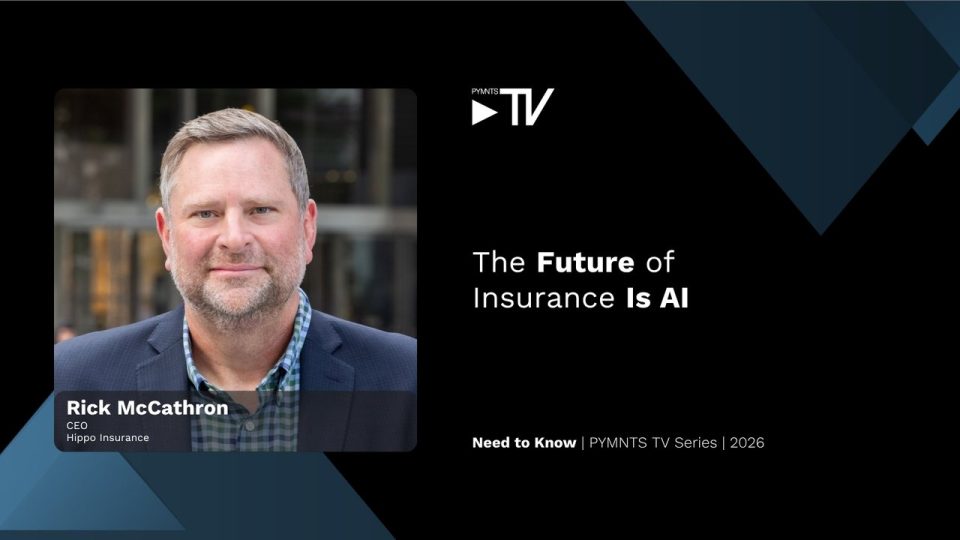
Rick McCathron is president and CEO of Hippo Holdings.
PYMNTS CEO Karen Webster is one of the world’s leading experts in payments innovation and the digital economy, advising multinational companies and sitting on boards of emerging AI, healthtech and real-time payments firms, including a non-executive director on the Sezzle board, a publicly traded BNPL provider. She founded PYMNTS.com in 2009, a top media platform covering innovation in payments, commerce and the digital economy. Webster is also the author of the NEXT newsletter and a co-founder of Market Platform Dynamics, specializing in driving and monetizing innovation across industries.