Embedded finance has been able to put financial products almost anywhere.
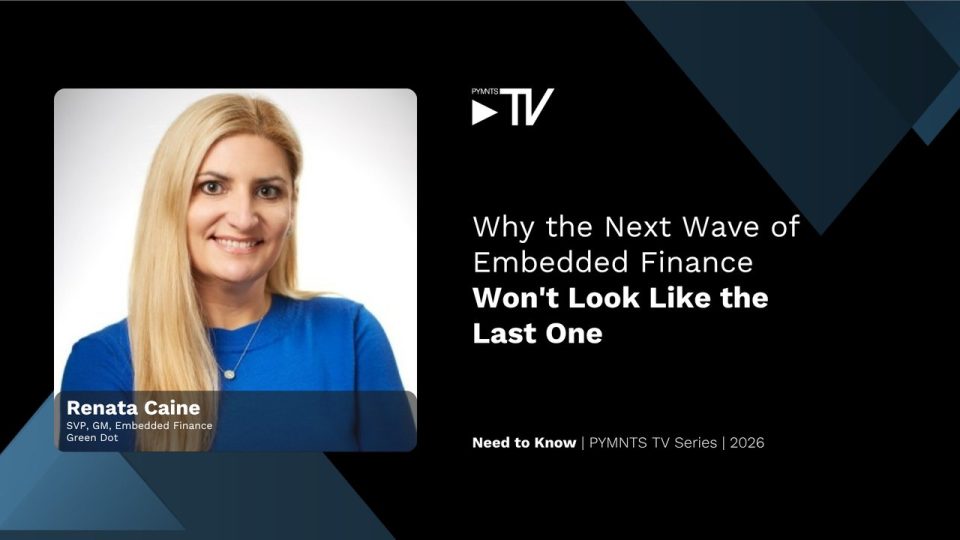
The trend is now one of verticalization, according to Renata Caine, senior vice president and general manager of embedded finance at Green Dot. The premise is straightforward. A payment capability designed to work across hundreds of businesses may provide access, but businesses do not move money in the same ways, face the same regulatory requirements or serve customers through the same operating processes.
“Horizontal is where we’ve been for a while now,” Caine told PYMNTS. “It solved the access problem, and the vertical phase is really what everyone hopes is going to solve the value problem.”
That changes where providers must look for opportunity. Caine pointed to telecom, social platforms, automotive and human capital management as sectors with several characteristics in common, including frequent customer interactions, regular movement of money and financial transactions embedded within complicated workflows.
A telecom company, for example, may have to manage device financing, installment plans, service charges and bill payments. Workforce platforms sit between employers controlling the timing of payroll and workers receiving wages, creating natural roles for pay cards, payroll disbursement and earned wage access. The financial product becomes part of an existing process rather than a separate destination for the customer.
That helps explain Caine’s broader contention that standalone financial products are becoming an exception, not the rule, in finance, as offerings reside in the software and platforms where people already work, manage employees, communicate or conduct other routine activities.
For providers, that means the useful question is no longer simply where another payment button can be placed.
“The opportunity isn’t finding a way to add a payment,” Caine said. “The opportunity is identifying where money movement is already core and [asking,] ‘How do we make it better?’”
Verticalization Puts Workflows Ahead of Products
We’d love to be your preferred source for news.
Please add us to your preferred sources list so our news, data and interviews show up in your feed. Thanks!
Going vertical requires more than repackaging a general-purpose payments API for a particular industry. The differences can reside in how transactions are initiated, how frequently customers interact with a platform, which parties control funds, how products are configured and which regulations govern them.
There is precedent. Caine pointed to the development of virtual cards roughly 15 to 20 years ago. Broad access to virtual cards eventually gave way to more specialized applications in industries such as travel and insurance, where providers adapted the underlying capability to particular workflows.
Green Dot’s approach includes combining banking infrastructure with compliance capabilities and configuring products for specific operating environments. Caine cited rapid! by Green Dot, which supports 7,000 businesses with pay card and earned wage access products, as one example of applying that model to workforce management.
Compliance becomes particularly important as embedded finance moves further into regulated industries. Payroll, healthcare payments and workforce management bring requirements that cannot simply be added after a financial product has been designed, Caine said.
As for measuring success, transaction volume provided a convenient yardstick when the primary question was whether companies could add financial capabilities and persuade customers to use them. A vertical model makes the measurement more complicated.
Providers should examine workflow capture, including whether customers use the financial capability within an existing process, whether it removes friction, whether they return, and whether the product improves retention and customer economics, Caine said.
“Are people using it?” she said. “Does it solve a real problem? Does it bring people back and are people likely to stay?”
For the industry, that puts pressure on the familiar horizontal model without making it obsolete. Generic infrastructure still supplies much of what a company needs. Caine estimated that such platforms can get a provider about 70% of the way toward an embedded finance offering. The remaining 30% will depend on configuring technology, banking infrastructure and distribution around specific industries.
Watch the full interview with Renata Caine to learn more about:
- Why the experience of virtual cards in travel and insurance offers an early model for the verticalization now taking place in embedded finance.
- How companies can decide which points in an existing customer journey are worth turning into financial capabilities.
- Why technology, banking infrastructure and distribution must operate together as embedded finance moves deeper into individual industries.

 Add as Preferred Source