Artificial intelligence has reached nearly every part of the large companies surveyed by PYMNTS Intelligence, but its place in the daily workflow varies from one business function to another.
The September report “AI at Work: Why Deeper Enterprise Use Produces Stronger Returns” found that the 60 enterprises in the United States surveyed use AI in an average of seven of eight business functions, including payments, finance, product development and customer experience. Yet only 20% of the 437 deployments examined are embedded in a function’s regular work. The findings suggested an encouraging path to stronger returns for companies ready to put the technology to fuller use.
We’d love to be your preferred source for news.
Please add us to your preferred sources list so our news, data and interviews show up in your feed. Thanks!
Key findings:
- Most functions have room to go further. Another 37% of deployments are broad, meaning multiple teams use AI without making it a core part of their daily operations. The remaining 43% are in limited use or early exploration. A company can therefore have AI in most departments while still working out where it fits best.
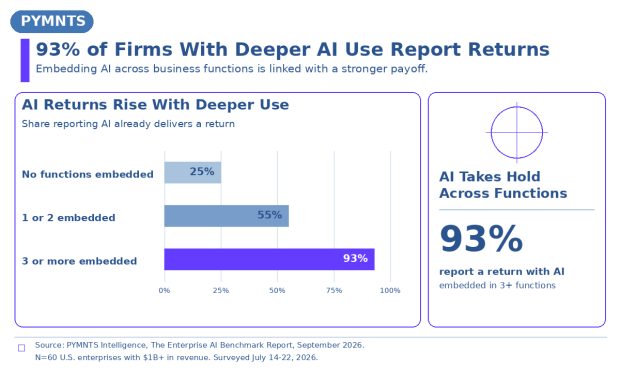
- Reported returns rise with deeper use. Among companies with no functions where AI is embedded, 25% said the technology already delivers a return. That share reached 55% for firms with one or two such functions and 93% for those with three or more. The survey showed an association, not proof that deeper use caused the higher returns.
- Adding tasks alone doesn’t explain the gap. Firms with AI embedded in one or two functions used it across an average of 41 of the 75 tasks surveyed. Those with three or more embedded functions used it across 40. Their reported returns still differed. Having tools on more workbenches doesn’t tell you how often people use them to build something.
The report also found that 62% of surveyed enterprises spent more than $10 million on new AI tools in the past year. Companies with deeper deployment reported more obstacles, including gaps in skills and unclear responsibility for the technology.
Earlier experience may help. Among firms that had embedded older forms of AI in at least two functions before 2022, 47% have now embedded newer AI in three or more.
The survey offered a snapshot rather than a history of each company, but it pointed to a practical opportunity. Firms can build on the processes they’ve already developed as they bring AI further into everyday work.
For all PYMNTS AI coverage, subscribe to the daily AI newsletter.
At PYMNTS Intelligence, we work with businesses to uncover insights that fuel intelligent, data-driven discussions on changing customer expectations, a more connected economy and the strategic shifts necessary to achieve outcomes. With rigorous research methodologies and unwavering commitment to objective quality, we offer trusted data to grow your business. As our partner, you’ll have access to our diverse team of PhDs, researchers, data analysts, number crunchers, subject matter veterans and editorial experts.


 Add as Preferred Source