Yet many still depend on people making phone calls, chasing drivers, updating shipment records and resolving exceptions by hand. The technology has improved, but the economics have not changed as much as many expected.
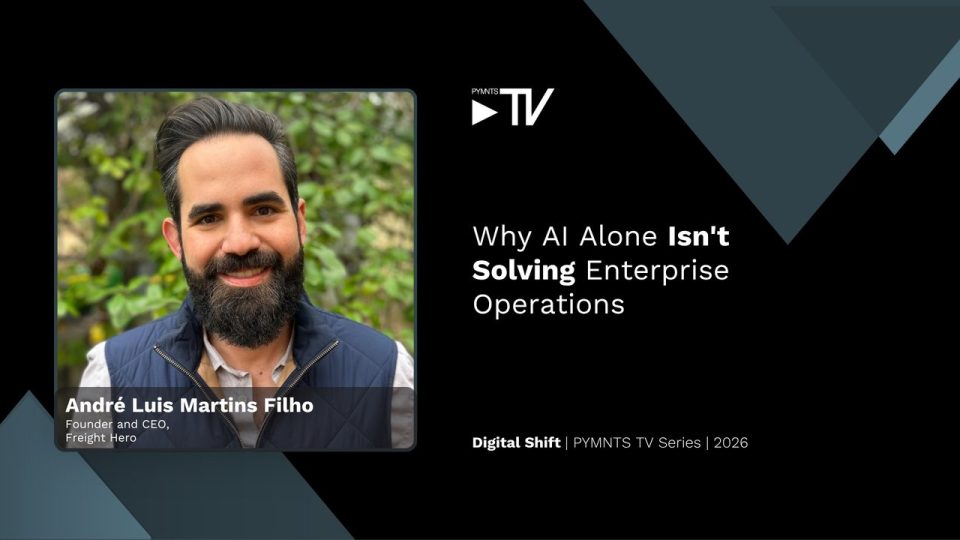
André Luis Martins Filho, founder and CEO of Freight Hero, said companies continue to sell AI as software instead of outcomes.
“Our customers don’t want to become AI experts,” Martins Filho told PYMNTS. “They don’t want to fully understand and deep dive into the technology and understand the nuances and the intricacies of building your evolved system, of coordinating model optimization… They want to see their job done. They want to see their job done more efficiently, and in a scalable way that preserves their costs.”
That philosophy has shaped Freight Hero’s business model. Rather than licensing AI software that brokers must deploy, configure and continually optimize themselves, the company charges a flat fee per shipment to manage freight operations from rate confirmation through delivery. AI agents perform most routine interactions while human operators intervene when judgment, empathy or customer relationships become critical. The company last month raised a $5 million seed round.
Freight illustrates one of enterprise AI’s biggest challenges, Martins Filho said. Building an AI demonstration is relatively easy. Building a production system that performs reliably across thousands of unpredictable situations is harder.
Freight is inherently messy. Drivers miss appointments, equipment changes, weather disrupts schedules and customer requirements shift constantly. AI systems must navigate environments where no two situations are exactly alike.
“AI is complicated,” Martins Filho said. “It’s great. It’s easy to prototype. It’s easy to get something done… It’s very hard to create something at scale that really solves an enterprise-level problem.”
That technical challenge is compounded by who is expected to use the technology. Freight brokers are relationship-driven operators whose expertise lies in negotiating rates, coordinating shipments and solving operational problems, not configuring AI models or managing prompt engineering.
The result is an industry where impressive product demonstrations often fail to translate into measurable business value, Martins Filho said.
“The demos impress,” he said. “The results don’t always come.”
We’d love to be your preferred source for news.
Please add us to your preferred sources list so our news, data and interviews show up in your feed. Thanks!
Outcomes-Based Model Behind Freight Hero’s Pricing
Freight Hero attempts to solve that disconnect by removing software implementation from the customer’s responsibility altogether.
The company steps in after a broker has secured a shipment. Its AI agents contact carriers, verify equipment, confirm pickup appointments, monitor shipments, detect delays and communicate with drivers throughout transit. When unusual situations arise, the workflow is handed to trained human operators who resolve exceptions before returning control to AI.
Martins Filho said the hybrid model reflects his view that AI should remove operational work without eliminating human accountability.
“These are not the personas we’re going to have an easy time configuring and iterating on a new, shiny AI tool,” Martins Filho said. “They like negotiating. They like communicating with truck drivers. They like making sales calls.”
“There are several scenarios where it’s completely unpredictable what happens…,” he added. “It requires human judgment, it requires empathy, it requires accountability that only a human in the loop can provide reliably at scale.”
Instead of paying for software licenses and maintaining back-office teams regardless of freight volumes, customers pay only for shipments they choose Freight Hero to manage. That converts a traditionally fixed labor expense into a variable operating cost while giving brokers flexibility during freight market cycles, Martins Filho said. It also simplifies purchasing because customers evaluate a completed operational service rather than projected software ROI.
Interestingly, the primary buyers are rarely chief technology officers, Martins Filho said. Operations managers typically become Freight Hero’s strongest advocates because they understand the daily complexity involved in managing shipments, while finance executives appreciate the predictable unit economics created by per-load pricing.
The company also plans to expand into billing and accounting workflows, using operational context collected during shipment management to automate invoice approvals and exception handling.
For all PYMNTS AI and B2B coverage, subscribe to the daily AI and B2B Newsletters.


 Add as Preferred Source