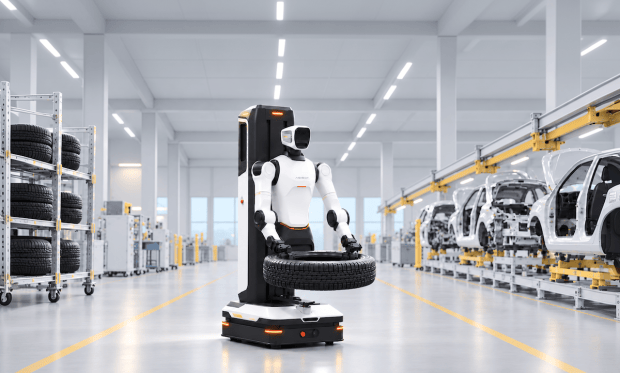
The robotics industry has measured progress by machines shipped, tasks demonstrated and hours logged. China’s AGIBOT is proposing a different benchmark: how much useful work the machines deliver. The humanoid maker introduced Worken at its AGIBOT Innovation Day on Oct. 29, a metric it defines as “effective intelligent work hours,” calculated by multiplying the number of active robots by their autonomous working hours and an output efficiency ratio that compares completed work with a benchmark for the task.
The proposal addresses a gap that widens as robots move from demonstrations into warehouses. Vendors can report rising deployments without showing how much productive work those deployments produce.
Worken Scores Robots on Output, Not Units Shipped
Three inputs make up the score, according to AGIBOT. The first counts only robots performing tasks in live environments, not units built or sitting in inventory. The second counts hours the robot works without a person stepping in. The third divides actual output by a task-specific benchmark, such as acceptable output from a human worker under normal operating standards. That is why, the company said, two fleets of equal size can produce very different results once human interventions and rejected work are counted.
AGIBOT frames the measure as a way to compare productivity across industrial handling, logistics, inspection and commercial services. Wider adoption could shift robot pricing from buying equipment to buying productivity packages, AGIBOT Co-Founder Wang Chuang said in an interview with KrASIA after the event. The company called Worken an evolving framework to be refined through deployment data.
Humanoid Makers Have Operating Data and No Common Yardstick
The operating data is now plentiful. Agility Robotics’ Digit humanoid has moved more than 100,000 totes at GXO Logistics’ Flowery Branch, Georgia, warehouse at roughly 98% accuracy while on task, Agility said when it unveiled Digit 5 in September. The company’s filing with the Securities and Exchange Commission puts Digit 4 at more than 65,000 operating hours, deployed or committed across nine customer facilities, with more than $300 million in multiyear Digit 5 orders subject to contractual milestones. Those numbers are about to meet public market investors. Shareholders of Churchill Capital Corp XI, the special purpose acquisition company merging with Agility, approved the deal Monday (Nov. 2), and the combined company is expected to begin trading on Nasdaq Thursday (Nov. 5). Figure AI’s Figure 02 robots ran 10-hour shifts at BMW’s Spartanburg, S.C. plant for 11 months and handled more than 90,000 sheet metal cycles, PYMNTS has reported.
Each figure measures something different. Operating hours show utilization. Task accuracy shows reliability. Orders show demand. Totes and sheet-metal cycles cannot be set against each other at all. That comparison is the one Worken is built to make, and no vendor has published it.
A Productivity Score Is Not a Payback Period
Worken is not a complete measure of return on investment. The formula has no cost term: equipment prices, lease fees, maintenance, electricity, integration and downtime sit outside it. A robot can post a high Worken score and still cost more to run than the labor it replaces. The metric is also one manufacturer’s proposal rather than an industry standard.
Even the most mature robot fleet reports output rather than payback. Amazon runs more than 1 million warehouse robots, PYMNTS reported, and Amazon Supply Chain Services wrote in a company post that they can save up to 15 seconds per item.
The same measurement problem shows up in corporate AI budgets. Between 90% and 100% of large U.S. enterprises report some return on artificial intelligence spending, but only 5% to 10% report a full payback, the PYMNTS Intelligence report “The Enterprise AI Payback Curve: Adoption Accelerates as Returns Take Shape” found in a June survey of 60 senior technology executives at U.S. enterprises with at least $1 billion in annual revenue.
Finance chiefs judge generative AI returns on several measures at once, according to another PYMNTS Intelligence report, “What Happens When CFOs Get Serious About Gen AI,” based on a December 2025 survey of 60 CFOs at U.S. companies with at least $1 billion in revenue. Customer experience was the most cited at 78.3%, followed by improved margins at 75% and lower operating costs at 60%. On timing, 39.1% expect very positive returns within one to two years, while 26.1% expect the payoff to take six years or longer.
Worken gives robot buyers a way to count the work. The payback period is the number they will ask for next.