Robots navigating factory floors, drones inspecting power lines, and autonomous vehicles reading traffic all share the same constraint: They need to act in milliseconds. Sending data to a distant computing facility and waiting for a response takes too long. For machines operating in the physical world, that delay can mean a missed obstacle, a wrong turn or a failed inspection.
The Robot Report noted that physical artificial intelligence systems can’t depend on remote computing for real-time decisioning. That problem has no software fix. It requires different infrastructure, built closer to where machines operate.
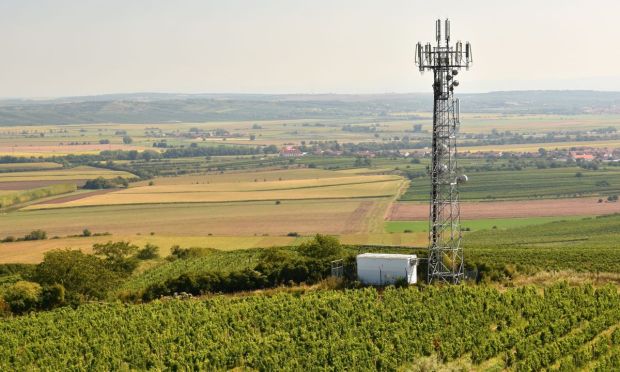
That gap is what Nvidia and T-Mobile are moving to fill. Working with Nokia, the two companies are running computing directly through cell tower infrastructure. Instead of routing data to a remote facility, the system processes it at the tower, near where the robot or vehicle operates. T-Mobile was the first U.S. carrier to run the system in a live pilot.
T-Mobile’s Tower AI Is Already on the Job
Physical AI deployments have been moving out of controlled environments and into live industrial settings. Robots update their behavior on the fly. Drones reroute around unexpected obstacles. None of that can wait. Sending data back and forth to a remote facility introduces delays that make the system unreliable. The issue isn’t bandwidth. It’s distance. Computing needs to happen closer to the machine.
Carriers are positioned to provide that. They already own tower infrastructure nationwide. T-Mobile CEO Srini Gopalan said the company built its network for exactly this requirement. Nvidia CEO Jensen Huang said at Nvidia’s GTC 2026 conference that telecoms, a roughly $2 trillion industry, are about to be reinvented around that opportunity. “The radio tower used to be just a radio tower,” Huang said. “In the future, it’s going to be an AI infrastructure platform.”
We’d love to be your preferred source for news.
Please add us to your preferred sources list so our news, data and interviews show up in your feed. Thanks!
T-Mobile’s AI Inspects Power Lines, Monitors Job Sites
Three deployments from the T-Mobile pilot show the use cases taking shape. Drone maker Skydio and AI developer Levatas are using the system to inspect power transmission lines. They detect problems like leaning poles, corrosion and heat anomalies five times faster than manual methods, Fierce Network reported. Visual AI developer Vaidio is using the same setup to run security and maintenance monitoring inside facilities. Fogsphere is applying it to safety monitoring in construction and drilling sites.
T-Mobile’s SEC filing noted that Figure AI’s humanoid robots are being designed to connect to T-Mobile’s wireless network. That positions the carrier directly inside the physical AI supply chain, not just as the connectivity provider beneath it.
Tower AI Changes Telecom’s Revenue Model
Carriers that can run computing at the tower collect a share of the physical AI business. That’s a different economics than selling a data plan. Nvidia and Nokia announced a separate partnership backed by a $1 billion Nvidia investment in Nokia.
T-Mobile isn’t the only carrier moving. Bell Canada and AT&T are already reporting returns from similar initiatives, Fierce Network reported. The industry group behind AI-enabled wireless networks grew to 132 members by early 2026 and showed 33 live deployments at MWC 2026, Data Center Dynamics reported.
Nvidia Senior Vice President of Telecommunications Ronnie Vasishta said the dependency runs in both directions. “Physical AI requires an intelligent network so operators can fully harness distributed intelligence across every layer of the network,” Vasishta said.
For all PYMNTS AI coverage, subscribe to the daily AI Newsletter.


 Add as Preferred Source