October signals a tipping point, as it’s the beginning of the last three months of the year.
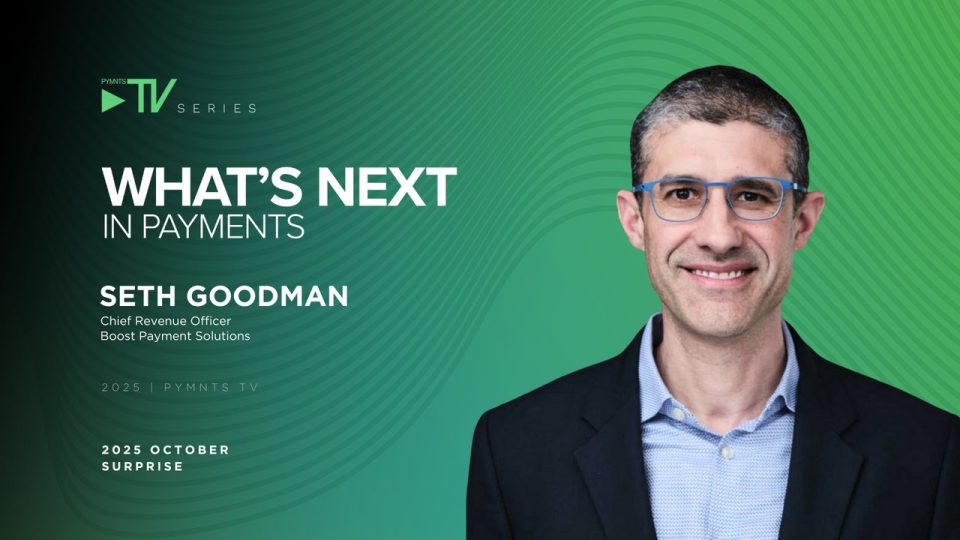
“October often has a way of reshaping the end of the year and maybe even setting the tone for next year,” Boost Payment Solutions Chief Revenue Officer Seth Goodman told PYMNTS during a discussion for the What’s Next in Payments series, “October Surprise.”
In B2B payments, that tone can mean the difference between friction and flow, between transaction systems that merely function and ones that actively accelerate growth. This year, Goodman said he sees the so-called “October surprise” coming less from shiny new technology and more from the shifting ground beneath it, including tariffs, interest rates and a surge in industry consolidation.
In other words, volatility is back, and businesses are demanding infrastructure that evolves with them.
“With so many moving parts toward this end of the year, like CEDP, tariff policy changes in motion, companies need partners who can future-proof their payments,” Goodman said.
“Working capital is still the top priority for CFOs and treasurers,” he added. “Payments are no longer a commodity. They’re truly a strategic advantage when properly optimized.”
Agility as a Business Model
In recent years, the payments industry has grown used to unpredictability. COVID-era digitization, the rise of embedded finance, and the normalization of virtual cards all pushed businesses toward transformation.
Another one of this October’s most tangible shocks, according to Goodman, may come from a less headline-grabbing but deeply consequential policy change. Visa’s Commercial Enhanced Data Program (CEDP) took effect Oct. 17.
The program, designed to bring greater transparency and data integrity to corporate payments, is forcing every player, from issuers to FinTech startups, to adapt quickly.
“It’s a fundamental change to how commercial transactions qualify for interchange,” Goodman said, adding that the ripple effects could surprise people. “It’s going to really reshape B2B pricing across the board.”
See also: Boost CEO Unpacks Visa’s New Interchange Rules for B2B Payments
For Boost, which has already completed its adjustments, Visa’s upgrade is not just a regulatory event but a stress test for agility.
That ethos of agility is more than rhetoric. In the enterprise payments world, speed no longer means seconds; it means adaptability at scale. Goodman shared how one of Boost’s largest enterprise clients discovered an internal compliance gap and needed immediate support.
We’d love to be your preferred source for news.
Please add us to your preferred sources list so our news, data and interviews show up in your feed. Thanks!
“Within 30 days, we executed a full migration of thousands of their customers, start to finish, without disruption,” he said. “That’s the kind of speed and precision that B2B clients are now expecting.”
Liquidity, Automation and Transparency
When it comes to B2B, there are two sides to the transactional bridge. On one side of that bridge are accounts payable (AP) systems run by enterprises and their technology partners like SAP or FIS; on the other side are suppliers and acquirers managing accounts receivable (AR).
“We view ourselves as a bridge between the AP and the AR side,” Goodman said of Boost. “When we’re working with an AP provider such as FIS or SAP Talia, we’re bridging that connectivity over to the suppliers.”
That bridge is more than metaphorical. It’s powered by automation, data and straight-through processing capabilities.
“We have supplier enablement services, so we’re really helping connect the tissue between these large enterprise buyers and suppliers,” Goodman said, adding that Boost also partners directly with acquirers, as it operates on the other side of the bridge, providing payment-as-a-service capabilities to payment processors who need help parsing virtual cards.
“Either way, we serve as the connected tissue between both sides of the ecosystem,” he said. “Sometimes it’s a little bit of a stream, or it could be an ocean between the two, but you still need a bridge to cross it.”
That unique position as a connective tissue is fueling Boost’s own next wave of innovation, a new working capital platform called Boost 100.
“It’s a working capital solution that supports either buyer-funded, supplier-funded or shared-funded models,” Goodman said. “What we’re really seeing is huge interest in the buyer-funded aspect of that program.”
In this model, enterprise buyers use their commercial cards to fund payments directly, absorbing interchange costs in exchange for more flexible liquidity. It reflects the broader trend of redefinition of payments as a tool for balance sheet management, not just transaction processing. In a high-rate environment, working capital is king, and the payments infrastructure that unlocks liquidity may determine the next phase of digital commerce.
“The winners of 2026 will be those delivering liquidity, automation and transparency at scale,” Goodman said.
For all PYMNTS B2B coverage, subscribe to the daily B2B Newsletter.


 Add as Preferred Source