As PYMNTS CEO Karen Webster told a podcast audience for last year’s B2B event, nothing is boring about B2B payments anymore. That’s what makes the application of artificial intelligence across them so exciting.
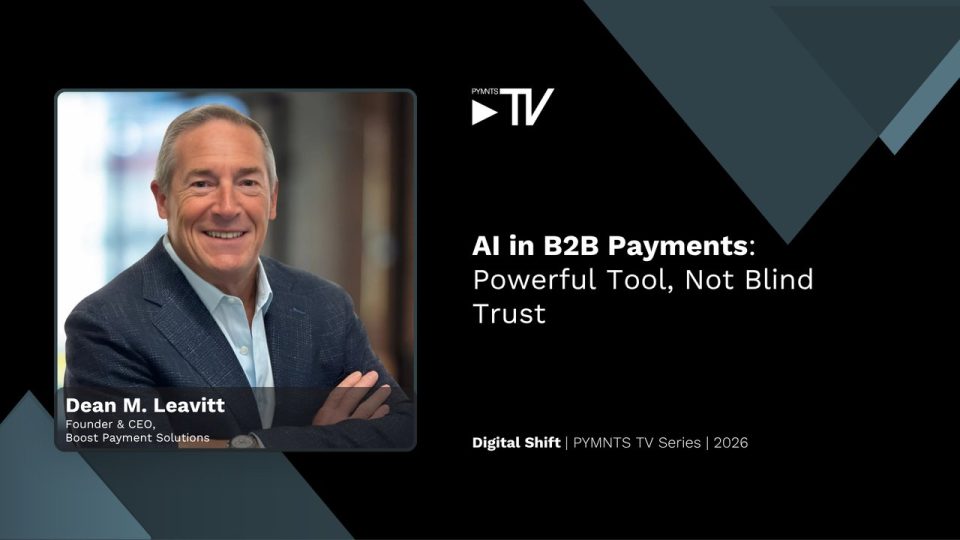
“This is different,” Boost Payment Solutions Founder and CEO Dean M. Leavitt told PYMNTS in a conversation with Webster, distinguishing AI from earlier payments hype cycles. “AI goes beyond payments. It will ultimately be completely embedded in payments, and payments will be embedded in it.”
Enterprise payments are dense packages of money, data and commercial obligations. A single transaction can represent thousands of invoices, each containing line-item details, account identifiers and buyer-supplier terms that must be reconciled precisely. This complexity makes B2B payments unusually well suited to AI, but also unusually unforgiving of its mistakes.
“In B2B and enterprise-level B2B, it’s this combination of two worlds,” Leavitt said. “It’s moving money and moving data.”
The data is often mission-critical because large payments may contain hundreds or thousands of invoices, each with extensive supporting detail, he said.
Everyone Thinks AI Will Change Payments. They’re Looking at the Wrong Layer.
Financial institutions and payments networks have spent decades building reliable infrastructure for moving money. The more persistent B2B friction sits in the surrounding data exchange and operational workflow.
The technology’s significance is that it can change the workflow rather than simply improve one feature within it, Webster said. Enterprise relationships are often governed by bespoke agreements covering payment timing, card acceptance, transaction limits, fees and working capital preferences. Historically, many intermediaries have lacked the ability to encode and enforce those terms dynamically.
AI can help organize that information, convert it into different formats and present it according to each stakeholder’s requirements.
That makes it potentially more transformative in reconciliation, exception handling and process automation than in the underlying movement of money. A faster payment still leaves companies with the burden of matching invoices, applying agreed terms and determining whether the transaction complies with internal policies and external regulations. AI offers a way to compress those steps into a more intelligent execution layer.
For its part, Boost is using AI to expand the number of rules it can support and enforce on behalf of buyers and suppliers. The goal is to automate approvals and adjudicate complex transaction conditions in real time.
“What we’re now able to do is reflect the nature of the commercial relationship in the payment itself,” Leavitt said.
Payments have historically been treated as “a last-minute afterthought” but are becoming a strategic tool for the office of the chief financial officer, he said.
Agents Will Execute B2B Transactions Before They Negotiate Them
That doesn’t mean autonomous agents are ready to replace human relationships. Humans will still be needed to establish relationships, ask questions and determine which rules make commercial sense. AI can then facilitate and enforce the decisions those people make.
We’d love to be your preferred source for news.
Please add us to your preferred sources list so our news, data and interviews show up in your feed. Thanks!
“The role of the agent is less so on the negotiation than it is on the implementation,” Leavitt said, adding that while agents can execute “better, faster, presumably cheaper and more scalable” than humans, the technology remains in its early stages.
Agents are likely to gain authority first in bounded workflows where the rules are explicit and outcomes can be verified. They may approve invoices, route payments, identify exceptions and apply contractual conditions before they independently renegotiate strategic supplier relationships.
That’s why, as AI tools become more widely available, the competitive advantage will come from the data used to train, guide and verify them.
“Those entities that have that data, have the experiential data from years of transactions, years of boarding relationships between buyers and suppliers, they’re ultimately going to be the winners,” Leavitt said.
Coupling proprietary data with AI can create “a superpower,” he said.
AI is often described as a force that removes middlemen. In B2B payments, however, the most valuable intermediaries may survive by turning their accumulated data, domain expertise and buyer-supplier relationships into a smarter operating layer. Generic models can process invoices or generate recommendations. They cannot easily replicate years of experiential data about how buyers and suppliers transact, which rules work, where disputes emerge and how exceptions are resolved.
The constraint is trust.
A commercial payment platform must reconcile every invoice, apply every rule and “tick and tie everything to the penny every single time,” Leavitt said.
That’s why Boost is using multiple agents in some workflows, with one checking the work of another, alongside human review. The approach reflects a broader reality. AI adoption in finance is unlikely to be a clean handoff from people to machines. It will be a layered system of models, controls and human verification.
“Engage it, learn as much as you can about it,” Leavitt said. “Certainly, don’t ignore it, but don’t just blindly trust it.”
Watch PYMNTS CEO Karen Webster’s full conversation with Boost Payment Solutions CEO Dean Leavitt to hear more about:
- Why AI’s biggest B2B payments opportunity isn’t moving money. Leavitt said payment infrastructure is already mature. The real breakthrough is using AI to organize invoice data, enforce buyer-supplier rules and automate the workflows surrounding enterprise transactions.
- How proprietary transaction data is becoming the industry’s most valuable AI asset. Generic models are increasingly commoditized, but years of buyer-supplier relationships, payment history and commercial rules create the data advantage that will separate future winners from followers.
- Why enterprise AI will augment, not replace, finance teams for years to come. AI agents can execute payment rules faster and at greater scale, but CFOs still need human oversight because enterprise payments demand precision, trust and verification rather than blind automation.
For all PYMNTS B2B and AI coverage, subscribe to the daily B2B and AI Newsletters.


 Add as Preferred Source