Bots have become the new majority on the internet, forcing companies to rethink how they tell a trusted customer from an automated threat.
That shift anchors “How Enterprises Can Build a ‘Know Your Agent’ Defense: Digital Identity Verification in the Age of Bots,” a PYMNTS Intelligence report produced with Trulioo. The report finds that companies now face two pressures at once. Malicious bots are attacking at scale, while legitimate AI agents are beginning to shop, book travel, manage subscriptions and make payments for users. The result is a harder verification task and a greater risk of blocking good customers along with bad actors.
We’d love to be your preferred source for news.
Please add us to your preferred sources list so our news, data and interviews show up in your feed. Thanks!
The report draws on a survey of 350 leaders in compliance, risk management, fraud, underwriting, supplier acquisition and merchant monitoring at global companies.
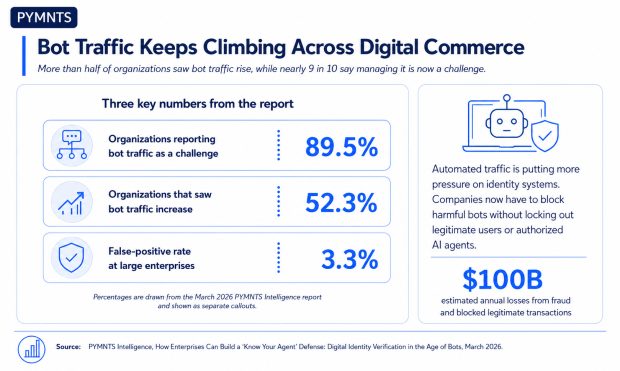
- 5% of organizations say managing bot traffic is a challenge. Most describe it as slight or moderate, but only about 1 in 10 say bot traffic creates no difficulty.
- 3% of firms reported an increase in bot traffic over the prior 12 months. Fewer than 10% said traffic stayed stable, showing how quickly automated activity is reshaping digital commerce.
- 3% was the false-positive rate for digital transactions at large enterprises, compared with 2.7% for firms with $50 million to $250 million in annual revenue. At global scale, that difference can translate into hundreds of thousands of legitimate users being delayed or blocked.
The new risk resembles a busy airport security line. Companies must stop dangerous travelers without holding up everyone else. That requires more than a one-time identity check at account opening. The report says firms need continuous verification across logins, transactions and other digital touchpoints.
The encouraging sign is that companies already understand the problem. More than 9 in 10 large enterprises still express confidence in their ability to distinguish harmful bots from helpful ones, even as their reported losses remain higher than those of smaller firms. The report also points to a practical path forward: strengthen know-your-customer and know-your-business systems, add real-time monitoring and set clear permissions for automated agents.
Other findings show that 57% of companies with at least $1 billion in revenue experienced bot or agent-related incidents or losses, compared with 32% of smaller firms. The report also estimates that fraud and the accidental blocking of legitimate transactions cost businesses nearly $100 billion a year. Better controls could reduce those losses while making digital commerce easier for trusted customers and authorized agents.
For all PYMNTS AI coverage, subscribe to the daily AI Newsletter.


 Add as Preferred Source