Banks are preparing to take more of the decision-making out of customers’ payments, with 35% of financial institutions planning centralized systems to coordinate how money moves.
That finding, cited in the PYMNTS Intelligence report “Why Multi-Rail Strategy Is Banking’s Next Competitive Edge,” points to a practical opportunity for banks. Offering cards, Automated Clearing House transfers, instant payments and wires gives customers choices. Coordinating those options can make them easier to use. The October Real-Time Payments Tracker® examines how payment orchestration, the process of selecting and managing a payment’s route, can help banks control costs and improve service. Think of it as a navigation app that chooses a route based on the destination and conditions. Customers specify what they need, and the bank determines how to deliver it.
- Banks are investing in coordinated payment decisions. According to Alacriti research cited in the report, 35% of financial institutions plan to implement centralized payment hubs within 12 to 18 months. These systems can select a network based on a payment’s amount, urgency and cost while checking available funds and whether the recipient can accept that payment type. That means a bank doesn’t have to treat every transfer alike. It can match the method to the customer’s priorities and reduce manual work.
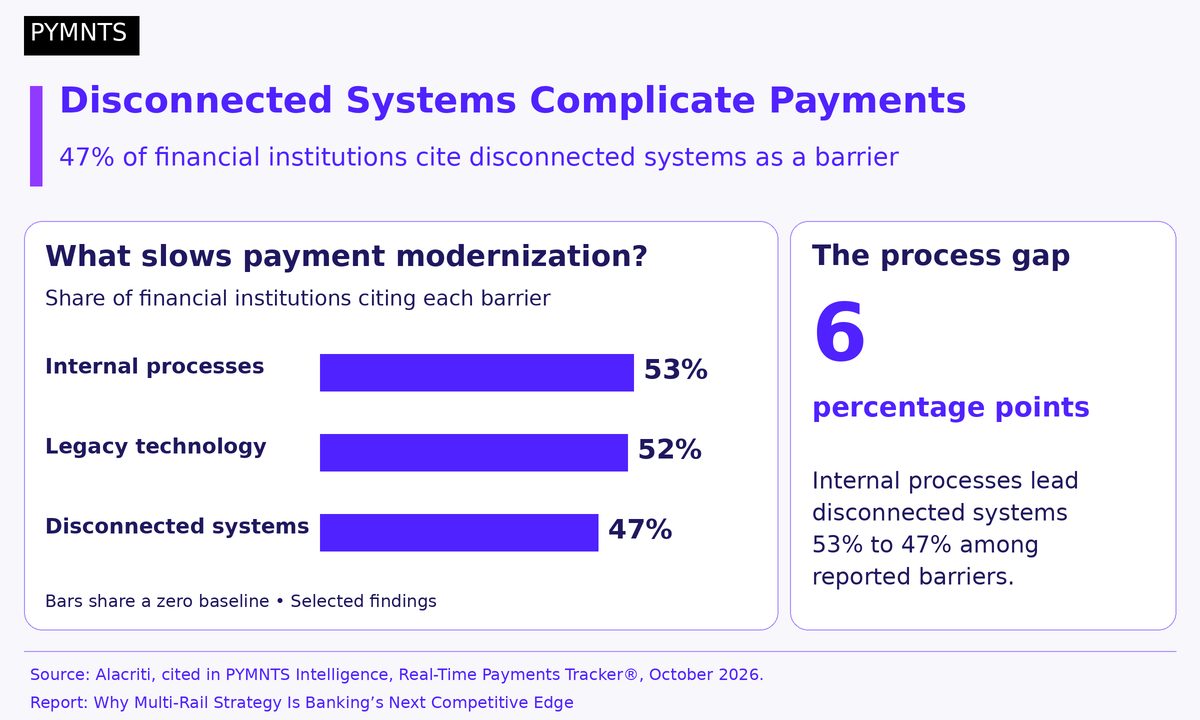
- Existing processes create an opening for improvement. Alacriti found that 53% of financial institutions identify deeply embedded internal processes as a primary barrier to payment modernization. Another 52% cite legacy technology and 47% cite disconnected systems. Adding payment options increases the coordination required because networks operate on different schedules and release funds at different times. Centralized management can help banks handle those differences more consistently, including tracking payments and ensuring money is available when it’s needed.
- Customers already have several ways to move money. Alacriti reports that 92% of financial institutions support ACH and 90% support wires, while nearly 45% support either the RTP® network or FedNow® Service. Those options serve different needs. An urgent payment may justify immediate delivery, while a less pressing transfer may favor a lower-cost method. Orchestration helps banks make those decisions without requiring customers to understand each network’s operating rules.
The report also describes how faster access to money can support broader banking relationships. At Amplify Credit Union, consumer accounts receiving instant payments grew 12% faster than the overall portfolio, according to The Clearing House. Members receiving those payments were also three times more likely to use their debit cards. Those results concern instant payments rather than orchestration itself, but they illustrate the opportunity: Banks that make money easier to receive and use can give customers more reasons to stay engaged.