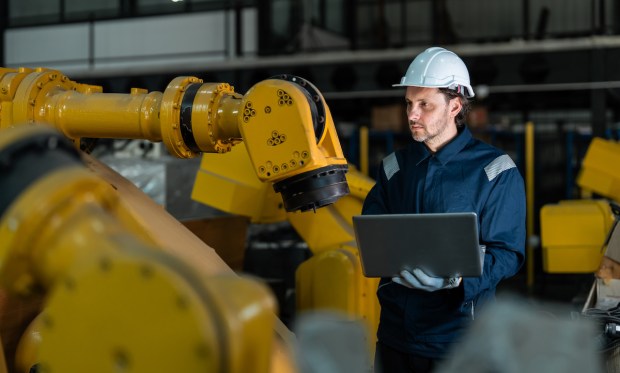
The company said its Series A round, announced Wednesday (Oct. 28), will allow it to build out its facility in Emeryville, California, and to accelerate deployment of artificial intelligence (AI) models into real-world manufacturing, and expand its robotics research, engineering, and factory operations teams.
“We believe the factories that revive America’s manufacturing sector will need to be rethought from the ground up rather than retrofitting one aspect in an existing factory,” Adarsh Kulkarni, founder and CEO of Foundry Robotics, said in a news release. “Our approach is to own the entire final assembly stack and integrate intelligence at every layer—own the buildings that manufacture for our customers while orienting them for robotics deployment. Our mission is to revitalize U.S. manufacturing and create more capacity to build and scale critical product assembly.”
We’d love to be your preferred source for news.
Please add us to your preferred sources list so our news, data and interviews show up in your feed. Thanks!
According to the release, Foundry has expanded its manufacturing footprint twenty-fold to a 130,000-square-foot facility in Emeryville. The company now serves defense and commercial sectors, with an emphasis on “high-value, complex” electro-mechanical products facing production constraints.
“Defense and industrial companies can design new hardware faster than ever, but manufacturing remains a critical bottleneck,” the release added. “Traditional assembly lines are built around a single product, take months to deploy, and are costly to reconfigure. Foundry takes a different approach, leveraging physical AI to build flexible assembly capacity that deploys quickly, adapts to different products, and scales with demand.”
In other robotics news, PYMNTS wrote earlier this week about efforts by insurers to develop a new line of business around the machines that can move, drive and make decisions on their own.
“Some of the new policies pay for the fallout when a robot breaks down, including the cost of a replacement worker or a rental machine,” said that report.
It came after Tokio Marine & Nichido Fire Insurance, the domestic arm of Japan’s largest nonlife insurer, announced plans to roll out AI robot insurance in November for wheeled, four-legged and humanoid robots.
The closest parallel in the U.S. comes from Axis Insurance, which designed a program for companies that make and deploy autonomous robots. As covered here in June, this program covers production losses when a software update or sensor fault takes a robot offline, even in situations with no physical damage.


 Add as Preferred Source