Legacy infrastructure provides more than a channel for institutions handling trillions of dollars each day. In a payments environment increasingly shaped by real-time expectations, digital wallets and artificial intelligence, scale, regulation and reliability — key characteristics of established core payments infrastructure — may be the determinants as to whether new technologies can move from novelty to permanence.
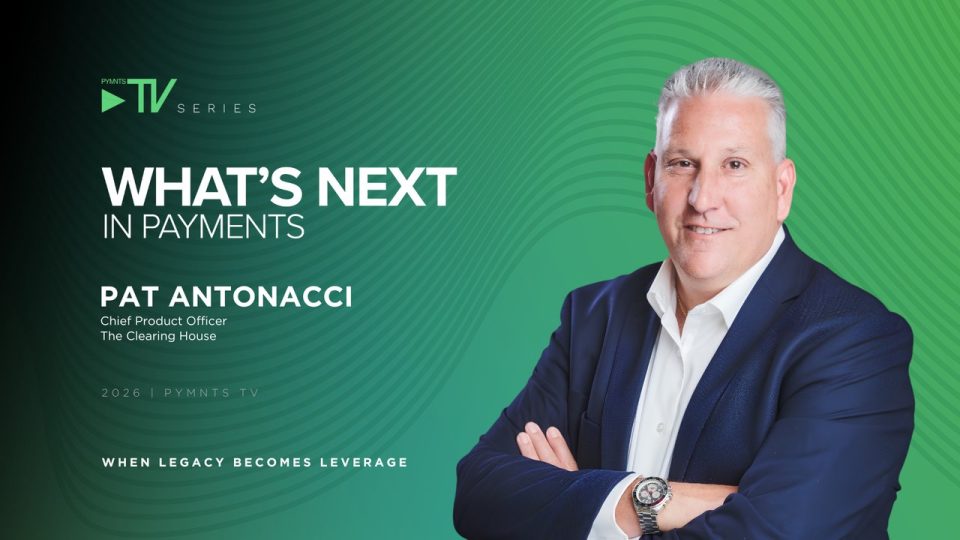
For The Clearing House, modernization in payments increasingly depends on the stability of the systems already underpinning the financial system. Pat Antonacci, the company’s chief product officer, noted that the term “legacy” often obscures the role those systems continue to play in core banking operations.
From Antonacci’s perspective, it’s core infrastructure. “Where you have the advantages there is in trust,” he said during a conversation with PYMNTS as part of the What’s Next in Payments series examining legacy systems in payments.
That trust, he argued, has been cemented by regulation, security and operational continuity. The Clearing House processes more than $2 trillion in transactions daily across its wire network, according to Antonacci, while automated clearing house (ACH) volumes reached roughly $60 trillion last year. Both continue to grow despite the arrival of newer payment methods.
The discussion with PYMNTS came as financial institutions confront rising pressure to support instant money movement while preserving the controls and resiliency expected from heavily regulated payment infrastructure.
Real-time payments, digital disbursements and open banking services increasingly require systems capable of operating continuously rather than within traditional banking hours.
Antonacci said the launch of RTP Network nearly a decade ago reflected that demand. He noted that the introduction of a new payment rail marked the first major addition to the U.S. payments system in roughly 40 years.
“The banks came [to us] and said, ‘this is what you should do,’” he said. “The community came to The Clearing House. At the time the Fed came to The Clearing House, saying ‘we want you to manage this from a real-time perspective.’”
Importantly, Antonacci noted that newer payment rails gaining traction across the past several years have not displaced older infrastructure. Instead, they have added functionality tied to gig economy payouts, instant settlement expectations and digital commerce flows that did not previously exist at scale.
That evolution has also complicated the common assumption that smaller challengers necessarily innovate faster than incumbents.
Scale Is a Challenge
Antonacci acknowledged that newer entrants can move more quickly in narrow areas, particularly when operating outside the regulatory demands managed by banks and clearing networks. Smaller firms can focus on a specific customer pain point or digital experience without maintaining the broader infrastructure obligations that accompany national payment systems.
“The challenge always then becomes scale,” Antonacci told PYMNTS. “Scale is driven by that level of trust, that level of security.”
That issue has become more visible as digital-first payment firms handle larger transaction volumes and confront growing scrutiny around fraud, cybersecurity and operational resilience. Antonacci pointed to tokenization efforts tied to deposit accounts as one example of how incumbents are responding to those concerns.
We’d love to be your preferred source for news.
Please add us to your preferred sources list so our news, data and interviews show up in your feed. Thanks!
The Clearing House has issued more than 40 million demand deposit account (DDA) tokens and processes roughly 80 million tokenized transactions, according to Antonacci. The goal is to reduce the exposure created when consumers share bank account details directly with third parties in digital environments.
Partnerships Lead to Modernization
The conversation also highlighted the degree to which collaboration between incumbents and challengers increasingly defines payments modernization.
Antonacci said partnerships work best when established institutions provide regulatory expertise and resiliency, while newer firms contribute specialized technologies or customer-facing innovations.
“Sometimes new players coming in create a level of competition that creates further innovation,” Antonacci said. “Where I think they work best is [when] you need a level of expertise or a new technology or something that’s different that you may not have in house.”
That dynamic is becoming more important as real-time payments adoption continues to grow. Antonacci said RTP Network volumes recently reached a peak of nearly 2.3 million transactions and $8.6 billion in value during a single day.
He also emphasized that the expansion of real-time payments has coincided with broader participation from banks, corporates and financial institutions seeking faster settlement capabilities without sacrificing reliability. The Clearing House continues extending real-time functionality into areas such as cross-border settlement and expanded operating hours for wire payments.
Artificial intelligence, meanwhile, may strengthen the strategic importance of legacy systems rather than weaken them, Antonacci said.
“The value of AI is using AI on the data that you have,” Antonacci said. “The incumbents or the core … has years and years of history and experience.”
He said AI is increasingly being used for fraud detection, cyber monitoring and operational analysis, particularly as payment systems generate richer datasets through standards such as ISO 20022, which is utilized by the RTP network as well as the CHIPS network, the high-value wire payment system also run by The Clearing House. Newer entrants should view established payment infrastructure not as an obstacle, but as a foundation on which newer services can operate.
“Find opportunities to leverage that, rather than immediately perceive it as competing or filling a gap,” advised Antonacci. “The value of coming together and understanding and partnering will make them, us, the banks, the consumers and the corporates more successful in continuing to modernize the way that we do payments.”

 Add as Preferred Source