In financial services, “legacy” has become one of the industry’s most loaded words. For some executives, it signals stability, regulatory maturity and systems that have processed trillions of dollars without blinking. For others, it represents technical debt, inflexible architecture and institutions optimized for a banking era that no longer exists.
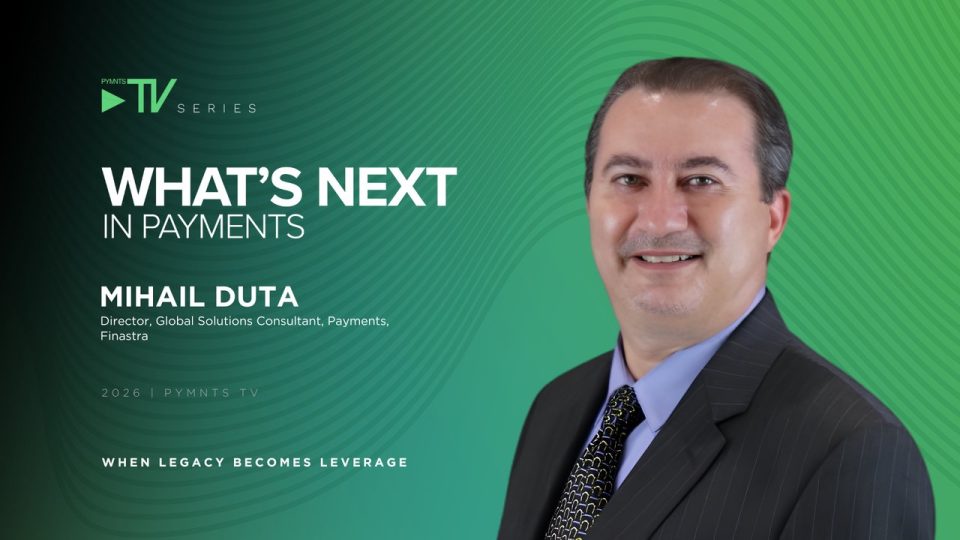
“Legacy solutions continue to do what they were designed to do. But I believe we’re reaching a point where they’re struggling to keep up with the ever-changing trends and other initiatives in payments,” Mihail Duta, director, global solutions consultant, payments, Finastra, told PYMNTS during a discussion for the May edition of the “What’s Next in Payments” series, “When Legacy Becomes Leverage.”
As instant-payment rails proliferate, ISO 20022 modernization accelerates, and artificial intelligence begins reshaping operations, banks and technology providers are confronting a difficult question: Can the institutions that built the payments system evolve fast enough to remain central to it?
“Legacy solutions have done what is needed to reach the minimum necessary to be able to produce ISO-formatted messages,” Duta said. “But it hasn’t been easy.”
More importantly, he argued, the migration was not a one-time compliance event. “The ISO journey just started. It didn’t start and end on July 14.”
That distinction matters because the modernization cycle in payments is accelerating. Systems that were refreshed once every decade are now expected to evolve continuously as new rails, messaging standards, fraud controls and customer expectations emerge in parallel.
Continuous Modernization
Payments modernization is becoming a permanent operating condition rather than a once-a-decade initiative. But the industry’s incumbents still possess advantages that newer entrants often underestimate: experience and sophistication.
Duta noted that many FinTech challengers entered the market through instant payments, particularly via the RTP® Network and the FedNow® Service. Those rails were intentionally designed to be simpler and more streamlined than older systems such as Fedwire or ACH. But simplicity at the edge of the ecosystem does not necessarily prepare companies for the complexity at its core.
“It’s one thing to offer FedNow or RTP capabilities,” Duta said. “It’s a different thing to offer Fedwire or ACH, which are more established, more feature-rich, more complex rails.”
That operational complexity is often invisible to end users but foundational to banks. Older providers possess regulatory knowledge, resilience and expertise that challengers lack. Decades of rule management, exception handling, regulatory compliance and settlement orchestration are embedded inside these systems. Reproducing that expertise is harder than building a modern front-end experience.
We’d love to be your preferred source for news.
Please add us to your preferred sources list so our news, data and interviews show up in your feed. Thanks!
“I think newer entrants are learning that it’s a lot more complicated to put together a Fedwire rail and an ACH rail than it is to put together FedNow or RTP,” Duta said.
Today’s hybrid model also shapes how the industry is approaching AI. Despite the surge of AI enthusiasm across financial services, Duta described banks as cautious adopters, particularly because payments sits inside one of the most heavily regulated operational environments in the economy.
“While legacy products do very well what they were designed to do maybe 10 or 15 years ago, they are not designed with AI in mind,” he said.
Against such an operational backdrop, the winners in payments may not be pure incumbents or pure challengers, but firms that combine regulatory depth with modern, flexible infrastructure.
Rise of Payment Hubs
Duta argued that the most important strategic shift happening underneath that convergence is the rise of payment hubs — platforms capable of orchestrating multiple rails from a single system rather than relying on isolated point solutions.
Modern payment hubs, he said, allow banks to abstract that complexity away from users while intelligently routing payments based on cost, speed or urgency.
“That’s the business model banks are looking for. What flexibility can your system offer me so I can in turn offer it to my customers?” Duta said. “Customers don’t necessarily know behind the scenes if it’s a FedNow transaction or Fedwire or ACH. They know they want the payment to go fast, or cheap, or high priority.”
Payments modernization is no longer about replacing one rail with another. It is about creating architectures capable of absorbing whatever comes next. And what comes next may arrive quickly.
“Today we’re talking about ISO 20022, we’re talking about instant payments,” Duta said. “[One day] we might be talking about stablecoin payments being a required rail that banks should offer.”


 Add as Preferred Source