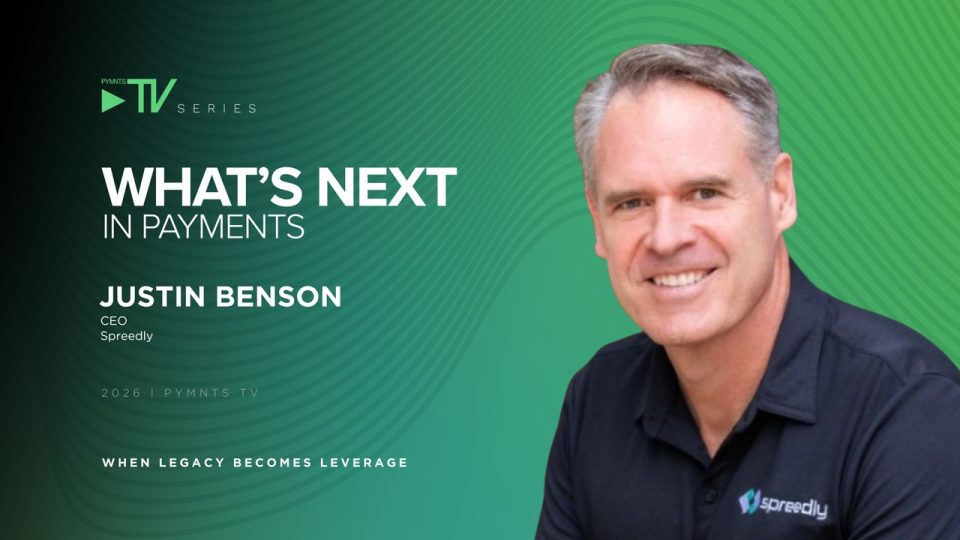
In payments, complexity is often the product itself. The systems moving money across banks, networks, processors and merchants were built over decades, and while newer entrants frequently portray legacy infrastructure as outdated baggage, Spreedly CEO Justin Benson argues the reality is far more nuanced.
Speaking during a PYMNTS “What’s Next in Payments” interview focused on infrastructure, Benson said the industry too often frames legacy technology as something to escape rather than something that helped build modern commerce in the first place.
“I would think about legacy infrastructure nearly always being an advantage,” Benson said.
That perspective cuts against a common FinTech narrative that older payments systems are automatically a drag on innovation. Benson instead argued that many incumbent providers survived precisely because they solved some of the hardest problems in payments.
“When you think about payments, you think about things like security,” Benson said. “You think about things like scale availability. You think about things like data and insights.”
The real tension, he suggested, emerges not from the infrastructure itself but from the business models built around it.
Control Versus Simplicity
Benson described payments as a constant struggle between control and simplicity. Merchants want payment systems that are easy to use, but they also want more authority over how their payment stacks operate.
That tension helped create the market for payments orchestration, where platforms such as Spreedly sit between merchants and multiple payment providers to help route, optimize and manage transactions without forcing companies into a single ecosystem.
“Orchestrators at their core really challenged that assumption that simplicity is a trade-off for control,” Benson told PYMNTS.
He pointed to the rise of companies such as Stripe, Square and Braintree, which initially gained traction by simplifying payments into streamlined, one-stop-shop services. But as merchants scaled globally and became more sophisticated, many wanted greater flexibility over routing, providers and economics.
That shift has created room for orchestration providers that promise merchants both simplicity and optionality. Benson argued that orchestration works with legacy infrastructure rather than replacing it, abstracting away complexity while still allowing merchants to maintain more direct control over their payment operations.
Why Startups Compete Differently
Benson also noted that newer firms often gain advantages because they are not burdened by legacy commercial expectations.
Legacy providers, he said, frequently operate from a defensive posture because they already have established revenue streams, profitability targets and investor expectations to protect.
Startups, by contrast, can price aggressively and simplify offerings because they are not constrained by older operating models.
“There’s a running joke that some of the highest paid engineers work on COBOL systems,” he said. “Those systems are highly resilient, tested and they’re reliable.”
That dynamic, he said, means the so-called “legacy problem” is often less about technology and more about competing priorities inside the executive suite.
We’d love to be your preferred source for news.
Please add us to your preferred sources list so our news, data and interviews show up in your feed. Thanks!
“It might actually be a CRO problem or a CFO problem or a CEO problem,” Benson said.
AI’s Impact on Legacy Infrastructure
Artificial intelligence (AI) could further reshape that debate.
Benson said AI has the potential to reduce one of the biggest historical advantages of newer FinTechs: easier integrations and cleaner developer experiences. AI tools may allow merchants to work around outdated interfaces and documentation that once made older providers difficult to use.
“There could be a renaissance for legacy providers,” Benson said.
At the same time, AI systems depend heavily on large volumes of high-quality data, an area where established payments companies may hold significant advantages because of their scale and transaction histories.
Benson cautioned, however, that AI will not eliminate commercial tensions around ownership, monetization and risk.
He pointed to agentic commerce as an example. Technically, autonomous agents can already operate on top of existing payment rails, he said. The larger questions involve liability, economics and control of transactions.
“The whole question becomes who owns the transaction,” Benson said. “What happens if there’s a chargeback? How am I going to monetize this?”
In the end, Benson argued that incumbents may underestimate how much innovation depends on commercial reinvention rather than pure technological replacement.
“Incumbents perhaps focus a little bit too much on the technology gap and less around the commercial relationship gap,” he said.
For an industry obsessed with replacing legacy systems, Benson’s message was notably different: the infrastructure itself may already be good enough. The real challenge is deciding how to modernize the business models sitting on top of it.
“Legacy infrastructure is very, very valuable,” Benson said, calling it “usually advantageous.”

 Add as Preferred Source