The rise of embedded payments is reshaping how platforms position themselves within commerce, shifting from peripheral service layers to systems that control both the transaction and the surrounding customer experience.
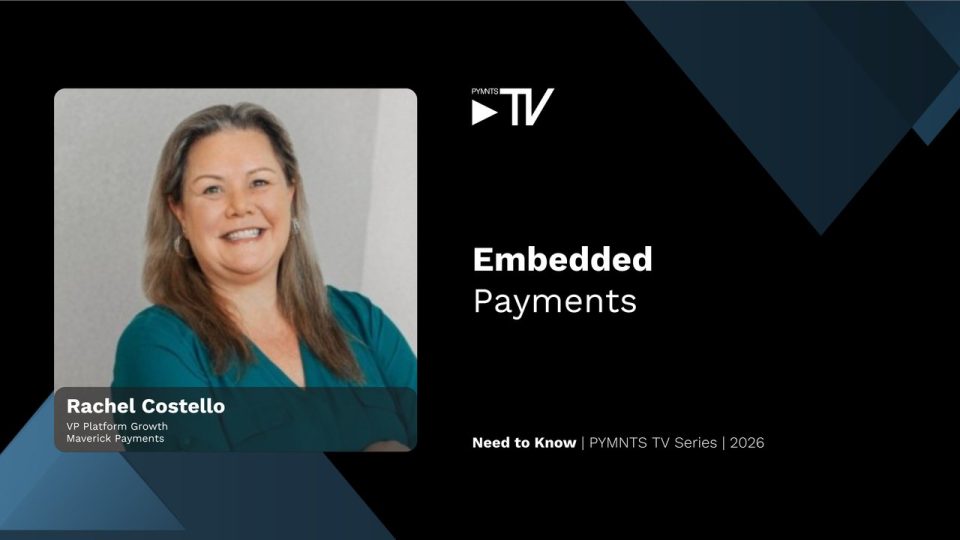
That transition remains uneven, and much of the divergence stems from how payments are integrated. Maverick Payments Vice President of Platform Growth Rachel Costello drew a sharp distinction between superficial integration and true embedding, noting that many platforms continue to rely on approaches that fracture the user journey rather than unify it.
“With bolted on payment solutions, it creates this disconnect in the customer experience,” she told PYMNTS. “Users are forced outside of that software that they’re natively in and they know and they rely on every day. That friction lowers the adoption and it makes payments feel like an add-on rather than part of the core value of the platform.”
The consequences extend beyond experience into the platform’s economic model. Fragmented systems disperse data, complicate reporting and limit control over pricing and performance. As scale increases, those inefficiencies accumulate.
Embedding payments directly into workflows alters both the customer relationship and the revenue structure. Payments tied to invoicing, subscriptions and checkout processes become part of daily operations, increasing switching costs and strengthening retention.
Costello framed that shift in operational terms. “Once it becomes part of that customer’s daily operating workflow, it gets tied into invoicing or subscriptions or checkout,” she said. “The platform becomes much more valuable and also harder to replace, and that drives retention because the switching costs inherently become higher. It also creates lifetime value because now you’re participating in both software revenue and payments revenue instead of one monetization stream.”
Connectivity, Partnerships and the Limits of Bolt-on Models
The path to embedded payments is not uniform. Platforms can build internally, partner with providers or rely on modular extensions, and each approach introduces trade-offs. Bolt-on models may accelerate deployment but often recreate the fragmentation that constrains long-term value.
Connectivity has therefore become central to execution. Unified APIs, which aggregate access to processors, payment methods and banking relationships, reduce engineering complexity and create a foundation for expansion without repeated integration work.
We’d love to be your preferred source for news.
Please add us to your preferred sources list so our news, data and interviews show up in your feed. Thanks!
Even so, technical simplification does not eliminate operational demands. Costello said many platforms underestimate the responsibilities tied to payments, including underwriting, fraud management and regulatory compliance.
“One of the biggest misnomers in embedded payments is you have to become a PayFac,” she said. That endeavor, she stated, introduces a different level of complexity and responsibility. You can find a partner that has the right operating model that absorbs a lot of that complexity for you, while you still maintain that customer trust and branding.”
Measuring Profitability Beyond Payment Volume
As embedded payments mature, performance measurement has become a point of separation between leading platforms and the rest of the field. Costello identified a recurring error in relying on gross payment volume as a proxy for success.
“The biggest mistake that of many platforms is they only look at top line payments volume,” she said. “Volume doesn’t actually tell you the full story about if the portfolio is healthy or if it’s profitable. They really need to be looking at merchant level unit economics.”
That level of scrutiny reveals inefficiencies that can erode margins over time, including legacy pricing models and operational overhead. Platforms that focus on merchant adoption and profitability, rather than scale alone, are better positioned to translate embedded payments into sustained revenue.
From Commodity to Strategic Growth Engine
The strategic divide emerges in how platforms conceptualize payments within their broader business model. For some, payments remain a functional necessity. For others, they represent a central product line that shapes growth, retention and customer experience.
Platforms that align product development, go-to-market execution and payments strategy can use embedded payments to reinforce their value proposition. Those that isolate payments as a back-office function risk constraining both adoption and profitability.
Costello argued that this distinction is decisive. “It happens when a platform stops thinking about it as a commodity,” she said. “Payments touches revenue, it touches retention, customer experience, data, all of that is much too important for a platform than just a nice to have add-on.”


 Add as Preferred Source