The simple, pandemic-fueled behaviors of “order online, pay in store” or “buy online, return in store” are no longer the key features of omnichannel commerce.
Matt Swatzell, head of Solutions, North American Acceptance at Visa, tells PYMNTS that the “anywhere storefront” is rapidly taking hold, fundamentally altering how retailers must engage with their customers.
Speaking to PYMNTS for the Visa Acceptance Solutions “The Rise of the Mobile-First Shopper” series, Swatzell said that traditionally, retailers operated in distinct channels: the familiar brick-and-mortar location, the mobile experience via applications or mobile-friendly websites, and the traditional eCommerce platform accessible on computers.
“Up until recently, those could actually be fairly different and fragmented experiences — because consumers would engage with you on each channel individually,” Swatzell said.
But today, Swatzell said, “when we talk about the anywhere storefront, what we’re seeing is that consumers view all three of those channels and any other engagements you have as one single interface with you as a retailer or as a merchant.”
This unified perspective means that any inconsistency or fragmentation across these touch points can be detrimental, Swatzell warned, resulting in lost sales and a weakening of customer loyalty.
The stakes, therefore, are high: a seamless, integrated approach is no longer a luxury but a fundamental requirement for conversion and sustained customer loyalty.
Mobile’s In-Store Rise and Shopping Fatigue
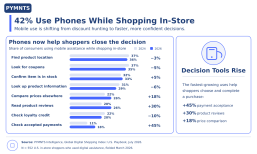
Swatzell pointed to a growing use of mobile phones within the physical brick-and-mortar environment, where joint research from Visa Acceptance Solutions and PYMNTS Intelligence revealed that a significant portion of consumers, at 24% or more, are using their phones in the brick-and-mortar environment.
This omnipresence of mobile devices fundamentally changes the dynamics of the in-store experience. Consumers are not merely looking up product information; they are actively engaging with retailers in new ways at the point of sale, harnessing their devices to enhance their immediate shopping experience.
However, this increased mobile integration also introduces a novel risk for retailers.
Swatzell pointed out that while consumers are physically present in a retailer’s location, their phones allow them to connect with other retailers, transforming a supposedly “captive” audience into one with myriad immediate options.
This new dynamic creates both opportunities for innovative engagement and unprecedented risks of competition within one’s own physical space.
Along the way, we’re seeing customer fatigue as a byproduct of the extensive digital engagement now expected of shoppers, encompassing everything from browsing to planning and paying. Swatzell acknowledged this concern, noting that recent mobile payment growth rates have been relatively stagnant.
To cut through the fatigue, Swatzell explained that a customer who has provided information or engaged with a brand via their mobile app expects that interaction to be recognized and utilized when they visit a physical store or access the desktop website.
A failure to bridge this knowledge gap leads to frustration and a sense of being treated as a new customer each time, regardless of prior engagement.
Key Elements for Success: Payment Methods and Rewards
A few key attributes stand out as paramount drivers of consumer behavior and, critically, sales conversions: flexible payment methods and compelling rewards programs.
A well-executed rewards strategy draws on an understanding of past purchases to incentivize future ones.
Swatzell illustrated a scenario: “I just bought something at the store, so the next time, [the retailer] is going to encourage me to buy the next thing with a discount program, a reward offering a custom coupon … but if you don’t have that end knowledge about the consumer, you’re not able to present those rewards in the same way.”
As for preferred payment methods, the goal is to provide an unobstructed path toward completing the sale, as “every bit of friction you add to a retail transaction will drive down conversions,” Swatzell said.
To mitigate this, retailers must ensure that the checkout experience embeds those preferred payment options, such as buy now, pay later.
The strategic importance of stored payment credentials in converting browsers into buyers — particularly in a world where mobile devices are actively used within physical retail spaces — cannot be overstated.
Swatzell identified three primary advantages to implementing a robust stored credential system.
First and foremost, stored credentials are a powerful tool for removing friction inherent in entering card numbers and other details.
“The second thing you’re doing, especially if you tokenize that credential, is that you’re adding security to the process and sort of reducing some of your compliance burden as a retailer in that process,” Swatzell said.
Finally, tokenized credentials can lead to improved authorization rates on the back end.
As Swatzell told PYMNTS, amid the rise of the anywhere storefront, “having these capabilities and storing that payment credential makes it much more likely that consumers will complete that transaction and leave your location with the item that you wanted to sell them.”