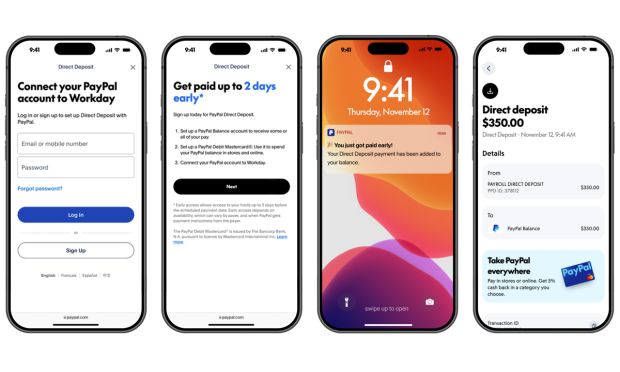
Employees of Workday customers can set up PayPal Direct Deposit through Workday’s Enhanced Direct Deposit program, giving eligible employees in the United States a way to get paid up to two days early, per the release.
“PayPal is helping consumers make the most of their money, and that means getting access to it sooner,” PayPal Vice President of Debit and Money Management Shanthi Sarkar said in the release. “Through our partnership with Workday, pay can land directly in the PayPal Balance account people already trust to shop, spend and send money to family and friends, up to two days early.”
The partnership offers employees benefits beyond early pay, according to the release. They can send money to friends or family via PayPal, move part of their pay into a PayPal savings account, or use the money to shop with PayPal-accepting merchants.
“More employers want to give their people real choice in how they get paid,” Workday Senior Director of Strategic Partnerships Meraj Mohammad said in the release. “Adding PayPal to Enhanced Direct Deposit gives employees on Workday payroll another trusted option, with less friction getting their paycheck where they want it to go.”
The partnership comes as consumers “routinely encounter mismatches between when bills arrive and when wages become available,” PYMNTS reported in July. These workers often continue depending on familiar financial workarounds even when earned wage access is available to them.
The PYMNTS Intelligence report “Wage to Wallet™ Index: How 30 Million Workers Borrow from Tomorrow to Pay for Today” found in March that 54% of Labor Economy workers needed money before payday to cover an essential expense during the 90 days before being surveyed. Meanwhile, 16% found themselves in that situation at least four times during the same period, showing that cash flow gaps are more the rule than the exception.
The research also spotlighted how workers react to these gaps, with 22% saying they relied chiefly on family or friends to help cover an essential expense. Others held off on payments, took extra shifts, sold personal belongings or took a combination of several approaches. And 9% had no practical way to cover the expense.