New data shows that what began as a convenience is becoming an expectation, with consumers not only embracing real-time disbursements but sticking with them long after their first experience. The real story is not just the speed of instant payments, but their permanence.
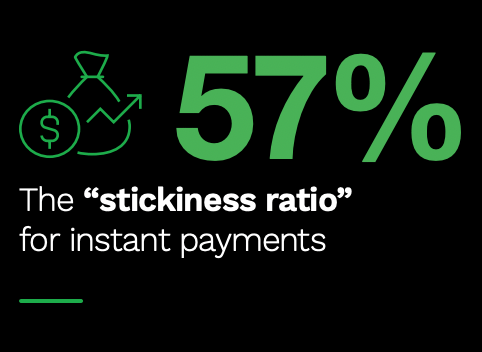 The PYMNTS Intelligence report “Beyond Speed: The Case for Instant Payout Adoption and Stickiness,” an Ingo Payments collaboration, finds that once consumers receive money instantly, they rarely look back. The so-called “stickiness ratio” for instant payouts (the share of consumers who make instant their most-used payout method) now stands at 57%, up from 39% in 2020.
In other words, nearly 6 in 10 recipients who try instant once make it their default.
That stickiness is not accidental. It’s being engineered by a convergence of technology and behavioral economics, like corporate senders offering virtual card accounts, digital wallets and incentives that reward recipients for keeping money in-network.
We’d love to be your preferred source for news.
Please add us to your preferred sources list so our news, data and interviews show up in your feed. Thanks!
Instant isn’t just speeding up payments; it’s creating new ecosystems of loyalty.
Key data points:
- As of May, 41% of U.S. disbursement recipients cite instant payment rails as their most-used method for receiving funds, up from 33% in 2021.
- The stickiest use case for real-time disbursements is transactional payroll recipients, such as gig workers, freelancers and marketplace sellers, as 68% of them become regulars after using instant once.
- Digital wallets outperform all other instant rails, proving 58% more effective than bank accounts in converting one-time users into repeat ones.
The Loyalty Effect
The research introduces the concept of “transactional payroll,” where instant disbursements function as de facto paychecks for gig and contract workers. For the 21% of recipients who rely on disbursements as core income, instant is not just faster; it’s foundational. Among these users, 73% received at least one instant payout in the last year, and 68% named instant as their top method.
The appeal crosses generations. While 78% of Generation Z consumers have used instant payouts in the past year, bridge millennials (ages 37 to 47) show the highest conversion rate, with 60% becoming regular instant users. Even among baby boomers, nearly half have made the switch. That broad adoption underscores a behavioral tipping point. Instant has become the norm, not the innovation.
The data also highlights how different rails serve different loyalties. Digital wallets dominate for income and borrowing disbursements, while push-to-debit leads for investment and gaming payouts, with retention rates of 77% and 69%, respectively. Although push-to-credit trails overall, it performs best in insurance and rebate scenarios.
That diversification suggests the next wave of competition will not be over whether companies offer instant payments, but which instant rails they offer, and how effectively they build habits around them.



 Add as Preferred Source