Small businesses are not abandoning banks for cross-border payments, but they are giving FinTechs a much larger share of the work.
That shift stands out in “The Cross-Border Opportunity,” a PYMNTS Intelligence and Mastercard report based on a survey of 310 U.S. small and medium-sized businesses that bought production inputs from international suppliers in 2025. The report finds that traditional banks remain the most widely used providers, while FinTechs are gaining users faster and earning stronger performance ratings. For providers, the takeaway is encouraging: SMBs appear willing to expand relationships with companies that make international payments faster, easier to track and simpler to manage.
We’d love to be your preferred source for news.
Please add us to your preferred sources list so our news, data and interviews show up in your feed. Thanks!
Key Points:
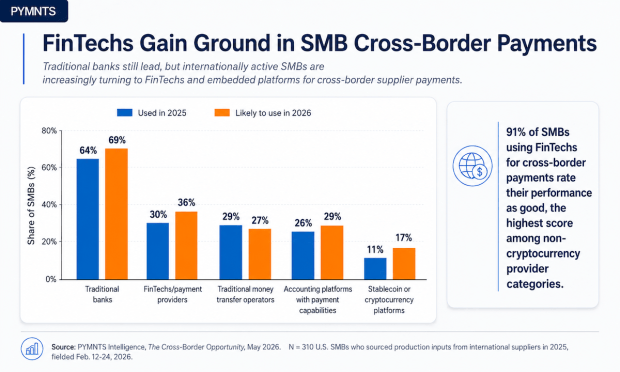
- 36% of internationally active U.S. SMBs expect to use FinTechs or payment providers for cross-border purchases in 2026, up from 30% in 2025.
- 91% of SMBs using FinTechs for international payments rate their performance as good, the highest result among provider categories outside cryptocurrency-focused platforms.
- 29% expect to use accounting platforms with payment capabilities in 2026, up from 26% in 2025.
Banks still hold the largest position. Sixty-four percent of internationally active SMBs used traditional banks for cross-border supplier payments in 2025, and 69% expect to use them in 2026. That projected increase shows that FinTech growth does not require a wholesale migration away from established institutions. Many businesses can maintain a bank relationship while adding a specialist provider for particular currencies, suppliers or workflows.
FinTechs have gained ground by packaging several functions into a single digital experience. The report points to fast payments, foreign exchange tools and multicurrency accounts as features that can make overseas transactions easier to complete. The arrangement works a little like a modern storefront built over an established highway: the FinTech controls the customer experience, while card networks or other financial infrastructure may carry the payment underneath.
The findings also create an opening for banks and networks rather than a simple threat. Financial institutions can improve digital interfaces, strengthen currency coverage and embed payments into accounting systems. They can also partner with FinTechs that already have strong SMB engagement.
Other findings show why competition is likely to continue. Specialized money transfer operators are the only provider category expected to lose usage, falling to 27% from 29%, while stablecoin and cryptocurrency platforms are projected to rise to 17% from 11%. The market remains broad, but performance is becoming a stronger driver of choice. Providers that reduce friction can grow alongside the expanding cross-border ambitions of small businesses.
See More In:
B2B, B2B Payments, cross-border payments, data brief, FinTech, Mastercard, News, PYMNTS Intelligence, PYMNTS News, PYMNTS Study, SMBs


 Add as Preferred Source