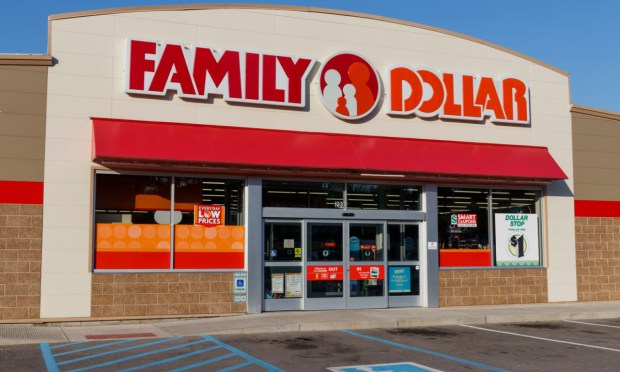
Dollar Tree CEO Rick Dreiling made that announcement Wednesday (Nov. 29) after the company’s third-quarter earnings showed Family Dollar falling short of its expectations.
“Similar to what other retailers have reported, we experienced softening trends throughout the quarter, particularly in October, as lower-income consumers responded to the accumulated impact of inflation and reduced government benefits, we saw a notable pullback in spending, particularly in higher margin discretionary categories.”
With this in mind, Dreiling said the company is undertaking a review of its Family Dollar stores to address underperforming locations.
“This will involve, among other things, identifying stores as candidates for closure, re-bannering or relocation with the goal of assuring that each asset under the Family Dollar banner is delivering its full value for our shareholders on a sustainable basis,” he said.
We’d love to be your preferred source for news.
Please add us to your preferred sources list so our news, data and interviews show up in your feed. Thanks!
Meanwhile, the company continues to see much of its growth coming from higher-income shoppers, said Chief Financial Officer Jeff Davis, who noted the company is attracting 4.3 million new customers per year.
“A lot of those customers are in that income demographic of $125,000 or greater and we’re capturing that passing,” he said.
In June, PYMNTS examined dollar stores’ new attraction among more affluent consumers, noting that there is no longer a stigma attached to patronizing dollar stores.
This was evident as research PYMNTS at the time showed that 16% of individuals with higher incomes were experiencing difficulties in paying their bills. Another 34% were living paycheck to paycheck but had no problems in meeting their monthly financial obligations.
As for lower-income consumers, grocery shopping remains a challenge, with PYMNTS Intelligence data showing that 40% of these consumers have used split-pay plans in the last 12 months to fund everyday necessities like food or gasoline.
Lower-income consumers — those who make less than $50,000 per year — share some characteristics that substantially affect their spending capacity and credit decisions, according to a PYMNTS Intelligence study done in partnership with Sezzle.
“For instance, lower-income consumers have, on average, $78,000 in outstanding debt, and only 24% of these consumers are not living paycheck to paycheck,” PYMNTS wrote last week. “Thus, lower-income consumers tend to rely on credit cards and other payment methods to cover their daily expenses.”


 Add as Preferred Source