The PYMNTS Intelligence report “Payment Hubs Fuel Digital Modernization for Banks,” a collaboration with FIS, explores how payment hubs are becoming essential for traditional financial institutions grappling with the high bar set by FinTechs and digital-first challengers. For today’s banking customers, speedy, secure and frictionless payment experiences are no longer optional; they’re fundamental to their choice of bank.
However, traditional banks often struggle with a complex web of siloed legacy systems that handle various payment rails, such as real-time networks, ACH, wire transfers and debit. Payment hubs offer a solution by acting as unified platforms that consolidate all payment processing, providing a fast, consistent and straightforward experience for customers regardless of the underlying payment rail.
The report highlights that 60% of banks have implemented payment hubs or are in the process of doing so. These hubs offer advantages not only for customers but also for the banks themselves. By replacing fragmented payment workflows with a single, intelligent command center, these hubs optimize operational efficiency, reduce manual intervention and errors, and lower maintenance costs associated with disparate systems.
The shift enables banks to enhance transparency, improve compliance, and free up resources for innovation and customer service, rather than being bogged down by complex infrastructure.
Key findings from the report underscore the urgency and impact of this modernization:
- Fifty-seven percent of organizations report encountering friction in payment processing at least once a week, underscoring a widespread challenge that goes beyond inconvenience.
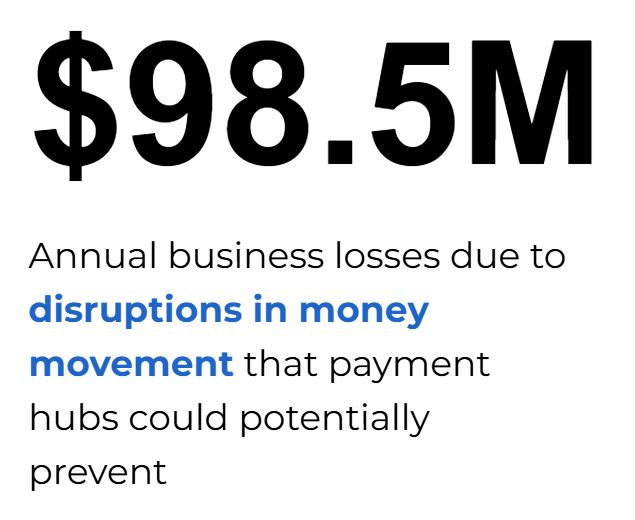
- Businesses face annual losses averaging $98.5 million due to disruptions and inefficiencies in money movement, with 88% of surveyed executives pointing to cyberthreats and 79% blaming fraud as primary financial concerns that payment hubs could mitigate.
- Sixty percent of banks have either already implemented payment hubs or are in the process of doing so, indicating an industry trend toward embracing this consolidated payment infrastructure.
Beyond these core findings, the report also details how modern payment hubs, built on modular platforms with open APIs, offer banks strategic flexibility. This architecture allows financial institutions to quickly adapt to market changes, scale their payment capabilities efficiently on a pay-as-you-grow model, and launch new services like request-to-pay and cross-border payments faster than ever.
Leading hubs include built-in functionalities such as real-time fraud detection and compliance tools, including know your customer (KYC) and anti-money laundering (AML) checks, thereby enhancing security and minimizing manual intervention for safer transactions. They can also optimize costs through smart routing, directing urgent payroll via real-time rails while routing routine vendor payments through lower-cost ACH options.
For all PYMNTS digital transformation coverage, subscribe to the daily Digital Transformation Newsletter.