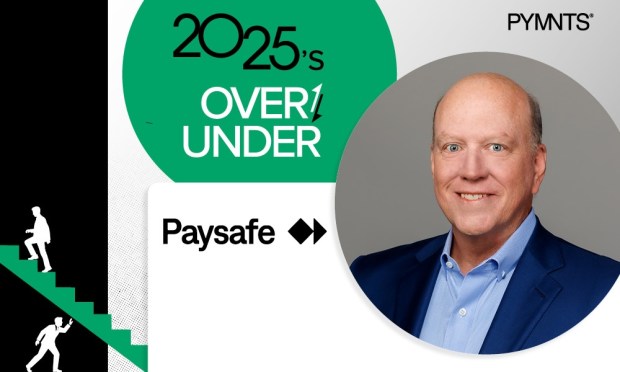
Adaptability is a key competitive advantage in the evolving payments industry, Paysafe CEO Bruce Lowthers writes in a new PYMNTS eBook, “2025’s Over/Under: The Bets That Paid Off.”
Looking back at the predictions made in 2020 by major industry players like McKinsey, Deloitte, Visa and Mastercard, most were remarkably accurate, though the timeline was compressed by the pandemic.
We’d love to be your preferred source for news.
Please add us to your preferred sources list so our news, data and interviews show up in your feed. Thanks!
In a remarkably short time, the way people pay — and expect to pay — changed for good. Digital and contactless experiences became the norm. Speed and convenience stopped being “nice to have” and became basic expectations. Behind the scenes, companies, banks and governments had to modernize systems that were never designed for this level of scale, speed or resilience.
Over: What We Saw Coming and Prepared For
- Explosion of digital wallets and mobile payments: This was spot-on. Global digital wallet transaction value hit $10 trillion in 2024, up from $3.9 trillion in 2020. Mobile payments soared, driven by Apple Pay’s dominance and Gen Z adoption. Smartphone penetration was a game-changer as consumers increasingly use their phones as their primary payment tool.
- Fraud prevention and security: AI-driven tools like tokenization and MFA adoption delivered measurable impact, reducing eCommerce fraud by up to 30%. Real-time detection now processes over a billion transactions daily.
- Embedded finance and open banking: Embedded payments hit $6.5 trillion in volume by 2025, and open banking adoption grew steadily, though U.S. progress was slower due to regulatory fragmentation.
- Contactless and cash usage: Cash usage fell sharply in mature markets, but cash remains surprisingly resilient globally. The coexistence of cash and digital reflects diverse consumer needs.
- Merchants’ evolving needs: Once expected to navigate increasingly complex financial reporting, small and medium-sized businesses (SMBs) today increasingly expect to manage their finances as seamlessly as consumers do. There is a demand for immediate access to funds and a consolidated view of performance.
Under: The Unexpected Turns
- Wallet-free retail didn’t materialize as imagined: Grab-and-go store concepts struggled and many closed, proving that frictionless doesn’t always equal recurrent business, and perhaps consumers appreciate some interaction.
- Rise of real-time payments: the prediction of their high availability was correct, with UPI in India and Pix in Brazil leading the charge. However, in the U.S., this didn’t scale as expected, lagging behind other markets. Bank transfers and alternative payment methods remain critical, but instant payments haven’t reached the ubiquity seen elsewhere.
- Surge of AI, followed by its role as an advisor: Not only was the surge of AI quick with ChatGPT’s first adoption spike in November 2022, but its record usage brought a shift in consumer behavior — people increasingly turn to AI for general advice instead of search engines, signaling a new era of trust in machine-driven insights.
Lessons for 2026 and Beyond
The past five years reinforced that adaptability is the ultimate competitive advantage. Predictions were largely held, but the location, pace and shape of changes were unpredictable. Early signals like smartphone ubiquity and AI’s rise mattered more than anyone realized. For the next chapter, we expect continued convergence of payments and data, deeper personalization, and a sharper focus on resilience. The over/under lens reminds us that while foresight is valuable, flexibility defines success.



 Add as Preferred Source