The opportunity for progress in B2B payments has never been hard to spot. Trillions of dollars still move through processes built on paper checks, manual reconciliation and disconnected workflows that digital tools never fully replaced. Change has arrived, but slowly, and usually at the margins.
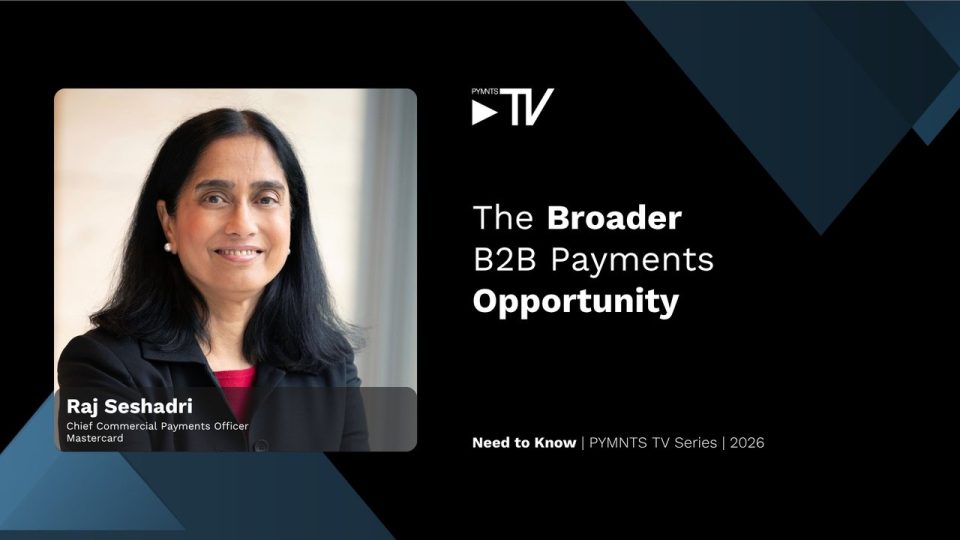
PYMNTS CEO Karen Webster summed up that inertia at the start of a dynamic conversation with Raj Seshadri, who leads commercial and new payment flows at Mastercard, recalling that analyzing the space a decade ago “was a little bit like watching paint dry because there wasn’t a lot of innovation.”
Seshadri didn’t disagree. Instead, she focused on what’s different now and why this moment feels more consequential than previous attempts to modernize the space.
What has changed, she said, isn’t just technology. It’s pressure. A tighter macro environment has made inefficiency harder to tolerate. Float is no longer a nice to have. It’s a drag on working capital. Slow settlement and fragmented cash visibility are no longer manageable inconveniences. They are operational risks.
As Seshadri put it, companies are now under pressure to “really optimize cash flow, working capital expenses and the capacity to invest.” We’re seeing an inflection point, and payments happen to be right at the center of it all. They touch procurement, payables and receivables, yet often sit across systems that do not communicate well with each other.
CFOs who once treated payments as a back-office function are now taking a hard look at their payments infrastructure and the way it directly impacts liquidity and investment capacity.
Fraud Is Not Just a Tech Problem
At the same time, fraud has become more persistent and more complex. Treating it as a technology issue misses the bigger picture, said Seshadri. The tools matter, but the underlying challenge is trust between counterparties.
“Fraud is not a technology problem. It is truly a business problem,” Seshadri said.
Smaller businesses carry much of that risk. They are often the most exposed points in a buyer/supplier network, and their vulnerabilities ripple outward. Weakness in one part of the network creates exposure across the system. Protecting those endpoints is not just about protecting individual firms. It’s about maintaining the integrity of the broader ecosystem.
Rail Convergence Over Rail Replacement
The long-running debate over which payment rail would win has largely faded. In its place is a more practical view. Different rails serve different purposes, and the real value comes from making them work together.
“It’s not rail replacement,” Seshadri said. “It’s actually about rail convergence and integration.”
Real-time payments, account-to-account transfers and cards each solve different problems. Cards, for instance, continue to play a meaningful role where data, controls and embedded benefits matter alongside the movement of funds. The challenge now is connecting these rails into unified workflows so that payments, data and controls operate together rather than in parallel silos.
Rising Expectations Inside the Enterprise
There is also a shift happening inside organizations. Employees entering the workforce expect business tools to feel like the consumer apps they use every day. Fragmented workflows and manual reconciliation are harder to justify.
We’d love to be your preferred source for news.
Please add us to your preferred sources list so our news, data and interviews show up in your feed. Thanks!
At the same time, finance leaders are more aware of the case for modernization than ever before as the connection between payment processes and working capital outcomes becomes undeniable.
The next phase of change will likely involve artificial intelligence agents helping manage payment workflows. They will initiate transactions, route them and reconcile them with limited human input. Just last month, Mastercard brought this concept to life with a timely innovation particularly aimed at small businesses.
That innovation is the Virtual C-Suite, an AI-powered tool designed to give small businesses access to high-level strategic guidance across key operational areas including finance, marketing and security. The system uses specialized agents that function like digital executives, but the business owner retains full decision-making authority, with the AI serving in an advisory rather than autonomous role.
Stablecoins Are Early but Real
Stablecoins are gaining attention in B2B payments, particularly in cross-border scenarios and in markets where currency volatility creates demand for dollar-denominated settlement. At the same time, interoperability, compliance and integration with existing banking systems and counterparty trust all need to mature. The potential is clear, but the infrastructure is still developing.
“It’s quite exciting to see [stablecoins] growing,” she said. “At Mastercard, we do everything from on-ramps and off-ramps to enabling customers to buy and use stablecoin. We have about 130 co-brand programs across the globe — including in the small business space.”
Despite all the progress, one challenge remains consistent. Suppliers are still slow to adopt new payment methods. Buyers often see the benefits quickly. Suppliers take a more measured view, weighing costs, onboarding requirements and integration complexity.
“Supplier acceptance has been a constraint, and is a constraint,” Seshadri told Webster.
Adoption improves when the value is shared. Faster payments, better reconciliation and reduced fraud risk should benefit suppliers as much as buyers.
Trust Will Decide What Happens Next
The technology available to B2B payments today is far more advanced than it was even a few years ago. Connecting rails, embedding controls, automating workflows and using data intelligently are all within reach.
But capability alone doesn’t drive change, Seshadri noted. Businesses need confidence in the systems they rely on before they change how they operate. “You want adoption, but without trust, you won’t have it,” Seshadri said. “Trust is critically important.”
Seshadri said that the industry has largely answered the technology question. The next phase will be defined by whether it can solve for trust, and how quickly businesses are willing to move once they do. This is a key priority for Mastercard, which has been trusted by businesses for decades to protect transactions and operate reliably — a role they plan to maintain amidst major changes in the industry.


 Add as Preferred Source