The biggest obstacle to real-time B2B payments may be that the old system is not broken enough.
That was one of the more practical takeaways from the PYMNTS Intelligence report “Ready and Willing: B2B Payments Are Headed for Real-Time Rails. Here’s How They’re Getting There,” a collaboration with The Clearing House.
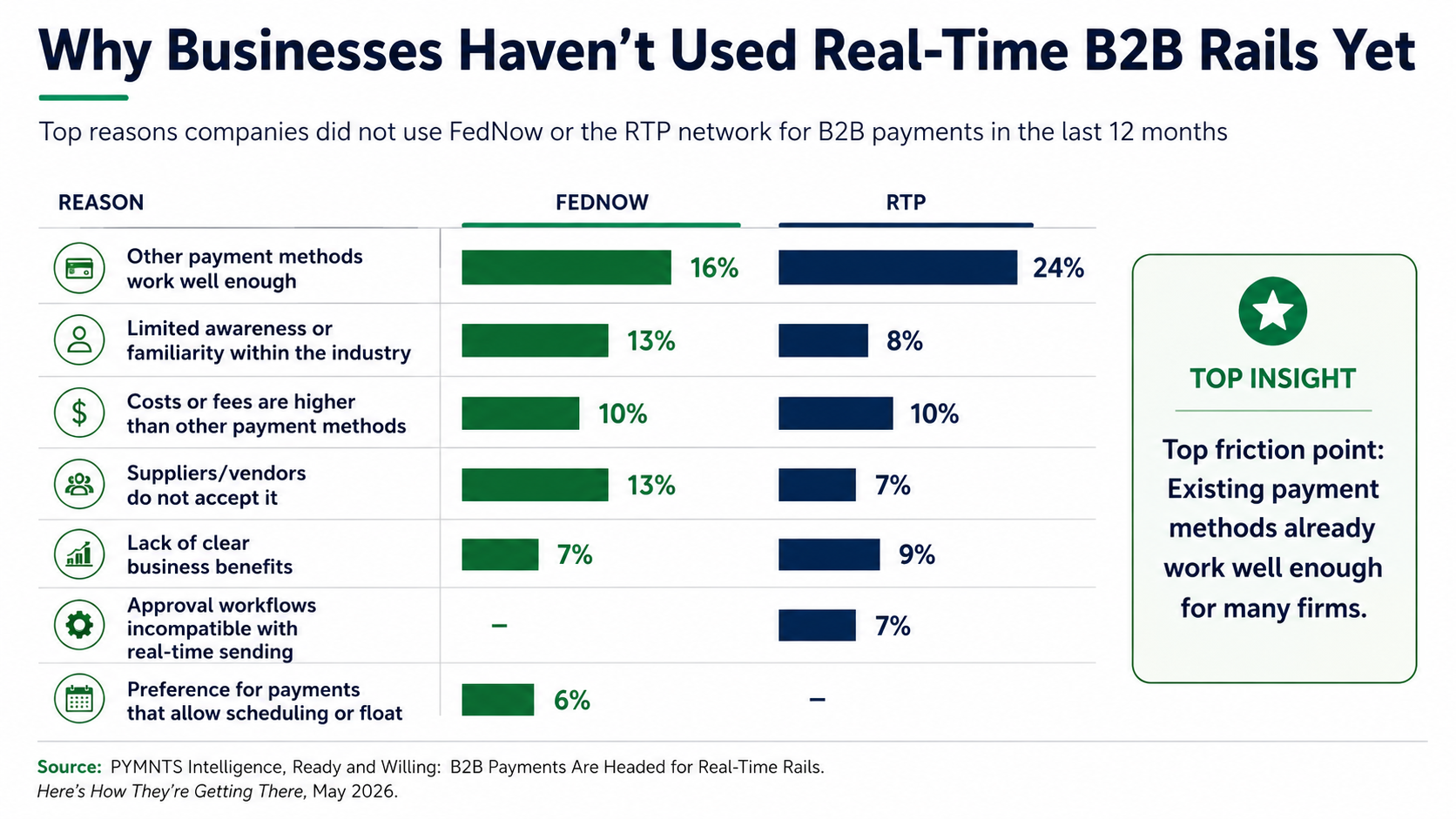 The report found that real-time payments outperform non-instant methods across every major business outcome measured, from supplier access to funds to reconciliation and cash flow management. Yet adoption remains early. Credit cards, ACH, checks and wires still account for most B2B payment activity because they are familiar, embedded and usually good enough.
That does not mean real-time B2B payments lack momentum. It means the industry is moving through the plumbing phase. The pipes work, but many companies still need to connect them to the accounting, treasury and approval systems they already use every day.
Today’s payment status quo works well for most businesses, which limits the urgency to change. The report revealed that 94% of businesses paid suppliers on time, and 86% said their accounts payable processes are efficient.
For many finance teams, that makes real-time payments feel less like a rescue tool and more like a performance upgrade.
We’d love to be your preferred source for news.
Please add us to your preferred sources list so our news, data and interviews show up in your feed. Thanks!
The report suggested that the upgrade is becoming harder to ignore.
- Of RTP® network nonusers, 24% said other payment methods work well enough. That was the most common reason firms gave for not using RTP rails for B2B payments in the past 12 months. Of FedNow® Service nonusers, 16% gave the same reason.
- The share of businesses that said better ERP, accounting or treasury integration would most improve B2B payment performance was 22%. Among companies with at least $25 million in annual revenue, that share rose to 29%, showing how large firms may see the biggest gains from connecting real-time rails to core financial systems.
- Within two years, 53% of businesses said they plan to adopt the RTP network. Nearly 30% were targeting adoption within six months, signaling that the current comfort with older methods may not last.
The optimistic angle is that the remaining friction appears solvable. Firms are not rejecting real-time payments outright. They are asking for clearer integration, broader supplier acceptance and stronger workflow fit. That is a different kind of hurdle. It is less like convincing someone to buy a new car and more like making sure the road, garage and navigation system are ready.
The report also found that experience changes perception. Businesses that have used RTP or FedNow give them ROI scores up to 21 points higher than nonusers do.
The gap suggests companies may underestimate the benefits before they see them inside their own operations.
Other findings pointed in the same direction. According to the report, 79% of businesses said instant payments improve cash flow management, 78% said they strengthen supplier relationships, and 76% said they improve reconciliation.
For banks, FinTechs and payment providers, the message is that speed alone will not drive the next wave of B2B payment adoption. The winners will make real-time payments feel less like a new rail and more like a natural extension of the finance office.
That is where the growth story sits. Real-time B2B payments do not need to replace working systems overnight. They need to make working systems work better.
At PYMNTS Intelligence, we work with businesses to uncover insights that fuel intelligent, data-driven discussions on changing customer expectations, a more connected economy and the strategic shifts necessary to achieve outcomes. With rigorous research methodologies and unwavering commitment to objective quality, we offer trusted data to grow your business. As our partner, you’ll have access to our diverse team of PhDs, researchers, data analysts, number crunchers, subject matter veterans and editorial experts.



 Add as Preferred Source