Highlights
A Texas family paid about $200,000 for a home a robot printed, roughly a third less than the conventional build they were quoted.
Homebuilding output has barely moved in 30 years, and labor shortages alone cost builders $11 billion a year and add two months to every build.
Reframe raised $40 million for robotic microfactories that can turn out up to 250 single-family homes a year.
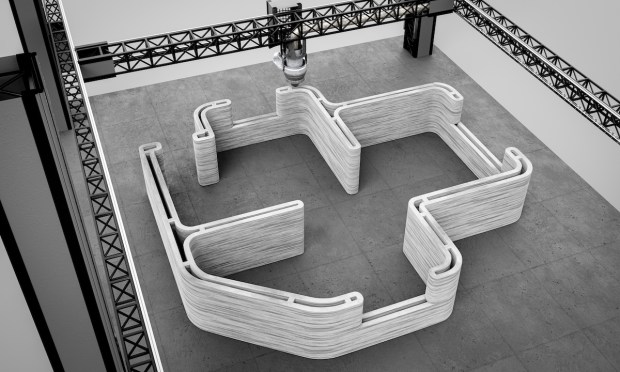
Building a house has gotten expensive enough that a family in Collin County, Texas, found even a smaller conventional home would run more than $300,000. The U.S. is short about 1.2 million homes, the National Association of Home Builders (NAHB) estimates, and builders can’t find the workers to close the gap. So, in 2023, the family let a robotic concrete printer build their 1,700-square-foot, 3-bedroom house instead, for about $200,000, Erica Briones told the Dallas Morning News at the time. She said her family compared prices and found “a conventional house is way more expensive than doing it this way.”
The savings came from replacing a framing crew with a machine that three people can operate, Dallas Innovates reported.
Labor Math Robots Are Trying to Beat
Homebuilding has a productivity problem that more workers and new policies haven’t solved. Residential construction productivity has risen about 16% since 1993 against gains above 50% for the broader economy, NAHB chief economist Robert Dietz told CNBC. Nearly 300,000 construction jobs sat open in December, NAHB said in its 2026 outlook.
That gap has a price. Labor shortages alone cost builders about $11 billion a year and add roughly two months to the average build, Dietz said.
Phil Crone, then-executive director of the Dallas Builders Association, told the Dallas Morning News in 2023 that he robotic construction to take a larger share of the market over the next 15 to 20 years. “There’s every market incentive in the world for the built environment to find less labor-intensive options,” he said.
We’d love to be your preferred source for news.
Please add us to your preferred sources list so our news, data and interviews show up in your feed. Thanks!
On-Site Robots Take One Task at a Time
The first place that incentive is paying off is the jobsite floor. Dusty Robotics’ FieldPrinter prints digital plans directly onto slabs so framers, electricians and plumbers work from one layout, and the company says one operator can cover 10,000 to 15,000 square feet a day, according to CNBC. Founder Tessa Lau framed the problem as standardization rather than labor replacement.
Aaron Love of Oh Snap Layout pairs that layout with precut lumber and prefab wall panels in Southern California. The combination cut the shell construction timeline to about 11 to 12 days from roughly 21, he said. Whether that saves money across the whole build is still open. “We’re in that prove-it phase,” Love said.
The Briones home shows why. Printing covers the walls and walls are the cheapest part of a house. Foundation, roof, windows, finishes and plumbing make up nearly 80% of construction cost, the Texas Real Estate Research Center at Texas A&M noted. University of Michigan professor Vineet Kamat told CNBC the real test is whether robots work reliably across the variation in materials, subcontractors and site conditions that defines residential work while still paying off for the builder.
Capital Bets on Repeatable Work
Investment is showing the trend. Funders are putting the biggest checks into factories rather than jobsites. Reframe Systems raised $40 million to expand a network of robotic microfactories that frame and assemble walls, then ship components for on-site assembly, the company said last month. Its Billerica, Massachusetts, plant opens Oct. 5 and is designed to produce up to 250 single-family homes a year.
Physical AI startups overall had raised more than $37 billion globally by May, Crunchbase News found, beating the full-year record of $21 billion.
For all PYMNTS digital transformation coverage, subscribe to the daily Digital Transformation Newsletter.


 Add as Preferred Source