It’s quite a time to launch a new medical school. First there are the standard issues of funding and partnerships. Second there’s the wild card of artificial intelligence that makes anything in healthcare rife with opportunities and challenges for clinicians, patients, students and instructors.
Rutgers University says it’s up to that challenge. It announced Sept. 15 that it and RWJBarnabas Health are launching an innovation hub powered by Amazon Web Services as Rutgers prepares to combine Robert Wood Johnson Medical School and New Jersey Medical School. The partnership will support AI development for what Rutgers says will become one of the country’s largest public medical schools. Pending accreditation in 2027, the unified school expects to enroll its first class in 2028.
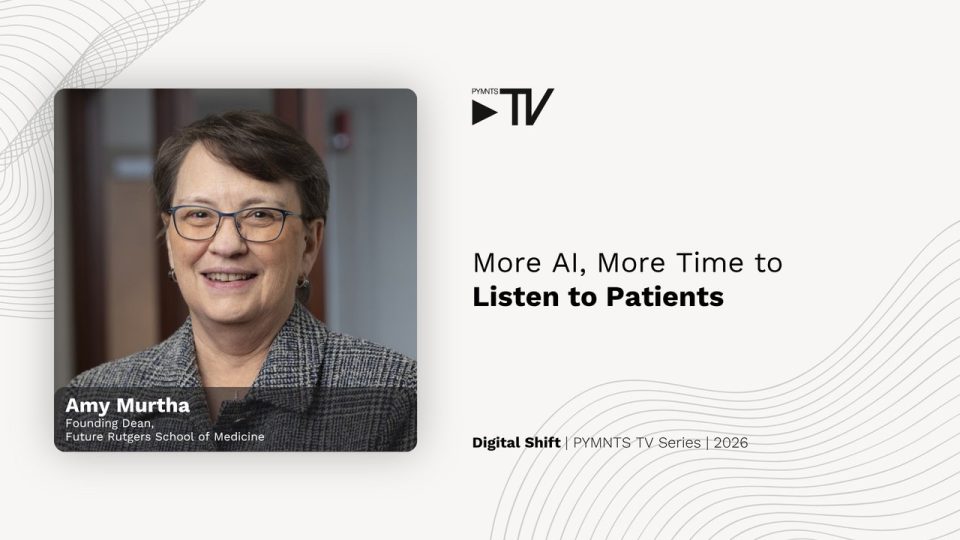
For Dr. Amy Murtha, dean of Robert Wood Johnson Medical School and founding dean of the future Rutgers School of Medicine, the promise starts with helping physicians handle the growing complexity of their work.
“Some of those things will be really essential to improving care delivery and improving the physician’s ability to manage large complex data, that in healthcare continues to get increasingly more complex,” Murtha told PYMNTS. “So it allows us to manage that data in a way that helps us to provide better care.”
That opportunity requires scrutiny, she added: “We have to make sure that we’re using sources that we can trust, that we’re critical about how we actually interpret and evaluate those resources.”
The Buzz Around the Hub
The hub will bring together students from medicine, engineering, computer science, business and other fields. Up to five teams are expected in the first cohort, working on four- to 10-week projects addressing needs identified by faculty and clinicians. AWS will provide technology, cloud computing credits, operational support and technical mentorship. Operations are expected to begin this fall.
For companies considering AI deployment, the approach starts with a recognizable operating problem and involves the people responsible for solving it. The hub builds on Rutgers’ healthcare hackathons, where students and technology partners develop possible solutions to problems in education and care.
One project addresses a delay in medical training. Students practice clinical skills with actors playing patients, and faculty review recordings of those encounters. Returning feedback can take a month or more, Murtha said.
Rutgers has worked with AWS to develop an AI coach that reviews the audio and video using assessment criteria created by faculty. Faculty members support delivery of the feedback.
“It gives us the opportunity to get that feedback to the student in a more timely fashion, which improves their educational experience,” Murtha said.
Faster feedback gives students an earlier opportunity to correct mistakes and practice again. The broader challenge for medical educators is making sure students build their own knowledge as they learn to use AI.
We’d love to be your preferred source for news.
Please add us to your preferred sources list so our news, data and interviews show up in your feed. Thanks!
“We know that the students are using the technology,” Murtha said. “How do we make sure that the students are using AI in a way that will continue to advance and further their education and knowledge and not actually become a tool that they lean on necessarily for providing good care?”
For clinicians, Murtha sees potential in tools that help prepare notes and manage information. But she also wants technology to address a problem that earlier advances helped create: the time doctors spend at computers instead of engaging with patients.
“I’m hoping that some of the advances that we’re seeing with technology that’ll help with care delivery will help us regain that opportunity to spend time talking to our patients and, more importantly, listening to what our patients have to share with us,” she said.
Practical Applications Rule the School
That sets a practical measure for healthcare executives evaluating AI: whether it gives clinicians more time for the personal work of medicine. Patients could also benefit before entering an examination room. Murtha described using AI to assess empathy in recorded call-center conversations, then using the findings to help employees strengthen their communication skills. Some patients had reported feeling unheard or being directed to the wrong place.
Another potential application involves identifying patients at greater risk of returning to the hospital after discharge. Murtha sees RWJBarnabas Health’s data as a resource for exploring how to prevent those readmissions.
“Using AI tools, we may be able to identify some opportunities that can allow us to actually make sure the patient gets the care they need when they leave the hospital and not have to come back to the hospital for readmission,” she said.
Those possibilities still require development and evaluation. Faculty and clinicians will mentor the hub’s teams and assess their projects. The long-term goal is to move successful work into Rutgers’ academic programs and RWJBarnabas Health’s clinical innovation efforts, attracting research support and additional partners.
Murtha wants the combined school to prepare students to help build those applications alongside technology specialists and health system leaders. She also wants health equity to guide how it teaches students and serves communities.
Asked about the future, she described a goal that reaches beyond the technology itself.
“And what I’d love to see is pride from all of my faculty and staff for the organization that they live and work in, and the opportunity for us to contribute to health and wellbeing for our communities,” she said, “both in New Jersey and across the country in a really meaningful and substantial way.”

 Add as Preferred Source