For a household waiting on food assistance or disaster relief, a payment that is somewhere between the government and a bank account isn’t money that can buy groceries or pay for a hotel room.
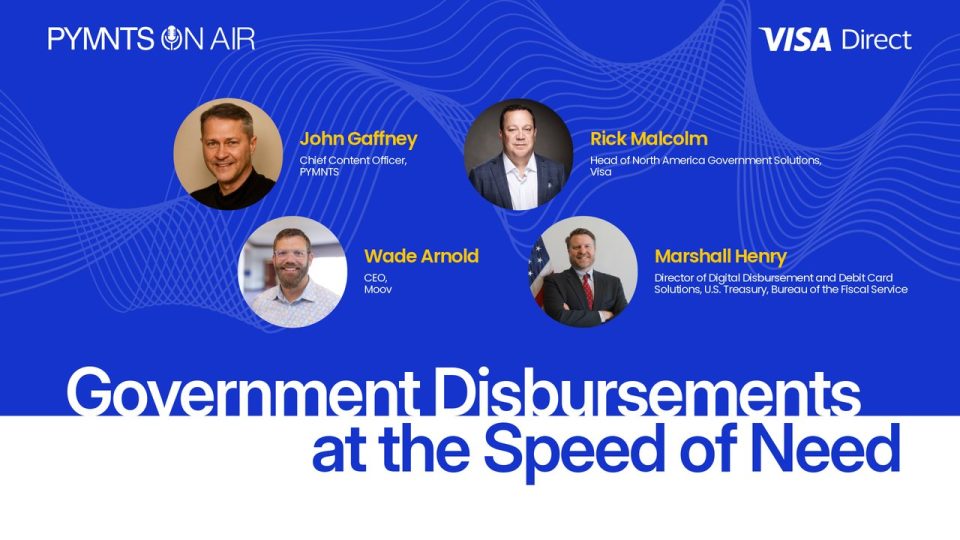
The gap between issuing funds and getting them where they need to go shaped a PYMNTS On Air Roundtable with U.S. Treasury Bureau of the Fiscal Service Director of Digital Disbursement and Debit Card Solutions Marshall Henry; Moov CEO Wade Arnold; and Visa Head of North America Government Solutions Rick Malcolm.
“For an agency, authorizing and issuing a disbursement is an important milestone, but for the constituent, the experience is not complete until the funds are actually available for them to use,” Malcolm said during the discussion.
For emergency assistance, unemployment benefits and disaster relief, constituents can incur late fees, borrow money or postpone essential bills while waiting, he said.
Young constituents encounter these problems frequently. The PYMNTS Intelligence report “Moving Money at the Speed of Life: Same Payout, Different Experience With Government Disbursements,” produced in collaboration with Visa Direct, found in July that 63% of Generation Z constituents reported at least one problem receiving a government disbursement, versus 12% of baby boomers. Gen Z constituents were also up to 16 times more likely than boomers to take out a payday loan when a government payment was late.
Henry traced friction across authentication, benefit eligibility, payment execution and eventual receipt. Near the end of that chain, agencies repeatedly encounter unclear payment status, incorrect credentials, difficulty accessing systems and confusion about when funds should arrive. Those are also the problems that can send constituents to agency call centers.
Arnold put the pressure on government systems in the context of payment habits formed elsewhere. Consumers who send money digitally are accustomed to knowing that a transaction occurred. A real-time transaction matters only if the person knows it happened. This means the confirmation is a key part of the experience.
Only 51% of Gen Z constituents were very or extremely satisfied with government disbursement speed, compared with 75% of boomers, according to the PYMNTS Intelligence report. Young constituents also rated security, convenience and choice less favorably.
But demographics are only part of the picture.
“I see this less as a generational issue and more as an expectations issue,” Malcolm said. “Getting the right payment to the right person is just the baseline.”
Constituents also expect timely access, an appropriate delivery option, visibility into payment status and confidence in security, he said.
More Payment Choices Create a New Operating Challenge
Federal policy is putting more of those decisions in the spotlight. President Donald Trump’s March 2025 executive order on modernizing payments to and from the federal government directed the Treasury Department to phase out paper checks where feasible while supporting electronic alternatives that include direct deposit, card payments, digital wallets and real-time payment systems.
Henry said the significance goes beyond replacing paper. Treasury can now consider the purpose of a payment, whether it is recurring or one-time, its urgency, fraud concerns and cost when determining how money should be delivered.
“By offering a portfolio of options, both to agencies and then to citizens, we are actually able to better look at how best to distribute the money,” Henry said.
Routine ACH can remain well suited for scheduled payments, while more urgent circumstances may warrant another route.
Choice, however, adds complexity behind the scenes. Checks, ACH, debit card payouts and real-time payments have different credentials, confirmation mechanisms, returns and exception processes. An agency still needs to know whether the intended recipient was paid without forcing employees to navigate separate operational processes for every rail.
“The same workflow, the same investigation process, the same ‘did this constituent get paid’ needs to be consistent from an operational level,” Arnold said.
We’d love to be your preferred source for news.
Please add us to your preferred sources list so our news, data and interviews show up in your feed. Thanks!
The function of the orchestration layer is to accept the agency’s payment instruction, route it through the appropriate method, and bring payment status, exceptions and reconciliation back into a common operating environment. Its value grows as agencies offer more ways to receive money because each additional rail otherwise introduces another set of exceptions to investigate.
Modernization also must coexist with systems that already distribute enormous volumes of government payments. Arnold rejected the premise that agencies could simply replace those systems wholesale.
“Nobody can just go rip and replace everything,” he said. “You just need to meet them where they’re at and help them through that transition.”
Newer payment methods can supply information that older ones weren’t designed to provide. Arnold cited card network tools that can check the recipient’s name and address and verify access to the card credential before a payment is sent. None is conclusive on its own, but the signals can be considered together when agencies assess a transaction.
Tokenization has a narrower role in this discussion. Arnold contrasted a physical mailing address used to deliver a check with a Visa network token used as an electronic payment credential. The practical point is credential modernization. Agencies need reliable digital endpoints while continuing to serve constituents who still depend on established methods.
Better information about the payment also changes what happens inside an agency after money is sent. Constituents who can see payment status and obtain funds sooner may have less reason to call for updates, while agency employees can more readily determine whether a payment was completed, returned or requires intervention, Malcolm said. The same transaction information feeds reconciliation and back-office work.
Henry said he sees that connection in Treasury’s operations.
“As payment certainty increases, the operational strain decreases,” he said.
Giving constituents a preferred payment method also gives agencies information about how those constituents want to interact with the payment process, reducing some of the uncertainty that produces status calls.
The measure extends beyond administrative efficiency, Henry said. Constituent experience should become a performance metric alongside the government’s non-negotiable requirements for compliance and payment accuracy.
“This constituent experience, this is our opportunity to build trust in government,” Henry said.
Every period in which a recipient believes money is owed but can’t access it can erode that trust, he said.
Watch the full PYMNTS On Air Roundtable to hear Henry, Arnold and Malcolm examine:
- What happens behind a government disbursement when constituents select different payment methods.
- How agencies can manage exceptions across multiple rails.
- Where payment credentials and verification tools fit as federal programs reduce their reliance on paper checks.


 Add as Preferred Source