Artificial intelligence is moving so fast that its promise can feel dizzying. Each new month brings announcements of breakthroughs that could redefine industries. For business leaders, the challenge is not only deciding whether to embrace AI but understanding why, when and where it truly adds value.
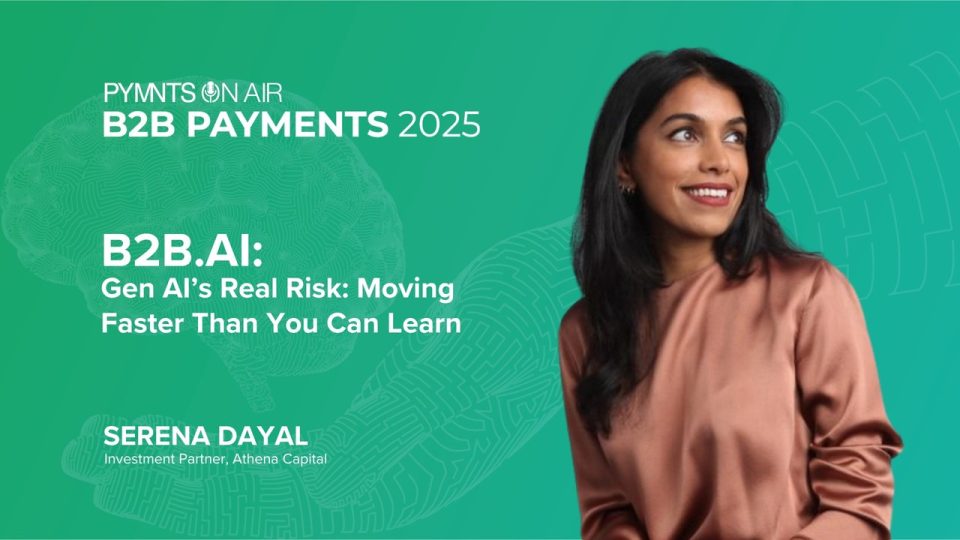
As Athena Capital Investment Partner Serena Dayal noted in a conversation with PYMNTS CEO Karen Webster, enthusiasm for AI often outpaces strategy. “I saw a cartoon on LinkedIn,” Dayal said. “It said, ‘What do we want?’ AI. ‘When do we want it?’ Now. ‘What do we want it for?’ We don’t know.”
That simple joke, she said, captures a growing dilemma. Boardrooms across industries are pushing for AI adoption, yet few executives can clearly explain where it fits into their current or future business plans.
The FOMO Factor
The fear of missing out is powerful. Every company wants to be seen as leading on AI. But Dayal warned that the pace of change makes it risky to rush. “Things that were at the front edge of the frontier are now becoming obsolete or mainstream every three to six months,” she said. In such an environment, patience becomes a strategy.
“This is a brilliant time to be doing active learning and to be getting sharp on what is going on in your industry,” she said. The smartest leaders are experimenting deliberately, testing in small, controlled ways rather than overhauling core systems too soon.
Dayal advised executives to start with low-risk, internal pilots focused on improving employee productivity rather than diving into customer-facing applications. “The number of board members I have spoken to who do not have access to the corporate LLM and who would love to is remarkable,” she said. The message is clear: before AI transforms customer experiences, it should transform how teams inside the organization work.
The Power in the Ordinary
The real promise of AI, Dayal believes, is not in futuristic moonshots but in the everyday, repetitive work that defines most companies. “It is honestly in the really mundane stuff,” she said. That includes any task that is high volume and low risk: drafting memos, summarizing data, generating reports, or assisting engineers through co-pilot tools.
These may not be headline-grabbing applications, but they deliver measurable results. By automating the small, routine steps that slow people down, AI amplifies human capability rather than replacing it. Dayal said the best early use cases are those that combine efficiency with oversight. “You are supercharging your ability to be a functional expert using your proprietary data,” she said.
Even in more complex areas such as treasury and finance, executives are already seeing impact. Webster pointed out that CFOs are using AI to improve visibility into payables and cash flow. These applications make professionals better at what they already do, not obsolete.
Why the Mundane Matters
The reason the mundane matters so much is that it creates real, durable value. AI’s biggest contribution is not found in science-fiction scenarios but in making the ordinary extraordinary. When companies use AI to optimize what they already do well, they build efficiency and insight into their core operations.
That process begins with data. “Data is the future and one of the most valuable assets that companies can think about shoring up right now,” Dayal said. The work is less glamorous than building models but far more foundational: cleaning, labeling, and structuring information so that it can be used productively. Even “exhaust data,” the byproduct of daily operations, can be mined for new value once companies recognize what they already have.
“What once was cost-prohibitive can now be done algorithmically,” Dayal said. “The ultimate problem is not can AI answer the questions, but what is the prompt and do you have the right prompt?” The lesson is that better data and clearer thinking will always matter more than the latest model.
The Governance Gap
As innovation accelerates, regulation struggles to keep pace. That means the responsibility for artificial intelligence oversight begins not with governments but with boards. “It is therefore really critical for boards and exec teams to have foundational principles around AI ethics and employee use of it,” Dayal said. “Because you have shadow AI in your organizations, meaning employees are using AI whether you know it or like it.”
Some companies have responded by creating AI employee handbooks that set clear expectations for use and governance. Others are benchmarking their approach against existing compliance obligations and evolving those policies over time. The alternative, Dayal warned, is exposure to risk from unmonitored or unauthorized use of third-party AI tools.
Governance is not a barrier to innovation; it is what makes innovation sustainable. Clear principles allow companies to experiment safely while protecting their data and reputation.
Building Moats and Vertical AI
We’d love to be your preferred source for news.
Please add us to your preferred sources list so our news, data and interviews show up in your feed. Thanks!
Dayal encouraged leaders to focus their efforts where artificial intelligence can create defensible moats. That means prioritizing computationally heavy, repeatable tasks over subjective creative work until the models are more mature. Engineering functions are an ideal starting point because they involve structured data and repeatable workflows.
She sees the next wave of differentiation emerging from hyper-vertical applications in fields such as healthcare, legal services, and specialized analytics. These are areas where domain expertise and proprietary data can create unique advantages that large, general-purpose platforms cannot easily replicate.
The companies that succeed will be those that combine technical capability with a deep understanding of their industry’s specific problems. In AI, specialization becomes the new scale.
The Investment Perspective
From an investment standpoint, Dayal described “smart money” flowing toward the infrastructure that makes artificial intelligence possible: compute power, data platforms, and cybersecurity. These are the “picks and shovels” of the AI gold rush. Costs will continue to decline, but the greatest returns will come from vertical applications that deliver concrete, defensible value.
Regulatory frameworks will evolve more slowly than the technology itself. In the meantime, companies cannot afford to wait for legislation to catch up. They must create their own guardrails and invest in the foundations that will support sustainable growth.
A Long Game of Patience and Preparation
For executives deciding when to act, Dayal offered straightforward advice: “Probably the number one thing is data. Shoring up your data, making sure you have everything you need, and then thinking really creatively with an open mind about what you can do with that data for your business and what you can do with AI.”
The excitement around AI is justified, but it can also be distracting. The most meaningful gains will not come from headline-grabbing innovations or moonshot ambitions but from the disciplined work of integrating AI into the daily fabric of business. The companies that treat artificial intelligence as a long game rather than a sprint will be the ones that endure.
As Dayal put it, “Just remember this is the first inning of a very, very long curve.” The potential of AI is vast, but its power begins with the basics. The future will belong to those who master the mundane first.
Register now to access all streaming and on-demand episodes from the B2B Payments 2025 event series.
PYMNTS CEO Karen Webster is one of the world’s leading experts in payments innovation and the digital economy, advising multinational companies and sitting on boards of emerging AI, healthtech and real-time payments firms. She founded PYMNTS.com in 2009, a top media platform covering innovation in payments, commerce and the digital economy. Webster is also the author of the NEXT newsletter and a co-founder of Market Platform Dynamics, specializing in driving and monetizing innovation across industries.
Serena Dayal is a venture partner at Athena Capital focused on software, digital health, AI, and marketplaces.


 Add as Preferred Source