Identity verification has a peculiar economics problem: The controls designed to keep the wrong customer out can also keep the right customer from getting in.
That tradeoff is becoming harder to treat as a narrow compliance matter, as financial platforms add products, operate across jurisdictions and confront more sophisticated fraud.
Know your customer (KYC) remains a regulatory obligation, to be sure, but the operational question has widened to include how often customers should be checked, what information can be reused and where friction actually improves security rather than merely slowing a transaction.
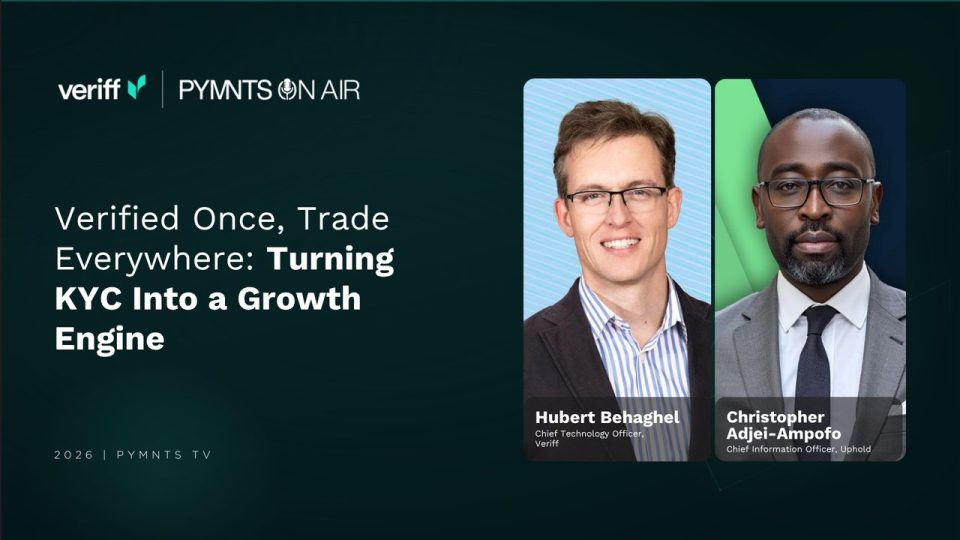
Hubert Behaghel, chief technology officer at Veriff, and Christopher Adjei-Ampofo, chief information officer at Uphold, discussed those questions during a PYMNTS “Payments on Air” conversation about the changing role of identity verification.
The shift starts with reconsidering what KYC is supposed to accomplish. Behaghel said the identity verification industry developed largely around regulatory compliance, which made passing or failing a check the central measure, a framing that can obscure the broader objective.
Examining Points of Friction
“It has always been about friction,” Behaghel said. “We want the least amount of friction for the honest [customers], and we want the maximum, the impossible friction, for the fraudster.”
Identity is no longer confined to opening an account. Behaghel argued that onboarding begins the relationship, while later events may require the platform to establish confidence again, particularly when a customer attempts a higher-risk transaction.
Adjei-Ampofo described the issue from the platform side. Uphold operates both consumer and enterprise businesses, and its enterprise relationships provide an example of identity information moving between parties rather than forcing customers through another complete verification process. A partner can conduct the initial identity verification and provide the resulting information to Uphold, allowing the customer to proceed without repeating the entire KYC process.
The cost of repetition can be straightforward. A customer asked for another passport or driver’s license may leave the application, retrieve the document and return to find that the session has expired.
“At that point, you’ve lost them,” Adjei-Ampofo said. “They’ll shift somewhere where it’s a lot easier and a lot quicker for them to actually access the services that they need.”
Friction Has a Time and a Place
Removing friction everywhere, however, would create a different problem.
Adjei-Ampofo said customers may accept additional verification when its purpose corresponds to an obvious change in risk. Linking a new bank account or initiating a large transaction can justify another check because the interruption gives the customer an opportunity to recognize unauthorized activity.
“Consumers don’t mind friction as long as it’s applied in the right place,” he stated. “Once I sign up and I’m transacting, I don’t mind friction if I know what it’s for.”
Behaghel described the same principle as matching the verification burden to both the risk of the activity and the user’s motivation to complete it. Someone applying for a loan, for example, may tolerate more steps than a prospective customer arriving through an acquisition campaign. The latter may simply abandon the process when unnecessary obstacles appear.
We’d love to be your preferred source for news.
Please add us to your preferred sources list so our news, data and interviews show up in your feed. Thanks!
That puts false rejections squarely into the economics of KYC. Identity systems have traditionally been judged heavily on whether fraudsters slip through. Behaghel said businesses are now paying closer attention to the opposite error: legitimate people who are rejected.
Keeping an Eye on Scale
The consequences extend beyond the lost transaction. At sufficient scale, even a small error rate can send thousands of legitimate customers to contact centers. “The true performance of an IDV, yes, it’s a false approval rate, but it is combined with the conversion rate you can guarantee,” Behaghel told PYMNTS.
Fraud itself is also changing the verification equation. Behaghel said artificial intelligence has supplied criminals with more capable tools, while organized “fraud as a service” operations allow techniques for bypassing controls to spread among fraudsters. Yet he cautioned platforms against focusing solely on the latest AI threat. Identity verification involves sensitive personal information, making the architecture and data flows behind verification systems a central concern.
Digital IDs may eventually alter that architecture, although Behaghel said the present picture remains fragmented. Documents, biometric registries and digital identity schemes coexist, while conventional identity documents remain an attractive target for tampering and fabrication.
That fragmentation also limits how far the “verify once” concept can travel.
Interoperable identity standards would make credentials easier to reuse, but Behaghel pointed to differing standards in Europe and the United States and differing definitions of acceptable trust among businesses. Identity verification itself is only one component of KYC, which can also include politically exposed persons (PEPs) and anti-money laundering (AML) checks. A credential accepted by one institution therefore may not satisfy another institution’s requirements.
Uphold faces a related problem across jurisdictions. Adjei-Ampofo said the company uses a common identity framework while layering jurisdiction-specific requirements over it.
His shorthand for the objective is “one record, many regulators, zero seams for the customer.” The common elements are knowing who the customer is, how that person was verified and what risk tier applies. Local regulatory requirements then determine what else must be done.
For industry executives, Adjei-Ampofo’s advice is to change how identity investment is discussed internally. Boards already understand security and regulatory risk, he said. The more useful case is to measure what happens commercially when legitimate customers encounter unnecessary verification steps.
“Show them that every single step of that ID process, the drop-offs, is costing the company,” he said. “Compliance, finance, product, growth. They all listen to the same message. They all recognize revenue. They all recognize the bottom line.”
Watch the full discussion to hear Behaghel and Adjei-Ampofo examine questions that extend beyond the mechanics of onboarding, including:
- How fraud networks share techniques, why conventional identity documents may remain a weak point even as digital IDs develop.
- The privacy questions surrounding biometric data.
- The difficulty of building identity systems that work consistently across national and regulatory boundaries.


 Add as Preferred Source