In 1949, a businessman named Frank McNamara finished dinner at a New York restaurant and realized he’d left his wallet at home. The story may be part legend, but the product it inspired was real. Diners Club gave members a card to use all month and one bill to pay in full when it arrived. The charge card was born, and “pay in 30” was the whole idea.
Revolving credit came next and let people carry a balance. Decades after that, buy now, pay later FinTechs peeled off the installment idea and planted it at the merchant checkout, where the bank that issued the customer’s card had no say in the matter.
Splitit’s new card puts the pieces back together and hands the result to the banks.
The Splitit World Mastercard, announced Tuesday (Oct. 13), is a white-label credit product built for mid-sized banks, credit unions and other financial institutions. The release calls it installments. Look closer, and it’s a charge card for everyday spending. Purchases are paid in full within 30 days. Cardholders set a dollar threshold in the bank’s app, and anything above it can automatically split into predictable monthly payments. The morning coffee stays on the 30-day tab. The new laptop becomes a payment plan. The cardholder can flip any purchase back to pay-in-full, or change the plan, right up until the statement is due.
“The Splitit World Mastercard is a new type of credit card built for banks and credit unions that resembles the simplicity of debit for consumers and pairs it with the flexibility of installments,” Splitit CEO Nandan Sheth said in the announcement.
In a conversation with PYMNTS CEO Karen Webster ahead of the launch, Sheth explained what the card is really for. Splitit wants to be the buy now, pay later FinTech for the banks that have the customers but not the product.
Banks Have the Trust but Not the Product
Sheth has watched a gap widen. Banks still hold the primary account and the customer’s trust. The installment products those customers actually use come from somewhere else.
“The trust element is still there. The product innovation isn’t,” Sheth told Webster. “And that’s really what we’re trying to fix.”
Plenty of bankers don’t believe their customers use buy now, pay later (BNPL) at all. Sheth has a standard reply. Pull a report of the debit and ACH payments going out to installment providers.
“Once they pull that report, many of them are stunned because they have no idea that their cards are being used to pay off an installment loan,” he said.
That report usually ends the debate about demand. It starts a different one about how much of a lending business the bank wants to build and run. Putting installments on a card turns out to be harder than it looks. “Many issuer processors have struggled with putting installments on a card,” Sheth said.
Splitit’s answer is to let each bank pick its own role. Regional and super-regional banks can bring their own capital and use Splitit mainly for the technology. Community banks and credit unions can have Splitit bring the underwriting, risk management, liquidity and servicing along with the technology, and carry the credit risk itself. That last part is new for Splitit, whose installments have historically ridden on credit consumers already had.
Banks can also change their minds. Several have asked whether they can start with Splitit as the lender and servicer, then take over if the program grows. Splitit built the model to allow that. It runs its own issuer processor and has built adapters for the larger processors, so a bank can launch on Splitit’s platform and later move the program onto the processor it already uses.
“Banks already have the relationship, the brand and the primary account. What many of them lack is a way to offer installment plans at the point of purchase without having to build a lending business from scratch,” Sheth said in the announcement. “Our white-label card gives them that, under their own name.”
Credit Gets Decided One Purchase at a Time
Speaking to Webster, Sheth called the model “transactional credit.” The card comes with a credit line, but the cardholder decides purchase by purchase what to extend, rather than financing the whole balance the way a revolving card does.
His example is a $500 set of tires at Pep Boys. The cardholder pays with the card and then gets an offer to split that one purchase. Pep Boys doesn’t need to offer Splitit, or any BNPL, at its checkout. Cardholders can also set rules by purchase amount or merchant category, or convert a purchase after the fact.
We’d love to be your preferred source for news.
Please add us to your preferred sources list so our news, data and interviews show up in your feed. Thanks!
“You can decide where you want credit at the transaction level without being locked into the merchant providing you a particular BNPL option,” Sheth said.
Webster pointed to the appeal of putting several ways to pay behind one credential. “There’s momentum both from the bank side in wanting to make it available, and on the consumer side in the simplicity of having a single account that gives them that flexibility,” she said.
Mastercard supplies part of what makes that work. Sheth said Splitit picked the network partly for Mastercard One Credential. The card will be issued as a World Mastercard, with the usual protections that come with it, and Mastercard is helping with distribution to financial institutions. Down the road, Sheth said, the capability could attach to a bank’s existing debit credential instead of a new card.
The economics hinge on what people do after they spend. There’s no annual fee and no late fee. Paying within 30 days costs nothing. Cardholders who choose longer plans, including pay-in-six and pay-in-12, pay a fee, and Splitit shares the program economics with the bank. Splitit’s models project that installment-minded consumers could put about half of their purchase value into installments, maybe approaching 60%. Daily transactors could put 25% to 30%. Those are projections, not results, and Sheth was careful to say so.
Finn Is There to Help People Pay, and Sometimes to Say No
The card comes with an agent. Finn, Splitit’s AI-enabled assistant, lives inside the bank’s app and watches what the cardholder buys. It can spot the tire purchase and offer to split it. It can also look at the whole month’s spending and help the cardholder settle the account in the way that makes the most sense for their cash flow.
It can push back, too. Sheth said Finn can question the use of installments for groceries, or enforce a rule that nothing under $200 gets financed.
“We don’t want to be pushing credit and fees,” Sheth said. “We want to make sure that consumers make the right decisions.”
A lender building software to talk customers out of borrowing is not the usual order of things. It’s also a good fit for the audience. Banks that have spent years protecting their customers’ trust don’t want a product that spends it.
The First Cardholders Show up Next Month
Sheth told Webster that they will start testing all of this with real people soon. Friends-and-family testing with roughly 250 participants is planned for November, followed by a beta of about 3,000 consumers. Sheth expects the first financial institution to go live in January or February, with prospective launch partners spanning a small credit union, a mid-tier bank and a FinTech or neobank. The card is expected to be available to financial institutions in early 2027.
Seventy-seven years after McNamara’s dinner, pay in 30 is back on the table. This time, it comes with a choice, a bank’s name on the front and an agent to help decide how to split the tab.
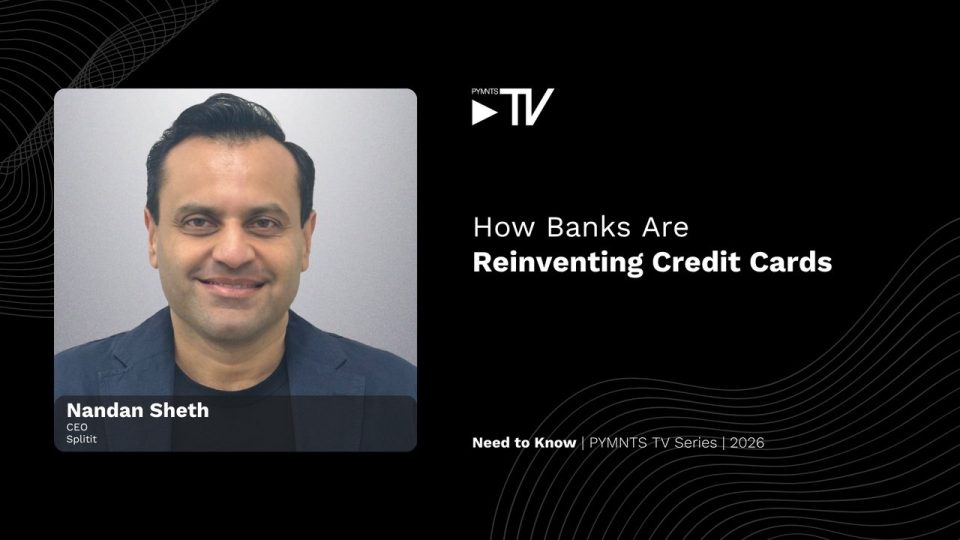
Watch the full interview with Nandan Sheth to learn more about:
- Why banks can choose different combinations of technology, capital, underwriting and servicing.
- How transaction-level credit changes where and when consumers can select installments.
- How the Mastercard One Credential and Finn fit into Splitit’s plans for the card.


 Add as Preferred Source