For workers with unpredictable pay, the problem with saving isn’t necessarily deciding to do it. It is knowing how much money they can afford to set aside and leave alone.
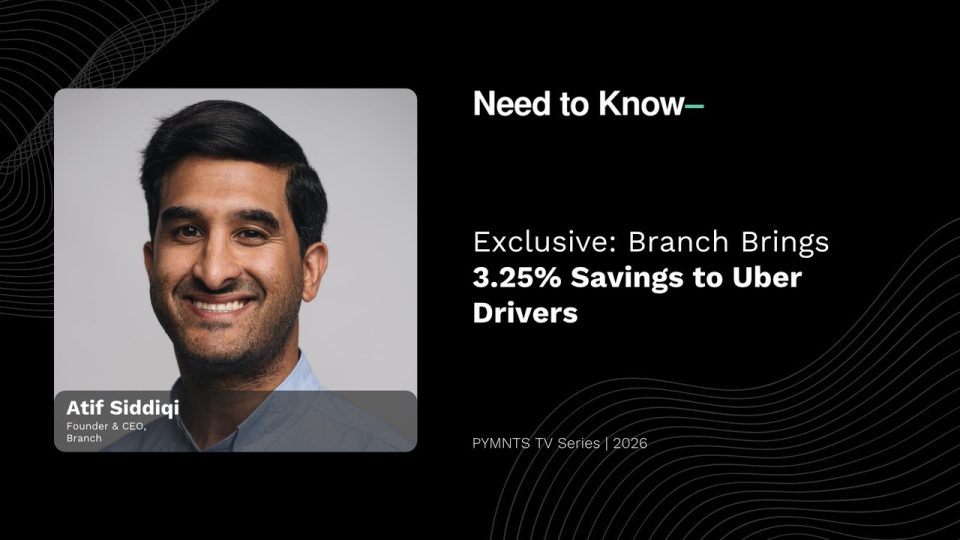
Branch Founder and CEO Atif Siddiqi sees that problem among the hourly, tipped and gig workers his company serves. Their earnings can rise and fall with schedules, shifts and demand, while higher prices continue to put pressure on what remains after expenses.
“They have very few ways to set money aside,” Siddiqi told PYMNTS CEO Karen Webster.
Branch is now adding one. The company said Thursday (Oct. 1) that it has launched High Yield Savings, starting with Uber drivers and couriers through the Uber Pro Card. Users can earn 3.25% APY with a $500 average daily balance. Below that threshold, the account pays 1.25% starting with a balance of one cent.
The account has no minimum to open. More significantly for workers without predictable pay, earning the top rate doesn’t require a recurring direct deposit or a specified amount of card spending. Some high-yield savings accounts require direct deposit or a certain level of card spending to earn their highest rate. Those requirements can be difficult for workers whose income varies from week to week.
“As their income fluctuates, they don’t need to worry about a direct deposit,” Siddiqi told Webster, with a nod to Branch’s new offering.
What workers do with the money once it reaches savings is another part of the calculation.
Siddiqi wants users to be able to put aside relatively small amounts rather than wait until their income or schedule becomes more predictable.
Siddiqi described the desired result as workers reaching a point where they can say, “‘I’ve not only saved money, but I’m watching it compound at a decent rate.’”
Users can automate contributions daily, weekly, every two weeks or monthly. That gives compounding (a favorite wealth building tool championed by none other than Warren Buffett) a role in the household financial strategy even when savings accumulate gradually.
Saving Without Giving Up the Cash
We’d love to be your preferred source for news.
Please add us to your preferred sources list so our news, data and interviews show up in your feed. Thanks!
Often the stress in this cohort is timing, not always income. The tension, Webster said, comes from wanting to save while not wanting to be “caught short at the end of the month.”
Siddiqi said users can move funds between checking and savings if their cash position changes. There are no restrictions on moving the money back when a user encounters a liquidity problem.
Uber shows how this works in practice.
A driver earns money through the platform but also has expenses directly connected to generating that income. Fuel, maintenance, insurance and taxes compete with personal expenses and savings for the same cash. The activities dovetail with Webster’s observation that the Uber driver winds up functioning in some respects like a small business managing working capital.
Siddiqi said the unpredictable schedules of drivers and couriers helped make Uber a fit for the initial rollout. The savings account is being added to the Uber Pro Card, with Branch planning to extend High Yield Savings to its own app and other Branch-powered applications afterward.
The launch also gives Branch a reason for money to remain after it arrives.
Branch has built its worker relationship partly around getting earnings into accounts quickly. Savings introduces the opposite behavior: leaving some of those earnings in place. Branch winds up giving customers a point of contact on “both sides of the liquidity equation,” as Webster pointed out. Workers can draw on available money when they’re short and build savings when they aren’t. Siddiqi said the savings account is separate from the checking account used to receive pay and that deposits are held at a sponsor bank.
Credit? Siddiqi said it is “definitely on the roadmap.” He pointed to a user population that includes people who are thin-file or credit invisible and said Branch is considering how to provide access to mainstream credit products at fair prices.
Savings puts another piece in place first. It gives workers somewhere to put money when they have it, while acknowledging that with variable income, savings may sometimes have to become spending money again.
Watch the full interview with Atif Siddiqi to learn more about:
- What Branch is seeing from early use of automatic savings.
- How workers choose among daily, weekly and monthly contribution schedules.
- How the cash needs of Uber drivers differ from those of other hourly and tipped workers.
- Why Branch has put credit on its product roadmap.


 Add as Preferred Source