With consumers forced to make budgeting decisions amid ongoing economic challenges, older millennials and younger Generation X consumers are seeing buy now, pay later (BNPL) options play a central role in their purchasing decisions.
By the Numbers
For the study “The Credit Accessibility Series: BNPL’s Wide-Ranging Impact on Consumers and Merchants,” PYMNTS Intelligence surveyed more than 3,100 U.S. consumers to get a sense of how they engage with BNPL options and how it informs their buying decisions.
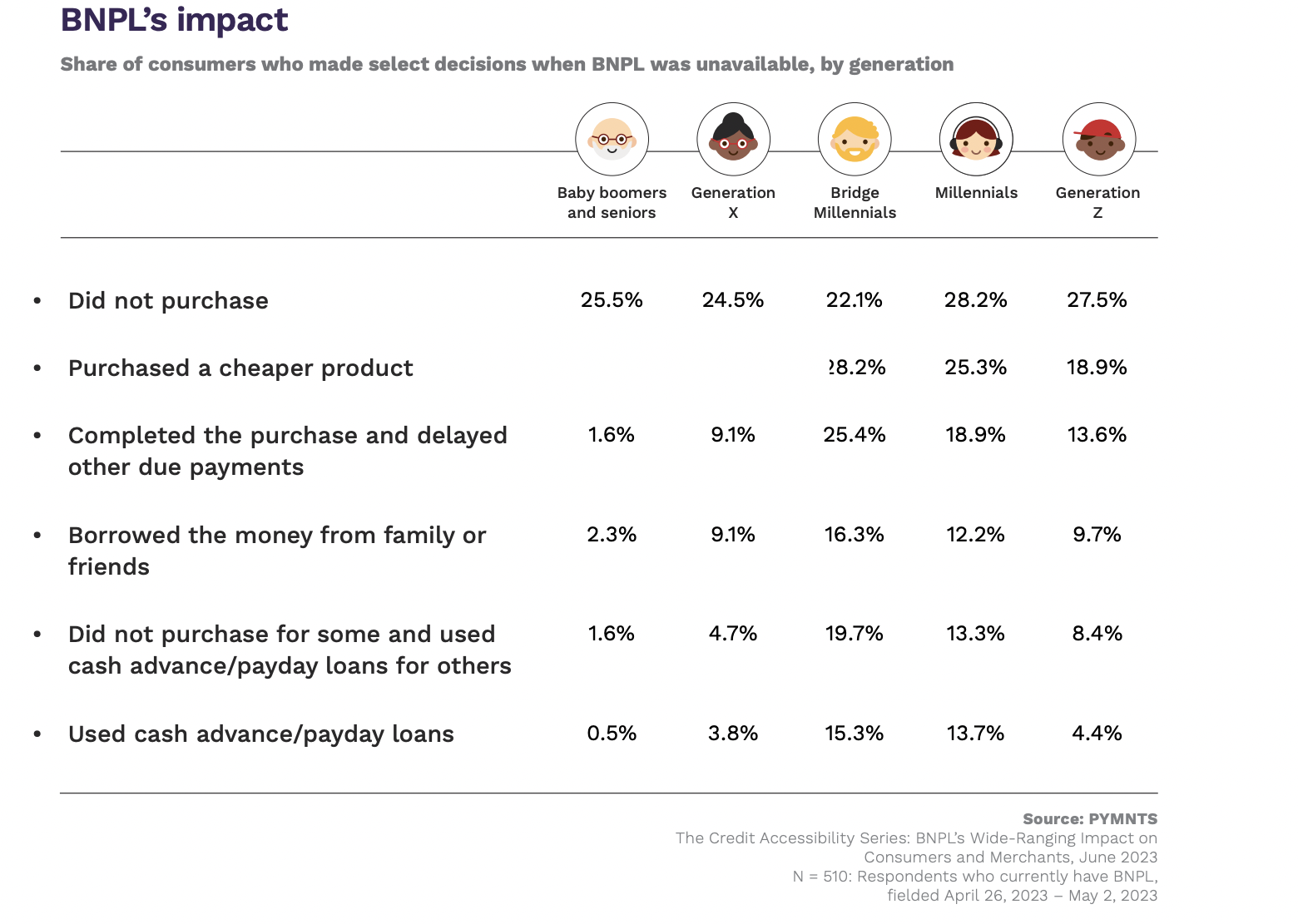
The findings revealed that many BNPL users change their purchasing behavior when the payment option is not available. Many bridge millennials — the cusp generation between Gen X and millennials born between 1980 and 1989 — reported that they purchased a cheaper product because of the lack of BNPL options. Twenty-eight percent of consumers in this demographic did so, a greater share than any other generation.
The Data in Context
Demand for BNPL options has risen in recent years.
“The pandemic caused widespread financial instability,” Pedro Bennasar, head of payment for Vestiaire Collective, told PYMNTS in an interview for the Buy Now, Pay Later Tracker®. “This financial adversity, however, did not cause consumers to stop shopping but rather to seek financial flexibility to accommodate their existing spending habits. This [change] resulted in major increases in the use of BNPL services. Consumers could enjoy the satisfaction of purchase without the pain of a big down payment.”
Shoppers demand payment choices that meet their budgeting needs, as Drew Olson, senior director at Google Pay, told PYMNTS in a December interview. Failing to meet this demand could impact their purchasing behavior.
“Whatever calculus the user performs to determine the payment methods that they want to use, they want more options across more merchants,” he said at the time.
For all PYMNTS retail coverage, subscribe to the daily Retail Newsletter.
See More In:
BNPL, buy now pay later, Consumer Spending, ecommerce, economy, Generation X, Millennials, News, PYMNTS Intelligence, PYMNTS News, PYMNTS Study, Retail