Rising costs are pushing younger consumers to work harder at money management, even as fewer Americans say their coping strategies are actually helping.
That is one of the clearest takeaways from “Generations Under Pressure: How Younger Consumers Are Coping With Higher Living Costs,” a new PYMNTS Intelligence report based on a survey of 2,747 U.S. consumers.
We’d love to be your preferred source for news.
Please add us to your preferred sources list so our news, data and interviews show up in your feed. Thanks!
The broad finding is familiar: more than half of consumers still say daily living expenses are a challenge. The more revealing part is how generations are responding. Younger adults are stacking tools and tactics like layers of blankets against a chill, while older consumers are more likely to rely on fewer moves or take no action at all.
One of the key points to a gap between effort and confidence. Consumers are trying to adapt by cutting spending, leaning on credit, avoiding large purchases and using installment plans. Yet more activity has not produced a stronger sense of control. That is especially notable because it suggests the real issue is no longer just inflation. It is the strain of managing recurring bills and everyday expenses month after month.
3 Data Points That Stand Out:
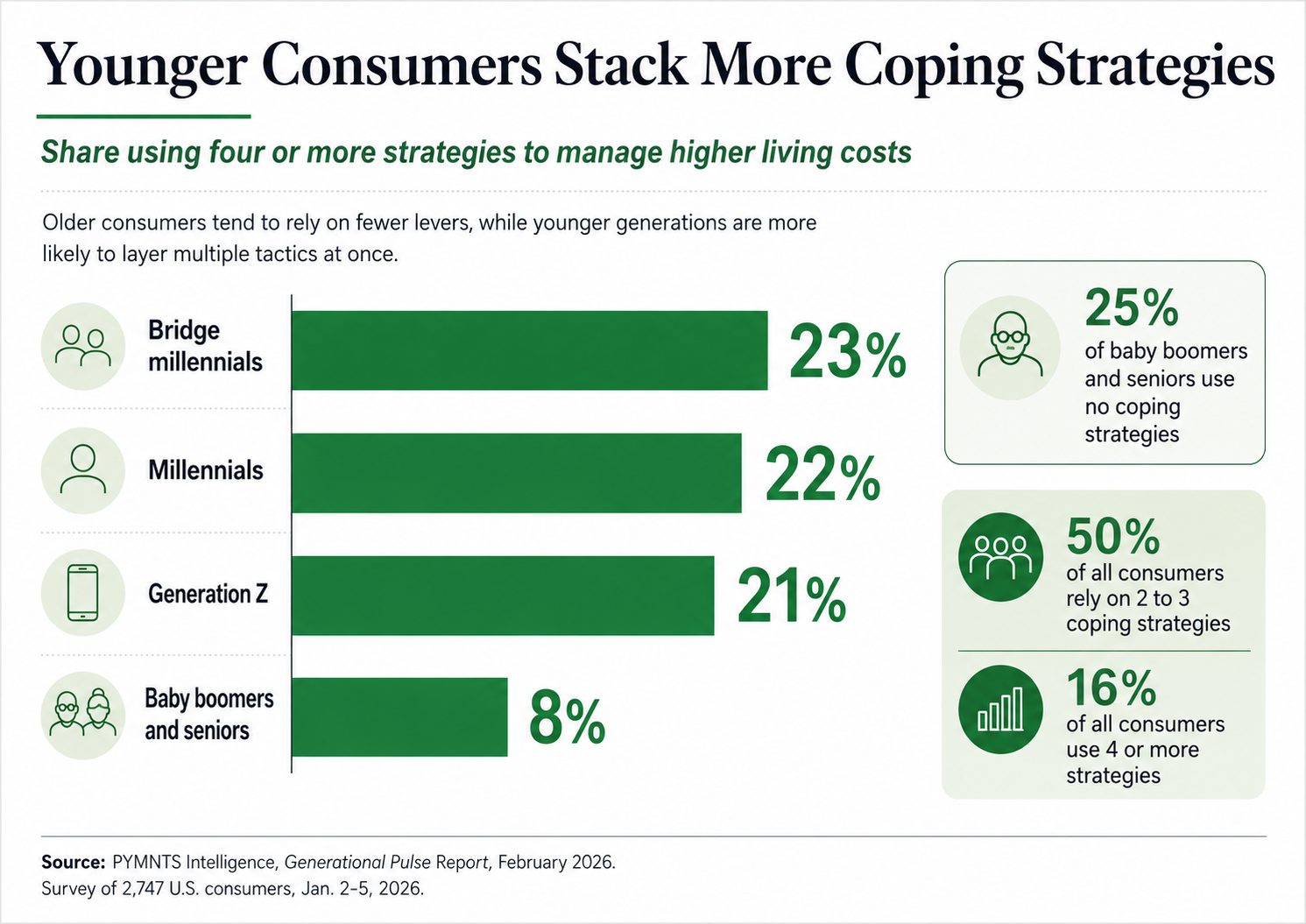
- Younger consumers are far more likely to use four or more coping strategies. That group includes 23% of bridge millennials, 22% of millennials and 21% of Gen Z, compared with just 8% of baby boomers and seniors.
- Older consumers are more likely to sit out the coping playbook altogether. The report found that 25% of baby boomers and seniors use no coping strategies, showing a much lower-intensity response to higher living costs.
- Doing more is not making consumers feel better. The share of consumers who said their strategies were extremely or very effective fell to 25% in January from 34% in October 2025.
That mix of data helps explain the generational split in money management. Younger consumers often face several pressures at once, including housing, future planning and daily expenses.
The report found bridge millennials average 3.5current cost pressures and millennials 3.4, versus 2.6 for baby boomers and seniors. In practice, that means younger households are more likely to patch together a plan from several smaller actions rather than rely on one clean fix.
Other findings in the report reinforce that idea. Grocery stress rose to 89% of all consumers in January, while healthcare pressure intensified at both ends of the age spectrum. For older consumers, insurance premiums and dental or vision costs are becoming a heavier burden. For Gen Z, stress is spreading across prescriptions, dental care and mental health services.
There is a constructive angle in all of this. As consumers become more deliberate about how they manage cash flow, the opening grows for financial tools that offer clearer visibility, more flexibility and better timing around recurring expenses.


 Add as Preferred Source