Faster payments compress the time available to catch a bad transaction, reconcile an exception or determine whether the party moving money is who it claims to be.
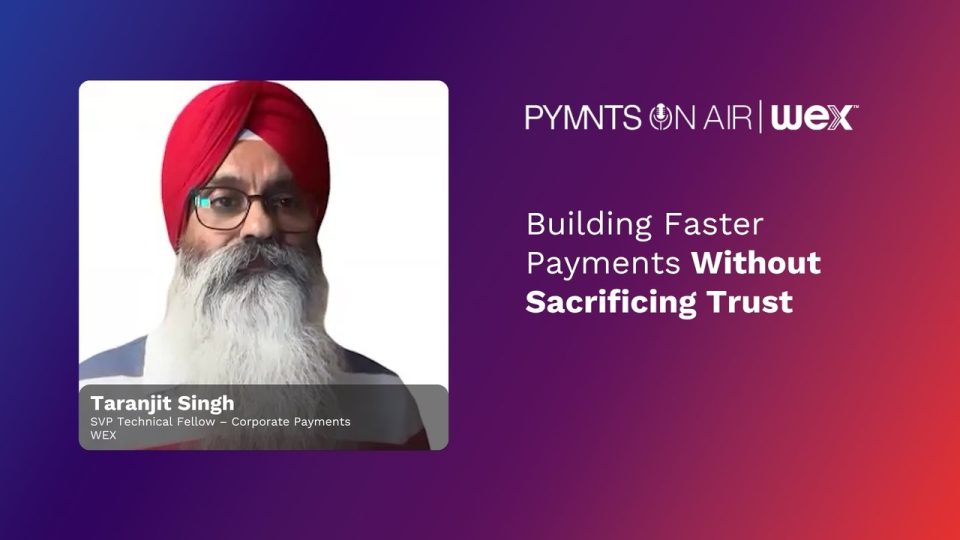
Speedier payments put more pressure on infrastructure that customers rarely see. In a PYMNTS interview, Taranjit Singh, senior vice president and Technical Fellow for Corporate Payments at WEX, said payment technology has been directed at three persistent demands, including expanding access to capital, moving money faster at lower cost, and strengthening trust through security and compliance.
Embedded features amplify the pressures. Financial services now operate inside invoicing, software as a service and other business workflows, placing more of the customer experience outside traditional banking interfaces. Payment providers still retain responsibility for compliance, anti-money laundering controls and risk frameworks as that distribution model expands, Singh said.
“Payments still involve money movement, sensitive data, fraud and regulatory obligations, and we cannot take our eyes away from that,” Singh said.
Trust includes the mechanics behind a transaction, such as who carries regulatory responsibility, how money settles, how risk is assessed and whether the ledger remains accurate as volume rises, Singh said. Separating fraud and risk management across providers can create blind spots, while an integrated provider can see both customer-facing payments and underlying fund movements.
Fraud Moves Into the Software Supply Chain
Artificial intelligence is altering the risk calculation because attackers and payment companies can draw on the same class of technology. Singh described an “AI versus AI” environment in which criminals can use generative AI to synthesize identities while financial institutions deploy AI to identify suspicious behavior.
We’d love to be your preferred source for news.
Please add us to your preferred sources list so our news, data and interviews show up in your feed. Thanks!
“Your overall payment security is as strong as the weakest software vendor in your supply chain,” Singh said.
His argument for AI-driven defenses rested on data. WEX has 40 years of proprietary payments data, and models can combine contextual information with institutional knowledge and compliance guardrails, Singh said. Without those inputs and feedback loops, AI can produce false positives and poor financial decisions.
AI also has a role after authorization. Treasury and payment operations still devote labor to reconciliation, exception handling, and combining structured and unstructured information. Models can bring those sources together and manage more complex post-payment workflows, Singh said.
Speed, however, depends on fundamentals that predate AI. Infrastructure needs visibility into faster money movement, modular and API-driven architecture, Singh said. It also needs compliance, know your customer, AML and risk controls embedded directly into workflows. Reconciliation is part of the same equation because faster transaction processing offers limited operational value if discrepancies take days to identify.
Singh said he favors continuous modernization over large replacement projects that can take years while business requirements change. Before replacing components, institutions need a detailed map of system dependencies and a common record for customers, transactions, contracts and pricing.
“You cannot modernize a system which you haven’t thoroughly mapped,” Singh said.
The same discipline applies when evaluating newer infrastructure. APIs reveal little about ledger architecture, consistency, transaction capacity, recovery times, encryption or the controls operating behind a payment call, Singh said. Institutions need to examine those underlying capabilities, along with reporting and risk mitigation, before relying on an interface to move money.
Singh said his priorities for the next several years follow from that foundation. Technology, product and compliance teams need shared workflows; new infrastructure should use flexible APIs and common standards where possible; and AI should operate within security, regulation and risk management rather than outside them.
Watch the full interview with Taranjit Singh to learn more about:
- Why faster payments require visibility and reconciliation to advance alongside transaction speed.
- How generative AI is changing identity fraud and the information payment providers need to detect it.
- Why Singh said legacy modernization should begin with mapping dependencies before replacing core components.


 Add as Preferred Source