Consumers are preparing for higher costs before those costs fully hit their wallets.
PYMNTS Intelligence found that 58% of consumers expect economic forces to hurt their finances over the next six months, while the same share expects everyday goods to be affected most. The findings point to a broader shift in consumer behavior: households are making financial adjustments in anticipation of pressure instead of waiting until stress becomes acute.
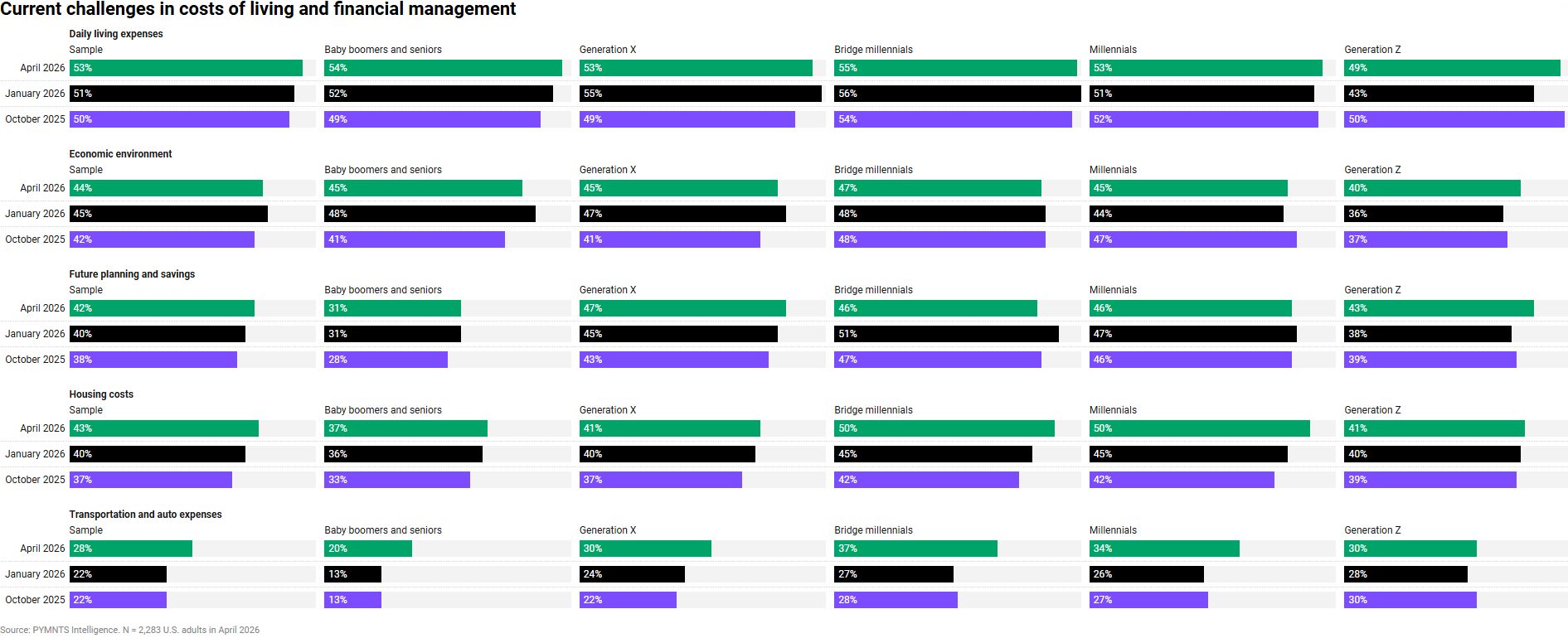
That caution is unfolding against a backdrop of already elevated financial strain. According to the May 2026 PYMNTS Intelligence report, “Inside the Cutback Economy: How Age, Behavior and Financial Pressure Shape Consumer Spending,” more than half of consumers say daily living expenses remain a challenge. The data suggests the pressure is proving persistent even as consumers adapt to it.
The pressure is also spreading across categories that directly shape household flexibility. A reading of financial-management challenges shows housing costs, transportation expenses and future planning concerns all rising since October across multiple generations. Millennials and bridge millennials each reported housing-cost pressure at 50% in April, while transportation and auto expenses climbed sharply among younger working-age consumers. Generation X consumers also showed a steady increase in planning and savings concerns over the same period.
The findings suggest consumers are not simply worried about inflation in the abstract. They are focusing on the cumulative effect of recurring obligations that are harder to delay or avoid. Housing, utilities, transportation and everyday expenses are all pressuring household cash flow simultaneously, making financial predictability more valuable than ever.
Households continue to maintain selected discretionary spending categories even while reducing spending elsewhere, underscoring how financial stress reflects strategic tradeoffs rather than blanket retrenchment.
The report also suggests that financial strain is becoming more behavior-driven than demographic-driven. Consumers within the same generation are responding to pressure in dramatically different ways depending on liquidity, income stability and how proactively they manage financial obligations.
We’d love to be your preferred source for news.
Please add us to your preferred sources list so our news, data and interviews show up in your feed. Thanks!
That fragmentation complicates traditional segmentation models used across banking and payments but also provides opportunity. Some consumers are retreating into defensive spending patterns and preserving cash wherever possible. Others are taking more proactive steps, including adding income sources, negotiating bills or using financial products strategically to smooth out cash flow.
The Push Upstream
The bigger opportunity for financial providers may lie “upstream” of financial distress itself.
As households grow more cautious about future expenses, demand is likely to increase for tools that help consumers anticipate financial pressure instead of simply documenting it afterward. Safe-to-spend calculations, forward-looking cash flow projections, automated bill visibility and emergency savings tools may become more valuable than static budgeting dashboards alone.
The same dynamic could reshape how banks and FinTechs think about engagement. Consumers facing uncertainty are trying to answer practical questions before problems emerge: How much flexibility do they really have? Which bills are likely to create pressure first? What spending adjustments are sustainable without disrupting daily life?
That creates room for financial institutions to position themselves less as transaction providers and more as operational partners in household cash management. The institutions that can help consumers forecast liquidity gaps, identify tradeoffs early and preserve optionality may strengthen long-term engagement even if overall consumer spending slows.
Concerns around planning and savings have climbed across nearly every generation since late 2025, while living expenses remain persistently elevated. Consumers are signaling that the issue is no longer just absorbing higher costs. It is uncertainty about what tomorrow’s obligations will look like and whether household cash flow will keep pace.
In that environment, financial services may shift away from simply offering more credit products or rewards incentives. Consumers appear focused on predictability, flexibility and visibility into what comes next. Financial firms that can help households prepare before stress turns into missed payments, revolving balances or disengagement may ultimately gain a larger role in how consumers manage everyday financial decisions even if or when the stressors subside.
At PYMNTS Intelligence, we work with businesses to uncover insights that fuel intelligent, data-driven discussions on changing customer expectations, a more connected economy and the strategic shifts necessary to achieve outcomes. With rigorous research methodologies and unwavering commitment to objective quality, we offer trusted data to grow your business. As our partner, you’ll have access to our diverse team of PhDs, researchers, data analysts, number crunchers, subject matter veterans and editorial experts.


 Add as Preferred Source