Inflation has broken through an important psychological barrier, so to speak. The Federal Reserve’s impetus to cut interest rates may have just gotten a bit stronger.
But the question remains as to whether the more than 60% of U.S. citizens who live paycheck to paycheck will feel much relief, if any at all.
The Consumer Price Index, released Wednesday (Aug. 14), rose 2.9% in July from a year earlier, which signals a break below the 3%+ level that has been in place for months. The latest reading is the lowest report since 2021, when the pandemic was still raging. Month over month, inflation was at 0.2%, up from the 0.1% decline that had been seen in June, and May’s flat reading versus April’s levels.
Although the Fed may indeed cut rates sooner rather than later, a dive into some of the key categories of everyday spending shows that inflation is sticky, which in turn indicates that paycheck-to-paycheck pressures will still be challenging.
Inflation Is Notable for Food and Shelter
The data showed that the overall food category saw prices increase by 0.2% in July, the same pace as in June, while quickening from the flat-to-0.1% gains in the preceding several months. The “food at home” segment, which is a read-across for groceries, was up 0.1% in July and up 1.1% from a year ago. The “food away from home” data, which indicates pricing at restaurants and other establishments, was up 0.2% month on month in July, as the annualized price increases stood at 4.1%.
But the standout here seems to be shelter, where the 12-month increase was 5.1%, and in July the month-over-month increase was 0.4%, which was a rebound from the 0.2% rate seen in the previous month.
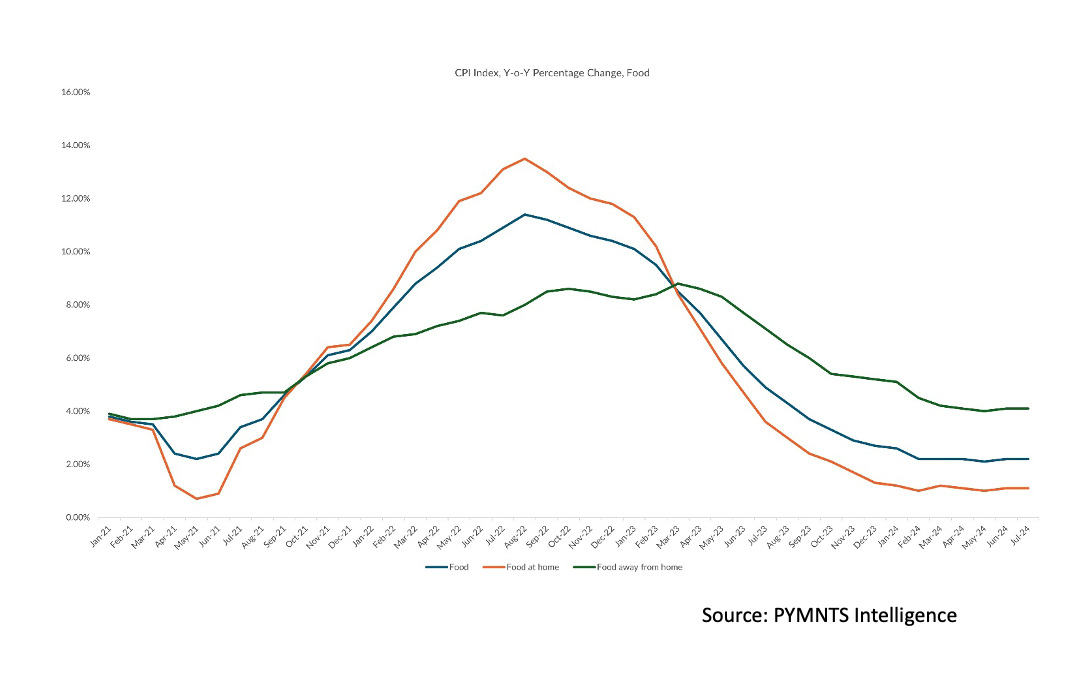
PYMNTS Intelligence data noted earlier this year that coming into the summer months, consumers were paying about 20% more, cumulatively, than they paid before the pandemic for groceries. Shelter accounts for more than a third of the take-home pay for households earning less than $50,000. The tally winnows down to about 13% for households above the $50,000 threshold, but it is still significant. PYMNTS Intelligence estimated that the combined food and shelter bills account for about 60% of the take-home pay of consumers and households with up to $50,000 in annual income.
Food inflation is off its peak, but it remains a force to be reckoned with.