The holiday shopping season is kicking into full gear, and this year tariffs are again shaping the economics of the checkout line. After months of shifting trade rules, merchants appear ready to navigate the turbulence without derailing demand.
Retailers Lead in Tariff Confidence
PYMNTS Intelligence data in the accompanying chart, reflecting the views of 60 firms across industries including retail, shows 80% of companies are “very or extremely confident” they can adapt to tariff-related supply-chain disruptions, while 20% are “somewhat confident.” Among goods-sector firms — which include many retailers — confidence is even higher: 85.2% very or extremely confident and 14.8% somewhat confident. Services follow at 82.6%, and tech at 60%.
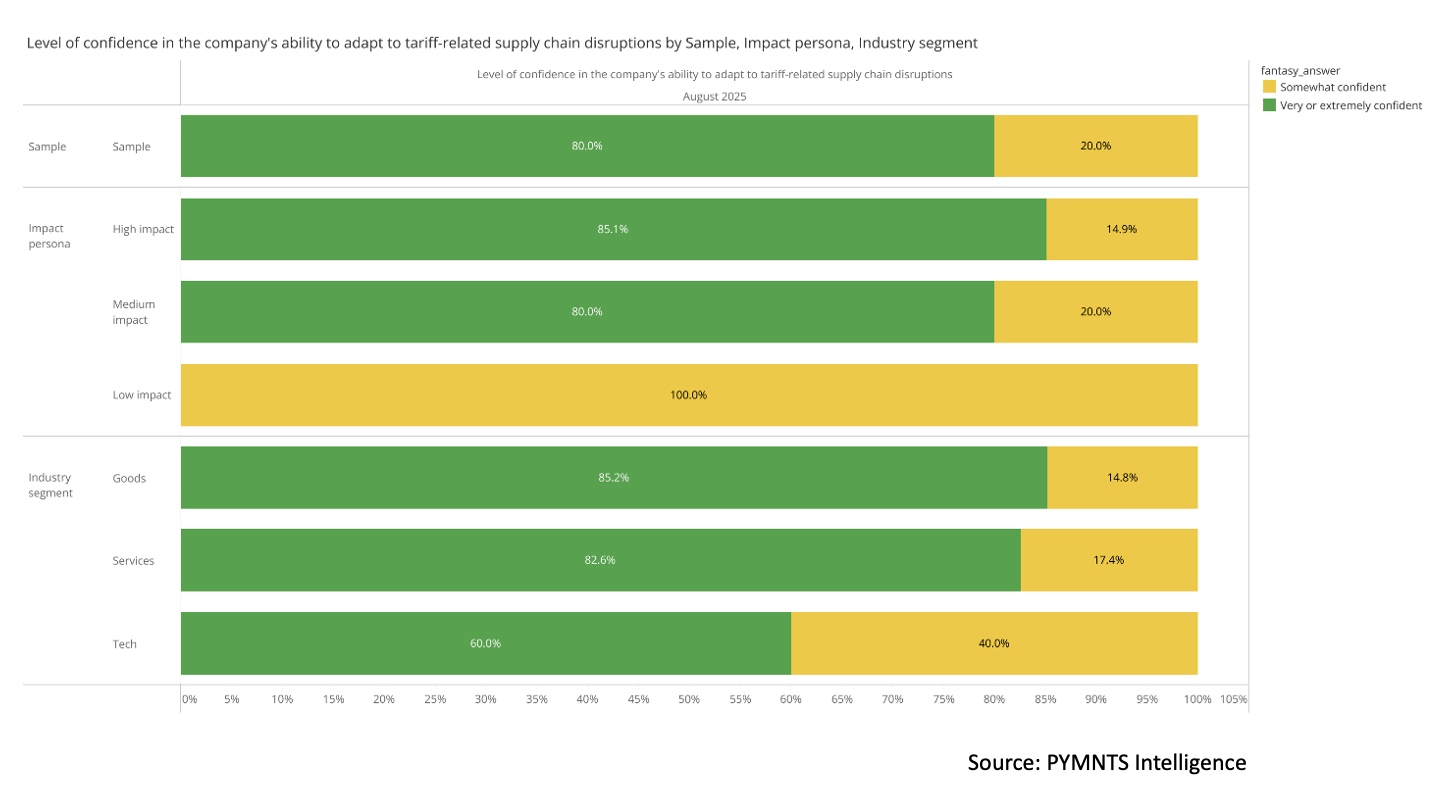
Even companies expecting a strong tariff impact remain upbeat: 85.1% of “high-impact” firms describe themselves as very confident, and 80% of “medium-impact” firms echo that view. The outlier is the “low-impact” group, where 100% are only “somewhat confident.”
These results align with PYMNTS Intelligence’s September report, “Tariff Turbulence Splits the Middle Market as Confidence Rises,” which found that 29% of middle-market firms have increased prices, 21% have renegotiated supplier terms, and every goods firm surveyed has already taken at least one mitigation step.
Moderate Price Increases Ahead
Confidence does not mean profits are untouched. PYMNTS data show 9 in 10 goods firms and more than 7 in 10 services firms raised prices over the past year, yet roughly three-quarters of goods firms still experienced margin compression.
The response heading into the holidays is therefore tactical. The end result may be modest, selective price adjustments instead of broad increases. The goal: preserve consumer volume while safeguarding as much margin as possible — where the willingness to sacrifice a few basis points of profit still helps maintain traffic through the crucial December quarter.
We’d love to be your preferred source for news.
Please add us to your preferred sources list so our news, data and interviews show up in your feed. Thanks!
Consumers Turn to Flexible Payments
On the demand side, consumers continue to spend but are doing so differently. Recent PYMNTS Intelligence data confirm that shoppers are expanding use of structured payment tools to absorb higher prices.
According to separate PYMNTS Intelligence research, nearly 22 million U.S. consumers used both a private-label and a general-purpose credit card for installment payments — up from 19.8 million two years ago, a 5.3% compound annual growth rate. Store-card installment users reached 30.3 million (4.8% CAGR), while general-purpose card installment users numbered 47.8 million (0.8% CAGR).
That trend shows how card networks have effectively adopted buy now, pay later (BNPL)-style features, allowing shoppers to manage spending over time rather than pulling back outright.
BNPL Cushions Tariff Pressures
BNPL remains another key shock absorber. A PYMNTS Intelligence September study, “BNPL Growth Softens Tariff Impact on Higher Retail Prices,” found that 90% of surveyed merchants said BNPL adoption helped sustain sales volumes despite incremental price adjustments. And in “43% of Consumers Bail on Purchases Without BNPL Options,” nearly half of respondents said they would abandon a purchase if installment options were unavailable.
Those findings suggest that rather than retreating from higher prices, shoppers are re-engineering payment behavior — stretching budgets through credit installments and BNPL plans that align with biweekly pay cycles. Inflation expectations remain elevated, but consumers appear confident in their ability to manage costs month to month.
A Balanced Season Ahead
The combined message from merchants and consumers is one of controlled adaptation. Retailers have diversified suppliers, tuned pricing and leaned into digital payment flexibility. Consumers, in turn, are managing price pressures through structured borrowing tools rather than scaling back entirely. There’s proof that tariffs may raise costs, but not deter the determination to shop.



 Add as Preferred Source